
Piles of Decadence
Where does power lie in art, if not in the skill required to create it?
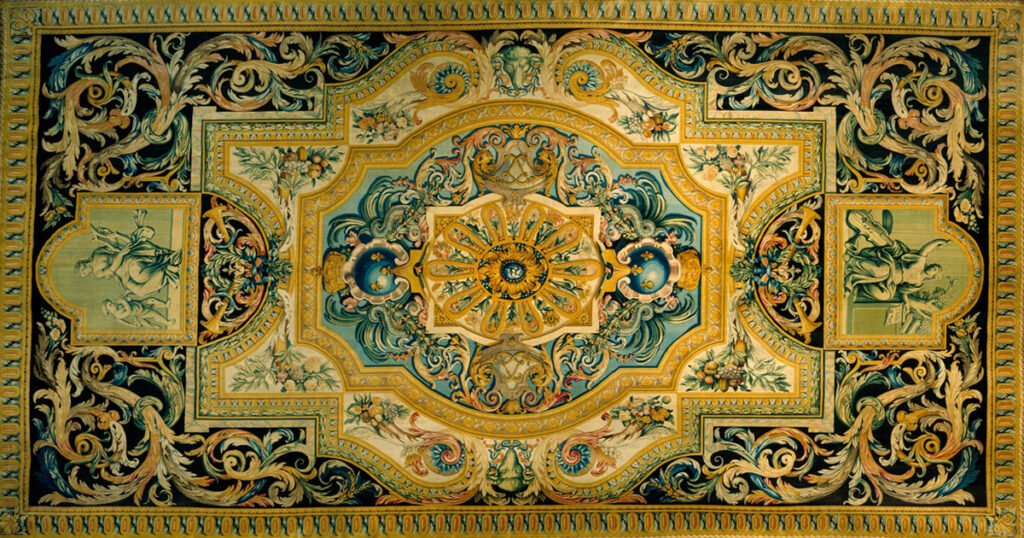
I don’t know how many years it has been since the word sumptuous has come to mind, but my head was absolutely ringing with it as I looked at Louis XIV’s carpet at the Met—actually 92 individual pieces that once made up a single work. I wanted to rub my cheek against the thick pile. I wanted to squish my toes into the creamy wool, and I wondered briefly if the king had ever wanted to do the same. But despite the expense and effort spent in its creation, the king never used the carpet. He had placed the order for it with the Savonnerie manufactory in 1668 and then changed his mind by the time it could be delivered—in this case, 20 years later. Royalty: They’re just like us.
The carpet was the largest ever manufactured: It could cover the 440-meter length of the Louvre’s Grande Galerie. Because this is the Met, and the rich now like to pretend to feel ambivalence about their wealth, the text accompanying the presentation of “A King’s Carpet” (on view through March 5, 2028) states that it was most likely made by children employed for their small, nimble hands. I mean, so was the polyester shirt of the woman standing next to me, probably.
It’s true that the knotted-pile wool textile was made by orphans from L’Hôpital de Bon Port, though this sounds worse than perhaps it was. Starting from the age of 10, children would begin an apprenticeship lasting six years, and several different factories had arrangements with orphanages. After that, they would either graduate as journeymen or register with the maîtrise—the mark of mastery that allowed them to start their own businesses. It was essentially free vocational training at a time when guilds were the only path to job security and financial stability in many fields.
France’s textile industry was originally established under Henri IV (who reigned from 1589 to 1510) to compete with Ottoman and Persian manufacturers. The royals had expensive taste in textiles, but with so much French treasure being sent east to pay for such goods, they thought it would be wiser to create a local industry from the ground up. According to Pierre Dupont’s Treatise on the Manufacture of Turkish Carpets (1632), before French artisans could compete, they first had to learn how to replicate the knotting techniques of their Eastern rivals. That plush texture required a density in the knots that the French had to learn through corporate espionage. Dupont traveled abroad to spy on Turkish weavers, then brought back carpets for his technicians to take apart row by row, which helped them redesign more heavy-duty looms that could support the weight.
And though the first French carpets replicated Eastern designs as well as their knots, soon the looms were being used to produce designs more recognizably French: fleur-de-lis, royal iconography, floral designs, and mythological figures. The carpet at the Met is a mess of blues and golds, bursting with flowers and a nude Venus with Cupid and curlicues and whatever else its creators could think of. It has that showy nature of the era—“Hey look at what our 12-year-olds can do!”
Because the King moved the royal court from the Louvre to Versailles in 1682, and the carpet had been custom-made to fit a room that no longer hosted official functions, by the time it was completed, the carpet wasn’t put to use. It was cut up into panels and redistributed as gifts, or else resold. One of the rugs at the Met was sent to Spain by a French ambassador, stored in a convent during the Spanish Civil War, then bought by one of the wealthy Americans who went shopping for European goods in the aftermath of World War II. It has survived revolutions and wars, transatlantic shipping, and now an unstable art market to find its way to the Met.
The carpet is housed in one of the reliably quiet parts of the museum, the furnishings and housewares department. One of the pieces is laid out for repair work, and you can watch weavers patch up damaged areas. It’s surrounded by the Met’s permanent collection of decadent ceramics, silverware, glassworks, and other decorative objects created between the 15th and 20th centuries, all originally meant to be lived around, with, and through, to be touched and handled and used, but now sitting a little sadly behind glass. Too delicate to be touched, but also not interesting enough to draw crowds.
But then who would want to live through these objects today? Our ruling class is hostile to the decorative and the frivolous, the millennials all live in gray boxes with gray floors and gray walls and “neutral” (gray) clothing, our tech overlords rarely bother to wear more than poorly fitting T-shirts and fleece vests. Even the RETVRN guys who bemoan the ugliness of contemporary culture and yearn for Gothic cathedrals, French interiors, and realism in art are not exactly signing up to learn masonry or glassblowing.
So what about our current White House? Donald Trump’s taste has often been described as “rococo,” but by that most people just mean a cluttered, fussy style. There’s gold on everything. From the gilding of Oval Office knickknacks and the spray painting of plastic wall adornments that may or may not be from Home Depot, the president has not so much redesigned his residence as simply added a lot of stuff that lacks aesthetic coherence.
Besides, real rococo design showed off actual skills. Look at how delicate we can make this, look at how elaborate. How fine the stitching, how thin the glass, how detailed the gold work. The Savonnerie manufactory was for a time required to make carpets only for the crown, thus rendering both its work and the monarchy more valuable, since you had to trade favors with the king to access those beautiful, sumptuous carpets. Their quality was a tribute to the nation of France, which is why they had to be the best in the world.
The Trump Aesthetic is more about what he can make people do without being questioned or stopped. Consider the attempted refurbishment of the Reflecting Pool on the National Mall. Or the spray paint-like gilding on the monuments near the Lincoln Memorial. Or the proposed Triumphal Arch.
The message is not, Look at how good this looks. It’s Look at all that I am able to make someone do.
For all the big talk Donald Trump made during his campaign about the return of manufacturing to the United States, none of his policies, including the tariffs, has done anything to nurture a healthy ecosystem for manufacturers and craftspeople.
The restoration of American Made isn’t only about investment and training. It’s also about reputation. A New York Times profile of Jacob Long’s American Woolen Company, which recently opened a textile factory in Connecticut with which to make textiles, reveals one surprising obstacle to finding clients: the poor reputation that the United States has for quality goods. Luxury fabrics come from Italy. The United States produces … well, not that much at all.
Long had bought the plant from Loro Piana, the Milanese luxury textile and clothing brand. But none of its client base transferred to American Woolen. “Everyone told us they were buying from us,” Long told The New York Times. “Nobody did.” Soon, the factory learned to pivot to more industrial fabrics and American clientele. It currently has a contract with the U.S. military.
Times of artistic and aesthetic flourishing, where craftspeople are employed and skills are in demand, isn’t just a matter of opening a factory or starting an arts school. It’s a whole system that requires delicate maintenance and balance, with government support and public investment. Two recent books, Christina J. Faraday’s The Story of Tudor Art and Ulinka Rublack’s Dürer’s Lost Masterpiece: Art and Society at the Dawn of a Global World, give holistic perspectives on the eras they discuss, and what’s missing from ours.
The Tudor period lives on for us in the works of artists like Hans Holbein, a German immigrant from Augsburg who moved to England in his late 20s. Here I am thinking sumptuous again at the National Gallery in London (which holds four of his paintings), where I want to reach through the surface of The Ambassadors to stroke gently the fur lining of the gentleman’s coat. Or touch the springy curl of the subject’s hair in Holbein’s portrait of Erasmus.
That Holbein not only found work but also fame in England comes mostly from the Tudors’ desire to present the country (and thus themselves) in a certain light on the international stage. They wanted to attract the skilled craftspeople— painters, embroiderers, builders, metalworkers, goldsmiths—who gained such fame and fortune on the continent and have them work for England. It got to a point that English craftspeople rioted, arguing that the government should be investing in local talent, rather than importing goods and workers from abroad. But buying a glassmaker from another country’s supply is easier than building an entire industry from the ground up, in the hopes that remarkable talent will emerge.
Faraday makes clear in her history that the purchase and display of expensive handicrafts and decorative objects were about flaunting not only wealth but also power. You buy armor and goldwork from Germany because they are the best, and the same for French tableware, Flemish textiles and glass, Italian armor. That the Tudors could tempt the people who made those things to leave their homes and set up shop in England showed another level of power.
The Tudors were successful in that the creations of their time still bring in visitors. I had to fight my way through a crowd to get close to the Holbeins, after negotiating another obstacle: America’s National Football League, in conjunction with a game being played eight miles away in Tottenham, was holding an event that day outside the museum’s doors in Trafalgar Square. But it was not successful in the sense that none of the painters of the time whose works survive were English in the nativist sense.
By contrast, in Germany, new developments in printing created a whole new kind of art market, one that Albrecht Dürer was eager to take advantage of. Frankfurt was at this point the center of the art and print market. Its annual fair drew craftspeople and eager buyers from across the continent. In 1507, Dürer was engaged to create an altarpiece to be showcased in Frankfurt—this, at the time, was how an artist created demand. The elites would flock to see the work, then compete to hire the hottest artist in Western Europe to paint portraits, religious works, and other pieces to show off to rich friends.
Dürer’s patron was Jacob Heller, a man who had so much money, Rublack writes, that his name lent itself to currency: “Around 1500, one gulden equaled two hundred Pfennig and four hundred Heller.” Heller had so much money that he hired men to go on pilgrimages for him, to wear his shoes and trace the holy routes of early Renaissance Italy, stopping at each site to pray for his family’s souls.
The arrangement between Dürer and Heller was standard for the time, but the relationship quickly grew contentious. Rublack presents correspondence that reveals Dürer’s arrogance and Heller’s pompous indignance that seem to epitomize the stereotypes of artist and rich patron. Heller was obsessed with making sure the altarpiece conveyed his financial status. “To everyone looking at the altar,” Rublack writes, the quality of the materials “would reveal the value of the commission and thus Heller’s place in society. Medieval contracts often set out in detail what qualities of gold leaf a painter was to use.” But Heller balked whenever Dürer asked for more money or explained what was taking so long. Heller seemed to view the money paid to the artist solely as a means of communicating his status, and he was frustrated that Dürer had his own intentions with the project other than announcing his patron’s piety and might.
The altarpiece was delivered to Frankfurt’s Dominican church in 1509, but the experience soured Dürer on similar projects for the future. He turned away from the altarpieces that still occupied his peers and turned his attention instead to the growing market for prints and engravings. These would be sold more cheaply but—and this seemed important—he would not be expected to please one specific gentleman. His audience would now be the public, and his eccentric and accomplished works are still instantly recognizable, from the detailed plate of a grumpy rhinoceros to the chubby baby of Melancholia.
Dürer had a taste for luxury, and his business decisions were at least in part influenced by his desire for market purchasing power. Rublack expands her focus to the establishment of art commerce in Dürer’s time. Her book is a fascinating look at both elite tastes and how regions met demands through the cultivation of artistic industries.
As for the completed altarpiece, it took a twisted road through the world, much like King Louis’s sumptuous carpets. Only a few years after its completion, Duke Maximilian I of Bavaria removed it from the church in Frankfurt to his private gallery. Rublack traces the routes of the other goods and materials that joined Maximilian’s collection, from tropical plants and animals to spices and silks. Gold works from the Aztecs were placed beside natural treasures such as Indonesian seashells and narwhale horns—rarity, exoticism, and the difficulty of procurement valued alongside craft.
There Dürer’s altarpiece remained, in the Duke’s collection, for more than a century until it was destroyed in a fire. All that remains is a copy made by Jobst Harrich, some preparatory drawings, and written descriptions by people who saw the original. It was Dürer’s “masterpiece,” but we have to take the word of those who saw it: Unlike the King’s carpet, its pieces won’t ever be put back together again.
The development of the printing industry may have enriched Dürer, but it started to nudge apart this divide between the fine and the decorative arts. Soon mass production would be everywhere, and it no longer took a 10-year-old orphan’s hands to create fine carpets or an expert gilder to make something look golden. It’s a theme that Walter Benjamin took up in his essay “The Work of Art in the Age of Mechanical Reproduction,” and it’s one that gains increasing relevance in the age of Temu and generative AI. As Rublack points out, without the difficulty in the creation and the exclusivity of the purchase to inspire awe in your peers and betters, having all this stuff is no longer quite such a flex.