
“Way back in the prehistoric days of 1926, a man called Aaron Copland was experimenting with jazz in the concert hall, and turning out some pretty marvelous pieces. … At the time he wrote his jazzy Piano Concerto in 1926, he was only 26 years old—a young pioneer of American music. And when that Piano Concerto was first heard a year later in 1927, in the stately town of Boston, Massachusetts, with the great [Serge] Koussevitsky conducting and Mr. Copland himself at the piano, there was a good deal of shock in the air. The Bostonians just couldn’t accept the idea of a third stream, way back then; but today, with the stream in full flow, the music sounds perfectly right and natural to us.”
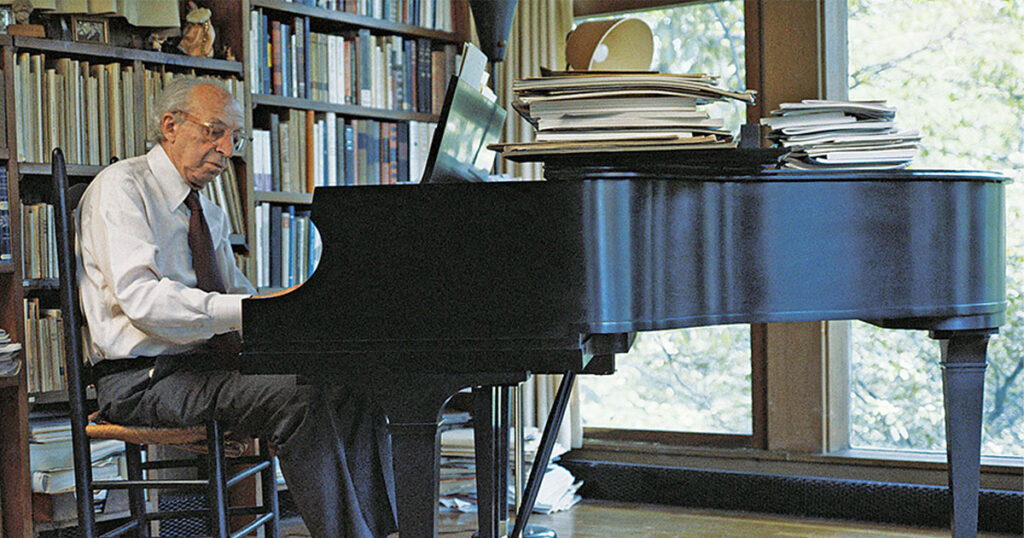
—Leonard Bernstein, speaking at a New York Philharmonic Young People’s Concert, March 11, 1964. Aaron Copland’s Piano Concerto, composed a century ago, was ignored for decades, eventually finding an audience largely because of Bernstein’s advocacy. And though Copland (pictured above in 1977) would go on to compose works that achieved greater fame, his early concerto, brilliantly fusing jazz and blues into its classical idiom, remains as persuasive in its own way as George Gershwin’s roughly contemporaneous Rhapsody in Blue.