
Rhetorical Questions
In Eavan Boland’s Stanford workshop, the poet imparted lessons on suffering, expression, and the importance of a sandwich
I first saw her on a typical sunny day on Stanford’s campus: She was walking among a crowd of students, head down, unrecognized, her short red hair bobbing against the light. I noticed the white headphones connected to a large device in her hand. I stopped in my tracks: This was Eavan Boland? Was the celebrated Irish poet listening to a podcast? Music? She looked, I thought then, so distant and cool.
Months later, she’d show off her phone in class. It was larger than most of ours—more like a miniature tablet. I can still see her, smiling, her glasses halfway down her nose, scrolling through email as she talked about all the features she enjoyed. She would tell us that if not for poetry, she would’ve gone into computers or tech. She was already living in Palo Alto.
But back to that initial sighting. In those first seconds, I wanted to approach her, introduce myself, say how excited I was that my first workshop with her would begin in a few hours. This was the fall of 2012, and I was one of the five fortunate poets to be selected for a two-year Wallace Stegner Fellowship, which involved studying with Eavan.
Instead, I hid behind a tree. Then I walked in the other direction.
I did not think at the time of something she’d written in a 1986 essay, which I’ll misappropriate here: “Every poet carries within themselves their own silent constituency, made of suffering and failed expression.”
Although Eavan would have probably mocked me for even thinking of transferring this “encounter” into metaphor, I think my workshop experience was a little bit like hiding behind, and looking out from, that tree. While we’re on the subject, I recall one of my classmates asking her, “Do you like Robert Hass?” She quickly laughed and shook her head. “All those juniper trees!” she began, but I don’t remember the rest of her answer. I realize that recounting flippant statements made in the privacy of workshop might veer into gossip; however, as many of her former students have pointed out, Eavan adored gossip. About book awards. About which writers were “midcareer poets.” About what constituted a “midcareer poet.” Before class, she would often ask us to throw out names of poets to invite for readings. One day, alluding to a very well-known, already famous recipient of the National Book Award, she said, “Give the damn award where it means something.”
But what about that feeling of hiding behind a tree? Eavan once pronounced, “The simile is like an appendix in the body.” And then she stared at us, shaking her head in a way that always, to me, seemed diagonal—side to side and up and down—which created an ambiguous, contradictory effect: Was she being earnest, irreverent, both? Were we meant to agree, undoubtedly? Was it a joke? In those workshops with her, I sweated frequently: my hands, my feet, all while trying to hide the feeling that I didn’t belong. Nervous that Eavan would find out we were fraudulent poets. Many Stegner Fellows were terrified of being found out.
Eavan would, I know now, use a simile to denounce a simile. She saw the irony. And this feeling was, from the first day of workshop, standard: I was sometimes frightened that I’d be unable to discern the tone of her statements, or that I’d interpret something the wrong way, say something stupid, or worse, say nothing. And yet, simultaneously, you could not look away from her. She was never at a loss for words.
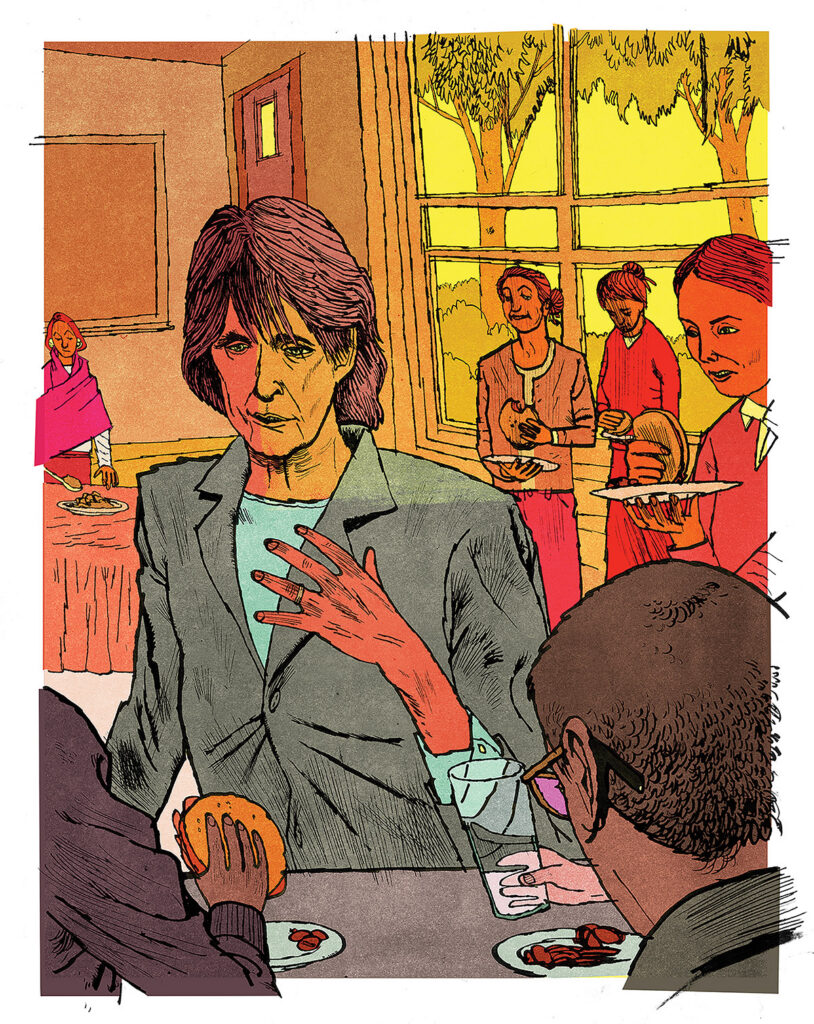
Eavan had our workshops catered. Sandwich trays. Great tacos. Fresh salads. Barbecue. Always a vegetarian option. This being California, lots of avocado. I had heard how a former Stegner Fellow had complained of how hard it was to commute to Stanford, find parking on the sprawling campus, hurry to workshop, and get lunch. Maybe Eavan had heard this, too, but I couldn’t relate. I mean, Fellows mostly had to show up a whopping one day a week. Besides, before I’d come to Stanford, before the three years I’d spent completing my MFA at Arizona State, I’d finished a six-year military enlistment, which included a year in Iraq. In short, I felt disgustingly pampered, but hell, I ate the sandwiches with joy.
I’m not sure who paid for all that food, but I know that Eavan was no stranger to finding and securing funding. One day before class, I saw her out in the hallway talking to a man with bushy red hair in a black blazer; it was Phil Knight of Nike fame. On our first day, Eavan announced that rather than reading poems prior to workshop, we would do “cold reads.” “That’s how we read poems in the world,” she told us. She then said, with a smile, that she wanted to “turn up the heat.” I nodded and picked up a grilled chicken sandwich with avocado. At any rate, I would incessantly, sometimes messily, eat tacos or sandwiches, pausing mid-bite to take notes, salsa sometimes on my face, a pile of dirty napkins on the table like the corpses of my poetic certainties (that appendix is for Eavan). Cue all of your conclusions about stress eating.
Years later, I was relieved to find that Eavan had also experienced some of this anxiety when introducing herself to Patrick Kavanagh in a Dublin café. In Object Lessons, she describes him as “a man trying to eat his lunch in peace on a winter afternoon.” Eavan, the ambitious young poet, writes, “I was callow enough to introduce myself.” However, the brief meeting went well; as they chatted, Eavan recounts, “we ate hamburgers, which were then still new in Dublin.”
One day, mid-workshop, she asked, apropos of nothing, “Who is the greatest”—she looked at all of us—“20th-century American poet?” I remember silence. I remember wanting her to define “greatest,” but instead, I quietly masticated. Slowly, names were thrown out: Lowell, Williams, Bishop, Stevens, Brooks. From Eavan, that sly grin, the crooked headshake. Were our answers stupid, brilliant, comical? Eventually, we’d find out, in her opinion, it was Frost.
Later, during the workshop break, standing around the table of catered food—which I think, years later, she arranged as a kind of metaphorical water cooler, a place to gather and talk—Eavan approached, grabbing a plate.
“Hugh, how are the sandwiches?” she said, enunciating each word distinctly in her sharp Irish accent, her speech direct and casually hurried.
Did she really mean this? Or was it ironic small talk? Was she asking me because she felt that all I could talk about was the quality of my sandwich? Or because I hadn’t given an answer to her earlier question about the greatest 20th-century American poet?
On another occasion, I felt brave enough to ask about my favorite poem of hers: “Quarantine.” The five-stanza poem uses a controlled musical anaphora (“In the worst hour of the worst season / of the worst year …” ) and a series of direct statements with plain, unadorned language ( “He lifted her and put her on his back. / He walked like that west and west and north”). Ultimately, the speaker recounts the death of a couple during the Irish famine of 1847. The most ambitious, and I think risky, turn occurs in the penultimate stanza, when the verse moves from descriptive narration to poetic statement. In short, Eavan abruptly stops the narrative and decides, in this moment, to critique the readers’ and her own desires to possibly romanticize and euphemize the scene of death. The poem concludes:
Let no love poem ever come to this threshold.
There is no place here for the inexact
praise of the easy graces and sensuality of the body.
There is only time for this merciless inventory:Their death together in the winter of 1847.
Also what they suffered. How they lived.
And what there is between a man and woman.
And in which darkness it can best be proved.
How, I asked, did she know how and when to shift the perspective, the voice, to move from descriptive narration to a more distant assessment? That fourth stanza seems to reflect upon and judge what occurred in the first three stanzas, especially in terms of tone. And no, I did not explain all of this to her; I did not elaborate much. She smiled and said, “Oh, Hugh, that’s rhetoric.”
Today, I still don’t know—and I was too afraid to ask a follow-up—if she meant my question was “rhetoric” (not the good kind) or if she was, self-deprecatingly, mocking a tonal shift she had made years ago, in 2001, when the poem appeared in Against Love Poetry. Or, most obviously, she might’ve been simply invoking the traditional meaning of rhetoric: the use of language to persuade. That rhetorical gesture—the sudden and deliberate alteration of perspective, tone—aims to convince the reader that there’s something false, something sanitizing about possibly ending the poem with rose-colored glasses, that image of comfort and tenderness: “The last heat of his flesh was his last gift to her.” Instead, Eavan takes us deeper into the uncomfortable harshness, these two people disappearing among the million dead during the famine.
Perhaps, she wanted me to decide for myself.
Years after sitting in those workshops, I think Eavan wanted me to begin to understand how self-doubt and failure, hesitation and anxiety were expected and necessary aspects of any writer’s life. She wanted to push us all to understand that poetry meant accepting that one must always reckon with uncertainties and questions that arise from any act of reading or writing. I think, too, that she aimed to relay to her students some of the discomfort and struggle that she faced. Writing as a young woman in Dublin, Eavan memorably describes the tireless work ethic and unwavering dedication required of the poetic vocation:
I had a soft and angry way of writing a poem. I would take a copy book and a biro, set it down on a table and make a jug of milky coffee. I would sit there, as if beside someone with a fever, waiting for the lines, the figures, the forms to take shape. I wrote it down and crossed it out; I read it out loud and wrote it again. I made it better. I made it worse …
Moreover, she never forgot—and never allowed us to forget—the deep tradition we were stepping into. “I knew,” she explains, “that this human action of sitting in a chair, taking a pen, writing lines on a page was part of the history of the poem.”
This history, as she made clear both in workshop and in her own work, required a constant ethical negotiation of the highest order. One day—and this was common—she quickly walked into the room, passed each of us a piece of paper; it was an excerpt from the correspondence of Denise Levertov and Robert Duncan during the American war in Vietnam. The major argument she wanted us to reckon with was Duncan’s statement: “The poet’s role is not to oppose evil, but to imagine it.” She wanted us, as usual, to read and react to the passage immediately; I remember most of us staying quiet, rereading the words again and again. As a young Iraq War veteran attempting to write about my experience, I found the passage particularly revelatory. What did it mean to “oppose evil” in a poem versus “imagining” it? Though many writers have probed this statement with nuance, Eavan’s goal that day, I am fairly certain, was not to clear the path for our poems but to show us how messy and complicated—riddled with brush and rocks and unmarked trails—that path was.
Eavan died on April 27, 2020, at the age of 75. Last year, Trinity College renamed its main library after her—the first time a building at that venerable institution has borne the name of a woman. As a woman writing into, and against, a long tradition of male Irish poets, Eavan worked to expand these spaces to include voices and experiences that had often been marginalized and flattened. “The woman poet is more alone with her meaning than most,” she wrote in 1986. According to the poet Alexandra Teague, “Boland fundamentally shifted Irish poetry, and poetry worldwide, by moving the ‘unfocused background’ into the foreground, and woman as objectified ‘motif’ into the role of active, speaking and thinking subject.”
Here Eavan is, again, as a poet coming of age in Ireland, reckoning with ethics and responsibility: “Who the poet is,” she contends, “what he or she nominates as a proper theme for poetry, what selves poets discover and confirm through this subject matter—all of this involves an ethical choice. … The more volatile the material—and a wounded history, public or private, is always volatile—the more intensely ethical the choice.” As she once said in workshop—so quotable, concise, profound, hilarious—“You cannot have an occasional poem just about the rain … the speaker cannot be unchanged by things they’re describing.”
And no one is ever, of course, only talking about sandwiches.