
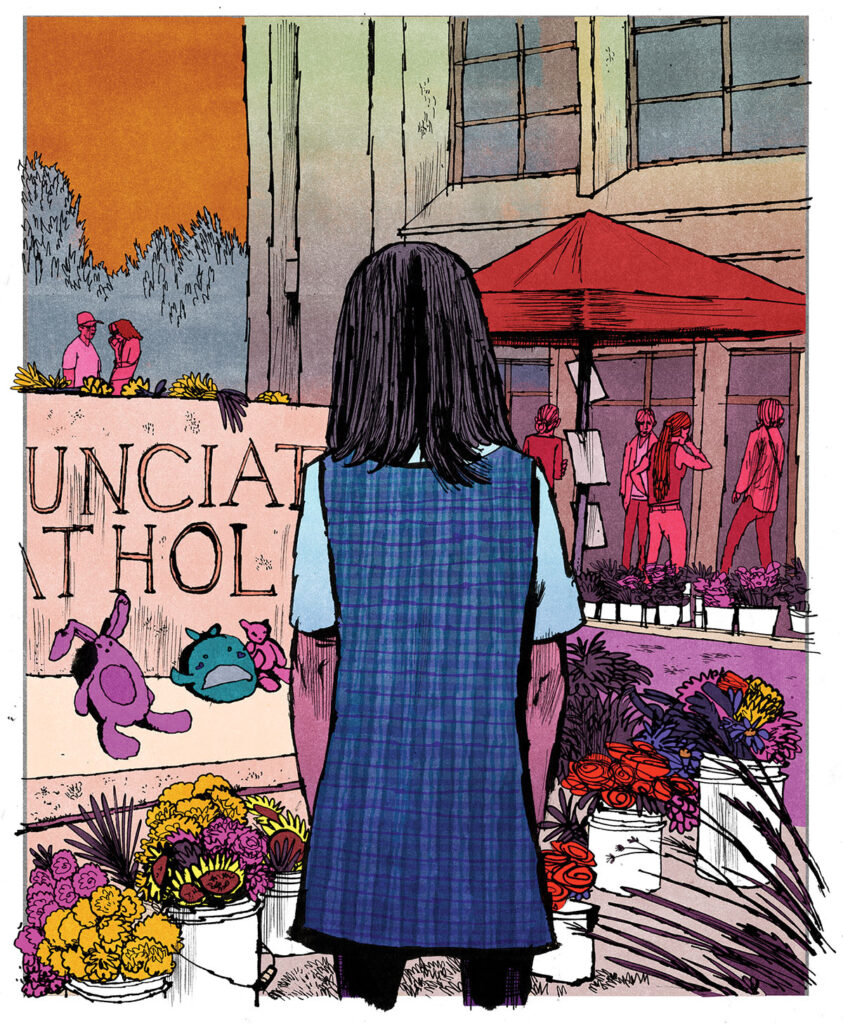
How modest these houses—and so near the church, almost snug up against it. As if the secular and the sacred, as in feudal times, had no strict boundary, and were part of each other. The midcentury church rises up like a massive windbreak sheltering the small houses. No wonder the residents of these tidy postwar homes heard the first shot that sweet late-summer morning, a Wednesday. If the shooter had just pivoted from his position facing the church, he could have taken out someone in the nearest white bungalow.
Instantly, these neighbors were calling 911.
The cops were there within minutes. Though, of course, too late for two of the children, Harper Moyski, age 10, and Fletcher Merkel, eight, murdered in their pews at a Mass marking the beginning of the school year, everyone singing. Twenty-seven others, mostly children and three parishioners in their 80s, were also hit. And then “the shooter,” as we’ve come to call these now familiar figures of our desperation, shot himself at a side church door, his litter of weapons—shotgun and semiautomatic rifle and pistol—scattered near his body.
A few days after the attack, I went to pay my respects, to be in solidarity—just to see, just to be there. Well, who knows what instinct, high or low, draws a person to the site of mayhem. There was an element of sleepwalking to it, driving across the Mississippi River from St. Paul, where I’ve lived all my life, to this church in Minneapolis I never before had occasion to visit. Even the neighborhood was unfamiliar to me. I had to use GPS to get there, though it is a well-known Minneapolis neighborhood. The little houses circling the big church shear off to more upscale houses along the sylvan Minnehaha Creek. A friend told me that his sister, living there, heard the shots, too. Her husband raced over, saw the bloodied kids screaming as they came out the church doors.
These two areas are part of the Annunciation neighborhood, the church itself an enduring sentinel of stability. I passed a “We love Annunciation” sign on a Methodist church on Lyndale Avenue, a nearby main street. And a hand-lettered message in black marker amid the bright pastel flowers at the church itself: “Our hearts are with the Annunciation community,” signed, “Sudanese Community.”
Here, it seemed, the postwar dream of a decent middle-class life still had a chance. None of the houses, not even the ones along Minnehaha Creek, bore the bombastic extravagance of the McMansions sprawling across the also sprawling suburbs that have extended “the Metro” of the two old cities. Nor were there any barracks-like multiple “units” that are becoming the panicked planning answer to urban housing needs.
Actually, I do know why I was drawn to the Annunciation. It was not the murders exactly. How many we’ve had here. We’re still pulling ourselves together—or apart—from the murder of George Floyd in 2020. That happened half a decade ago, in another part of Minneapolis, what used to be called “the inner city,” an area taking the blows of poverty, of racism, of displacement, and all the woes of crowded urban life as it tries to absorb new populations.
It wasn’t the murders themselves that drew me like a ghost across the river. It was the green-and-navy school uniforms the children wore. Those Catholic school uniforms. My heart snapped inside me, a physical sensation, something more intense than the word solidarity conveys.
I lived my childhood, my whole girlhood, in those Catholic uniforms, navy-and-white for us at St. Luke’s in St. Paul. Walking from school to church—the same half-block distance the Annunciation children walked—for the first Mass of the school year. Never a worry, never an “active shooter drill” in our classrooms. Shooting was for hunting season. Or way off in the romantic past when St. Paul, like Cicero, Illinois, was a safe haven for Depression-era gangsters—Ma Barker, John Dillinger, Alvin “Creepy” Karpis—as long as they behaved themselves and “laid low,” an intriguing concept for an outlaw. We loved those stories—because they were stories, just stories.
The Annunciation attack was in the church, not in the school, though children were the target. The heavy oak pews—duck, duck, it was reported everyone yelled—surely saved lives. So did the fact that a protocol was in place to lock all the doors of the church as Mass began. The shooter hadn’t counted on that. He couldn’t get in. He had to aim through the tall, narrow stained-glass windows, shattering the panels all along the side of the church. He got off more than 100 rounds.
The sight of those uniforms apparently erased, at least momentarily, the years between those children and me. Such an intense connection can seem merely nostalgic, hazy with tender inaccuracy, the past made cozier than it ever was. One of those occasions for a weary Okay, boomer remark.
But nostalgia gets a bum rap. Although it is composed of two Greek, even Homeric, roots—nostos (homecoming) and algos (pain)—the word was coined in the 17th century by a Swiss medical student (yes, I Googled it) to describe a severe malady, newly diagnosed, suffered by Swiss mercenary soldiers far from home. Nostalgia started as serious, not sentimental, business. An illness of loss, a condition to be treated, the disease of history.
The word has softened over the centuries, its medical definition lost, like the leeches and bloodletting of yore. Although the sensation of nostalgia is complexly bittersweet to the person experiencing it, nostalgia is not, for us, entirely reputable. Sentimental, we say. An indulgence. Therefore unreliable. Keep it to yourself.
But I’m sticking with nostalgia as the essential connecting tissue of time, of history, even of community. It is the soul of memory, useful in the retrieval of what’s worth holding onto after the deluge. Even during the deluge. Nostalgia surely was the engine driving my crazily intense time travel between the St. Luke’s school uniforms and Annunciation’s. Those blue-and-green uniforms drew me across the river to this neighborhood I’d never seen as if bringing me home. Those uniforms and the little houses with their small, well-kept yards—it was all part of the buoyant postwar world that I, a child of the working class, lived in and grew from. And here it still was. Shot up, ravaged, but here. And overwhelmed with flowers.
I was not alone. The area was crowded with slow-moving, pensive groups, some of the people old like me (a metal walker or two), but mostly there were families and young people, many clutching stiff grocery store bouquets, looking for a spot to leave them amid the masses of flowers already banked up around the church. The whole expanse around the building overflowed with flowers, covering yards of grass and cement, buckets and vases, beflowered wreaths propped on easels, the names of the lost—Fletcher! Harper!—like rudimentary cardboard grave markers in thick Magic Marker. And piles of stuffed animals, big and bright, small and pastel, with their improbably cheery sewn-on smiles—all set amid fervent messages in pastel chalk on the sidewalks.
There was even a refreshments station discreetly off to the side—drinks and free pizza, cookies and lemon bars, women urging people to take a slice. Free, free, yes, everything is free. You have to eat. Talk about communion. It was a church being … well, a church. I almost expected to see a sign for bingo, that old Catholic fundraising tactic.
I was standing in that most eloquent of modern American settings—the aftermath of a mass murder attack on children. But still, astonishingly, it was what we affectionately call “real life,” meaning not some ghoulish darkness to which we must surrender, but an act of collective imagination uniting past and present, drawing people together. For what? For the future, of course.
Fletcher Merkel’s father, standing in front of the church the day after the attack, said he didn’t want his son remembered for how he died, but for “the wonderful young man he was on the path to becoming.”