
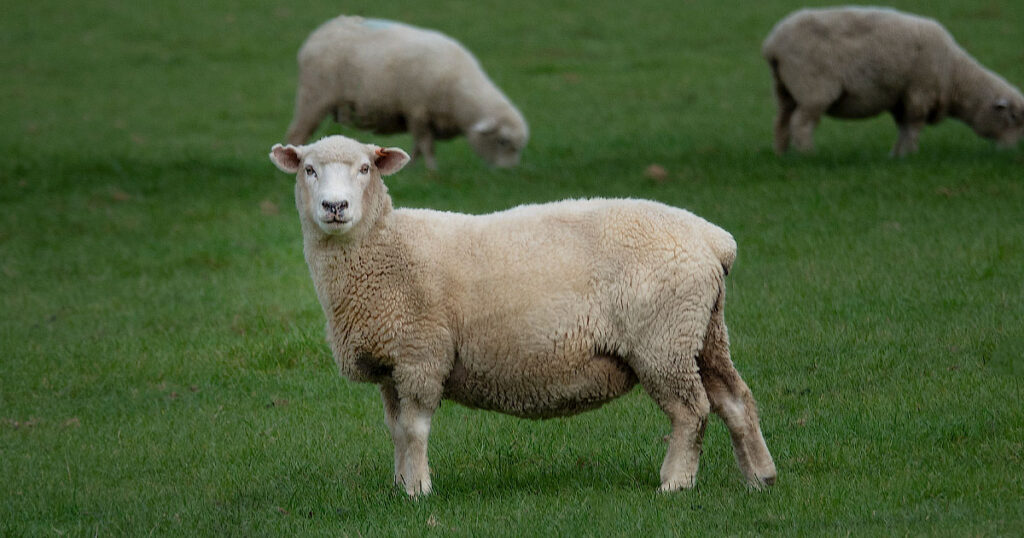
My dog Toby and I were just back from our early morning walk and I was in the living room when I heard a single bleat of a sheep. It was 8:30. The sheep bleated again.
How to describe the sound? Demanding, worried, and hesitant. Half, “Well, what?” and half, “Oh dear, oh help!” Half low moan, half high and wavering supplication. It’s a sound, like birdsong, that I’d have to replay endlessly to describe even half-right. And yet I recognized it immediately as different from the bleating of the small herd my neighbor’s nephew Jesús keeps in the fields across the lane from my house. This mournful bleat proclaimed, I am alone.
I looked out the window and saw the animal, emerging from the shadows where the lane dead-ended at the gated entrance to a field. It hesitated, then, almost deerlike, it advanced. What was it doing here, and where had it come from? Behind it I could see the fence at the entrance. It appeared intact. Beyond were the green fields where the sheep grazed among the partially built houses of an abandoned project on the ridge above the river. The bank owns the land now, but my neighbor’s family has the use of the fields. No other sheep were in view.
My son had heard the sheep, too, and we both stepped out into the lane. The sheep retreated into the corner against the fence. We didn’t have the nephew’s number, so we called my neighbor instead. He was in Holland, visiting his son for a few days, but he assured us he’d call his nephew right away. For good measure, he also gave us the number.
My son and I kept an eye on the sheep. I knew that my neighbor’s sister and nephew lived five minutes away. I expected them any moment. The sheep made a couple of tentative starts into the lane but retreated each time to its corner. The third time, instead of turning back when it came up against us in the lane, it stood its ground. Then it took courage, gathered itself, and made a mad dash around us—to the freedom of the open lane, nothing to stop it or impede its progress. It looked like a young male—I could see its testicles. I followed and saw it turn off the lane onto the grassy slope behind the sports center. If it continued in that direction, it would hit city streets. I moved back, hoping it would not press on. The grass on the slope was very green. Maybe the sheep would linger to nibble.
Back at the house, I wondered what was taking the owner so long. I went inside, but a few minutes later, from the corner of my eye, I saw a sheep in the lane, just like the earlier one, drumming up its courage to get past my son, still outside. Wait! I shook my head. It felt like déjà vu.
“Same one?” I asked, stepping back outside, and my son said yes, same one—back in its dead end, only to try to escape again. And still no nephew. My son sent a WhatsApp message.
The sheep made a last attempt. My son and I, prepared this time, jumped in front of it, waving our arms. At the last moment, the sheep veered, turned, and charged back to its corner. It made a funny little leap into the air, twice, to come down on all four feet in a show of petulance. Then it lay down on a patch of grass by the gate. Shortly afterward, a car pulled up.
Instead of the story ending, however, it took a turn. Rather than the nephew, it was his mother, with his girlfriend driving. The women explained that they got a call from my neighbor, explaining that the nephew hadn’t picked up. The mother and girlfriend couldn’t get in touch with him, either—the man was at work. So they’d come.
I pointed out the sheep, lying quietly in the shade of the wall. The sister wore a worried expression. The girlfriend seemed amused. How do we catch it, I asked? Oh, we won’t, the sister said. Another nephew in the family, cousin to Jesús, was coming. He would catch it.
So while we waited for the cousin, we watched the sheep. It was on its feet again. Was it favoring the front left leg, injured perhaps while wriggling free through a fence? Would it put up a fight? While we talked, a call came: Jesús, finally alerted by my son’s message. His mother passed the phone to the girlfriend. The cousin appeared, climbed out of his car, engine running and door wide open. He was looking past us as he advanced toward the sheep, backed up against the gate. Almost immediately, even before he’d had time to size up the situation, he turned to us. “That’s not Jesús’s,” he declared. The girlfriend passed the phone to the cousin, and in a minute he passed it back to her. She passed the phone to Jesús’s mother, as if rewinding a skein that had come unwound. A few words to Jesús, and the mother hung up.
“Well, whose sheep could it be, then?” I wondered aloud.
Nobody knew. Call the police, the cousin said, and left. The two women got in their car to drive off, too. As they turned the car around, I stepped up to the window. “Did you call?” I asked.
“No, no—we don’t have the number.” And they too drove off. I stared after them. Well, why wouldn’t they leave? The sheep wasn’t theirs.
It wasn’t mine, either, though.
To me, it looked like a sheep had been dropped among us, and we should all make a contribution to getting it where it belonged. My 45 minutes counted as my effort. What was theirs?
To them, the situation might look different—as if I’d started it all by worrying about a sheep when it wasn’t my business to worry about it, disrupting the morning of any number of people by involving them, too. And now I was trying to hand off the Old Maid card. They weren’t taking it.
But I didn’t want the card, either. I asked my son to alert the police. Then I went for a run.
But I kept thinking about the mystery sheep. By the time I was on my way back, I had remembered the old fellow, Rafa, whose little ram my dogs had attacked one day several years earlier. Just the day before, I had seen Rafa shearing sheep in a nearby field. So I circled past his place, and when I saw him in the yard among his geese and dogs, I stopped to ask if he was missing a sheep. He said he’d just come back from collecting her.
I looked surprised. “I thought it was a boy.”
The man shook his head. What I’d seen hanging down, he explained—without a word from me about why I’d thought ram—was the ewe’s swollen udder. She was young, he added, strong. “Your son helped me,” he told me. Even so, he’d had trouble. “Look,” he said, pointing to his lip where the leaping sheep had butted against him.
Bleating sheep to leaping sheep. Swollen udder and swollen lip.
I wondered how Rafa had found his sheep. I didn’t ask. With the calls, the messages, the phone passed back and forth, the seven other players in this comedy of errors, there was plenty of mystery already. A little more did no harm.
“Well, as long as she’s back home,” I said.
“Back with her friends,” Rafa agreed. Then, shaking his head, he added, “I don’t know why she ran away.”
That was a mystery, too—the first cause.
Stories, like paths through life, are not always handily linear. My eager involvement in this adventure is a different branch with a different line of investigation and a different first cause. That would be a board book I read to my children when they were toddlers, Sheep in a Jeep. Five sheep pile onto a jeep, patient and good-humored until they can’t get going. “Uh-oh! The jeep won’t go,” they lament. We had so much fun with that book. That might be my first cause when I lifted my head at the bleat of the sheep. Trying to get back. Not an easy one. Ask the sheep, because she knows how much trouble comes from that effort.