
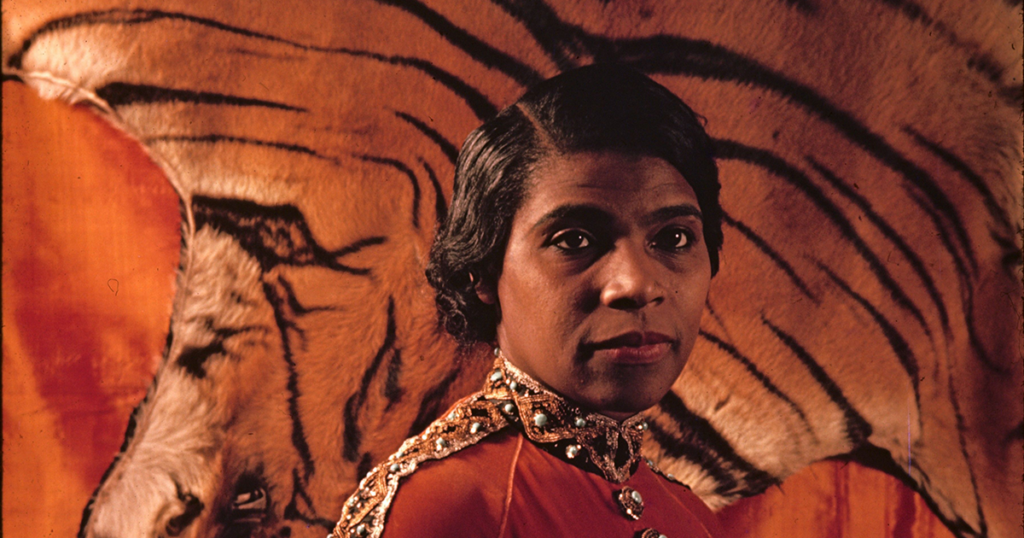
Voice of a Century: The Life and Artistry of Marian Anderson by Anthony Tommasini; Penguin Press, 352 pp., $35
As a child, Marian Anderson would sit at the bottom of the stairs, pretending to play piano and singing out loud to herself. Framing the story as allegory—Anderson’s music as her means of ascent—is almost irresistible. Her story is, on its surface, paradigmatic. The girl from Philadelphia who became one of the most celebrated singers of her time. The exemplar of African American excellence whose resilience and resolve opened doors for generations of Black artists. The public figure whose Easter 1939 performance at the Lincoln Memorial (after the Daughters of the American Revolution barred her from singing in Constitution Hall because of her race) remains a signal event in the struggle for civil rights in America. What can get lost in that familiar narrative is Anderson herself—the person and the musician.
Voice of a Century, Anthony Tommasini’s thoughtful and eminently readable new biography of Anderson, leads with that narrative, even as he seeks to recenter the singer’s musical achievement. He starts by showing us Anderson in 1941, when she was at her height as an artist, still riding the first wave of fame from that Lincoln Memorial concert. We see her through the eyes of a teenage Leontyne Price, who hears Anderson sing in a segregated hall in Jackson, Mississippi, and decides to make singing her vocation, too.
But Tommasini immediately pivots to the burden of such fame, provocatively balancing his sketch of Anderson’s ancestry and upbringing against the uneasy production of her 1956 autobiography, My Lord, What a Morning, characterized by the sometimes fractious negotiations between the reticent Anderson and her inquisitive ghostwriter, Howard Taubman. Tommasini’s is an unexpected choice that feels increasingly astute as, in later chapters, we witness the extent to which Anderson and her career were shaped by her public image: the fact of it and her efforts to deflect it, control it, stay ahead of it, get out from under it, and ultimately embrace it, albeit on her own terms.
Voice of a Century is the fourth volume in Significations, a Penguin Press series edited by Henry Louis Gates Jr., and follows studies of Harriet Tubman, Mary McLeod Bethune, and Harry Belafonte. Anderson was the most reluctant activist in that quartet. From the start, performing in churches and at Black colleges, she preferred to embrace the opportunities she had rather than attempt to claim those denied to her. In the 1950s, when booked at segregated venues in the American South, she opted for incremental compromise (Black and white patrons separated laterally, rather than the usual pattern of white people in the best seats, Black people in the balconies) until more outspoken advocates (including Bethune) persuaded her to take a stronger stand. During the national brouhaha surrounding her Constitution Hall snub, Anderson seemed, at times, almost like a bystander in her own story, taking refuge in the eye of the storm until it became impossible to do so. (If she had had her way, her autobiography wouldn’t have mentioned the concert at all.) “I don’t like a lot of show,” she insisted—an odd statement for a performer, maybe, but true to her instinct not to let confrontation define her. Her art would be her armor.
She had the voice: a striking, burnished contralto of unusually wide range. But she also had exacting, unsentimental self-perception and ambition. She knew what she was capable of—and what she needed to thrive musically. Already 30, and against the wishes of her then-teacher, she went to Europe for the first time in 1927 and there found the coaching, collaborators, and occasions that let her come into her own. In Europe, skepticism over Anderson’s race gave way to enthusiasm over her artistry—although, as the book notes, that praise was often framed around a sort of honorary whiteness. By contrast, in the States, public acclaim could not forestall persistent behind-the-scenes discrimination, even to the end of her career.
Voice of a Century builds on Allan Keiler’s groundbreaking 2000 biography of Anderson and Raymond Arsenault’s 2009 study centered on the Lincoln Memorial concert. Tommasini, a longtime classical music critic for The New York Times, adds texture, an instinctive feel for the music business, and especially a deft and detailed portrait of Anderson as a singer. He is keenly attentive to Anderson’s choice of repertoire, her diction, the intersections between her vocal splendor and her interpretive imagination—and is at times refreshingly frank on the limitations of language in describing such matters. (A digression into the critical shorthand of describing voices as “light” or “dark” provides fascinating and pointed context.) His analysis of how Anderson’s singing and interpretation changed after the German-American Franz Rupp took over as her accompanist from the Finnish Kosti Vehanen is particularly incisive, a model of how to listen to a duo, the nuanced dance of partnership, the butterfly effect of even the most minute musical choices.
Even here, connections between Anderson’s singing and the challenging mantle of her celebrity can be sensed but never proven. The concert spirituals she sang at nearly every performance (and which constitute much of her recorded legacy) took on more complex overtones as they became a fulcrum of her public and private selves. It feels significant that she was particularly persuasive when performing lieder by Franz Schubert, a composer forever drawn to hidden, fugitive emotions and a master of straightforward elusiveness. How much suppressed real-world bitterness should one hear in her numerous performances of Johannes Brahms’s Alto Rhapsody, a ruminative portrait of a person driven by disappointment into isolation and misanthropy, waiting to hear the “one note” of love that might quicken the heart?
Recordings preserve the rich unfurling of Anderson’s voice—even with microphones close and dry, as they often were at the time—and those that Tommasini highlights are well-chosen, well-examined, unimpeachable entry points to further listening. But recordings can only hint at her presence and the compelling tension that some critics described between her noble bearing, imbued with her import and fame, and a kind of interiority, even aloofness—closing her eyes as she sang, retreating into a private world of pure art.
In 1965, on the day she gave her farewell recital at Carnegie Hall, Anderson stopped by a New York television studio to appear as the mystery guest on What’s My Line? with blindfolded panel members attempting to guess her identity. In the episode, Anderson is regal, but she also clearly enjoys having to answer only benign yes-or-no questions. She stumps the panelists, who upon removing their blindfolds are somewhat awestruck to find themselves in the presence of music royalty. Without singing a note, she had delivered a quintessential Anderson performance: leaving her audience inspired, even ensouled, but always keeping some part of her identity strictly to herself.