
Six monks in burgundy robes were seated in six high-backed imitation Louis XIV chairs in a room at the Watergate Hotel. The year was 1984. The center chair was occupied by the Dalai Lama, Tibet’s 14th incarnation of Avalokiteshvara, the bodhisattva of compassion and one of the most famous religious figures on the planet. The Dalai Lama was on a globe-girdling tour to show that though he lived in exile in India, he was engaged in world affairs and was actively supporting the Tibetan people, who were living under the ruthless thumb of China.
I was seated in my own Louis XIV replica, facing the Dalai Lama. I knew little about him and nothing about Buddhism, but I was expected, as a reporter for The Washington Post’s Lifestyle section, to ask a few relevant questions. My assignment was what’s known as a “day hit,” a quick profile of some famous person passing through town. These pieces were always done at the last minute and were usually snarkily written. But snark and the 14th incarnation of Avalokiteshvara didn’t compute.
He had a Marine recruit’s buzzcut, a resilient smile, and antic black eyebrows. His inexpensive shoes had waffle soles, the first I’d seen among Washington’s peripatetic elite. He also seemed amused by the scene in which we all found ourselves.
When I asked him if he hated the Chinese, he emitted a laugh that came from deep inside him. The Chinese, he said, are “a small irritation.”
What followed was a kindly tutorial from someone who recognized ignorance and bewilderment in another and by nature wanted to help. He patiently told the story—for what must have been the thousandth time, I later realized—of how the Tibetan Buddhist hierarchy had searched for whom it considered the preordained successor to the previous Dalai Lama. The monks settled on him while he was still a child, and his early years of instruction took place far from home. His parents had recognized the gravity of the monks’ request and accepted their belief that he possessed unique gifts and spirituality and was obligated to devote his life to the well-being of all Tibetans. “I am just a simple Buddhist monk,” the Dalai Lama added.
He fled Tibet and his palace in 1959, disguised as a soldier. “There was great risk,” he said, “and great anxiety. We passed by the Chinese military camp. If they noticed us, they could easily pursue us. Their bullets could reach us.”
Their bullets did reach many Tibetans, although tens of thousands of them managed to join the Dalai Lama in India. Gulags prevailed in 1980s Tibet, and the Dalai Lama seemed to be doing the best he could for a people he may never have expected to live among again. At 49, he was the spiritual and political focus of Tibetans everywhere, combining the romance of the exiled priest-king with a natural good humor and a lack of pretentiousness. He said, for example, that the wide-ranging discussions that took place within his narrow circle of advisers sometimes involved chanting and even dancing. I tried to imagine President Reagan dancing with Caspar Weinberger and George Shultz, but couldn’t.
At this point, a Post photographer came in to take a headshot, and the Dalai Lama leapt up and hurried across the room to introduce himself—not just interested in the photographer but seemingly concerned about his comfort, too. I was in the company, I realized, of someone so far above all the other dignitaries and celebrities I’d written about as to be unclassifiable—and I had covered cabinet secretaries, entertainers, evangelical superstars, President Reagan, even Elvis Presley.
A few weeks later, I left the Post for another job, and Buddhism faded from my mind until my older daughter, Jess, a sophomore at the University of Wisconsin, began volunteering at the Deer Park Buddhist Center, established just outside Madison by the Tibetan Buddhist monk Geshe Lhundub Sopa. This was in 1992, and Jess’s job was to teach rudimentary English to monks making their way from Tibet to the States. These scholars, she said, were soft-spoken and earnest, and they wrote longhand in floppy copybooks. They took delight in the fact that the words had, hat, and ham—which sounded like homonyms to their ears—meant different things. To them, this revelation illustrated the oneness of the universe.
In 2009, I visited Big Sur with my wife, Penny. For me, the place had strong literary associations, both positive and negative—the elegant poetry of Robinson Jeffers, who had made his home in nearby Carmel, had moved and inspired me; Jack Kerouac’s Big Sur seemed far less impressive. On the back side of the coastal mountains, at the dead end of a steep, teeth-rattling dirt road, Penny and I discovered the Zen Mountain Center of Tassajara, a vision of rough-cut log houses. A clear creek threaded between massive boulders, and robed figures moved thoughtfully under a blindingly blue sky, through air so clear, it seemed to purify everything it touched.
The sensei, a kindly young man named David Zimmerman, explained that Tassajara, in the language of the Esselen Tribe, means “a place to dry meat.” Some 70 monks lived here and helped the monastery function as a hotel, too, one that could house 85 guests at a time. Some guests were allowed to pay half price if they agreed to help in the kitchen chopping vegetables. Then, in the afternoons, they could swim in the jarringly cold creek, often naked, and haul themselves out onto the sun-blasted boulders to warm up.
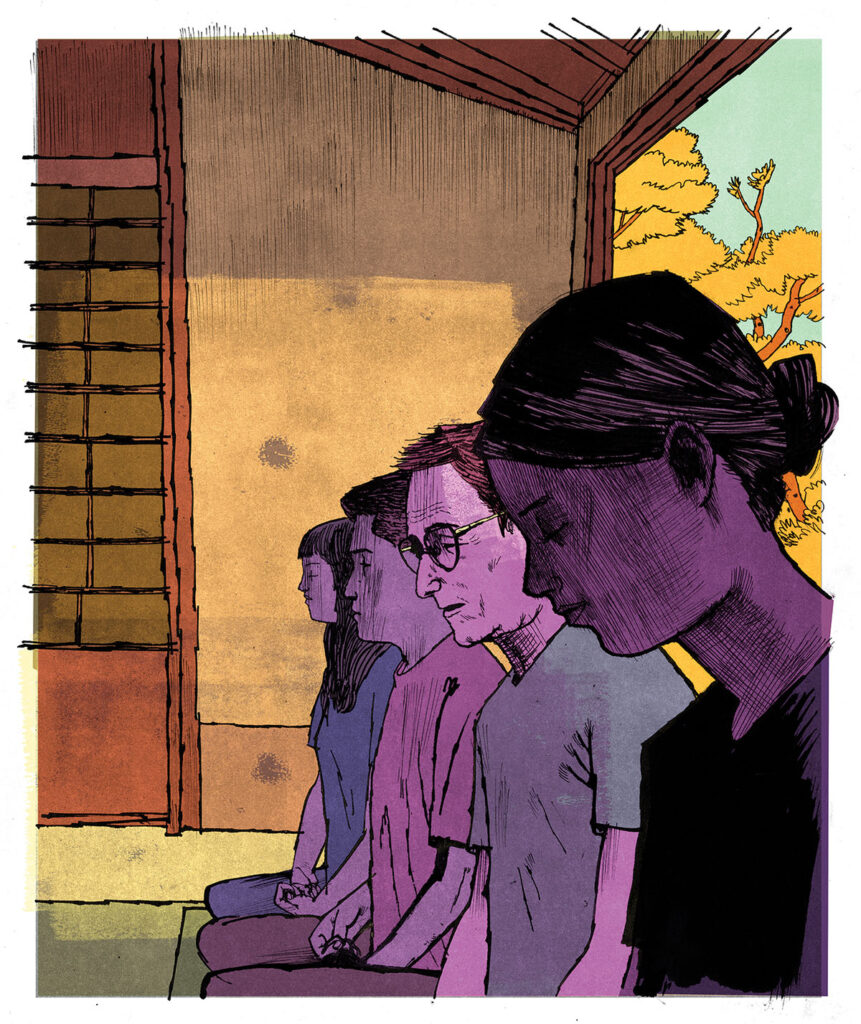
We heard distant chanting shortly after dawn one day, and the sharp clap of a mallet against a suspended board calling all into the dimly lit zendō, or meditation hall. I had never before attempted zazen, or seated meditation, but decided to give it a try. Inside, a monk handed me a black pillow and pointed to an empty spot in the line of those already sitting with crossed legs. I searched for a position that would let me endure 40 minutes of silence without moving, but I failed miserably, scratching at itches that spontaneously arose, recrossing my agonized legs, disastrously unstill during what had to be the longest 40 minutes of my existence. I pitied the monk seated next to me.
I didn’t think I would ever repeat the experience, but repeat it I did. About six years later, I was staying with my other daughter, Susanna, a glass artist in the East Bay. On leaving the public library one day, I happened to pass a bungalow set back from the street and a sign that read, “Berkeley Zen Center.” Inside, several people were seated around a table and welcomed me to join them. When it came time to meditate, I took off my shoes and proceeded into the zendō. Following the example of the Japanese man beside me, I bowed to my position and did a bit better than I had at Tassajara. This session lasted only 25 minutes. Back outside, I asked the man who was seated next to me, “How does one meditate, anyway?”
He appraised me with neither pity nor rejection but instead with what seemed like profound skepticism. “Work on your breathing,” he said.
A cop-out, I initially thought, but of course he was right: The breath is everything. Going out, coming in, it eventually lends some stability to zazen and leads to a degree of self-knowledge, a blessing.
I do not seek enlightenment, the way the Zen Buddhist does, and I do not believe in reincarnation, like the Tibetan Buddhist. My interest in meditation, however, persisted. In my home city of Washington, I discovered the All Beings Zen Sangha (sangha means “Buddhist community”), and I immediately liked its openness and its embrace of the urban environment. I disliked the vows I was expected to take when I was there: The spirituality I was supposed to feel remained elusive, the same problem I had as an altar boy at St. John’s Episcopal Church in Memphis. But after I began meditating at this sangha, I noticed a few changes. I stopped leaning on my car horn in traffic jams. I stopped shouting—from the high, righteous throne of my electric bicycle—at the motorized scooters invading the city’s bike paths. These days, I greet more strangers and don’t swear nearly as much, as I try to smooth out my old, rough edges.
I breathe.