
The Conspiracist Cotton Mather
The zealot who oversaw the Salem Witch Trials initially voiced restraint—what changed?
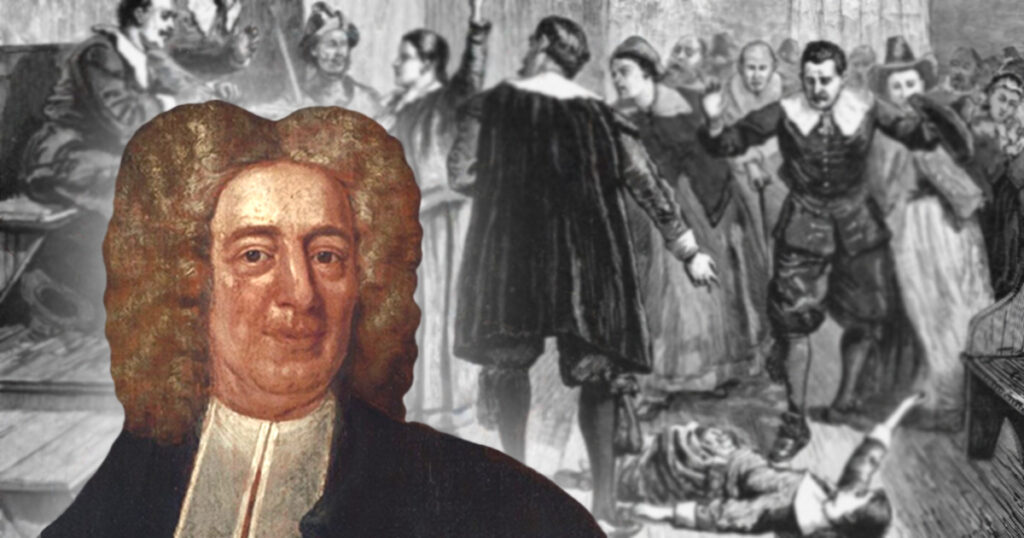
Cotton Mather was nervous. On May 31, 1692, he wrote a letter from Boston to his friend John Richards, one of the magistrates recently appointed to oversee the troubles that had befallen the small hamlet of Salem, Massachusetts. Since January, the town had seen an outbreak of strange behavior in several young girls, and accusations of witchcraft were afoot. Richards had officiated at Mather’s wedding in 1686 and was one of his family’s main benefactors, so Mather felt he could speak freely. He advised his friend to exert the utmost caution and not rush to hasty convictions. Particularly, Mather warned, the magistrates of Salem’s new Court of Oyer and Terminer—from the Anglo-French oyer et terminer, “to hear and to determine”—should not lean too heavily on either direct eyewitness testimony or claims of afflictions that could not be empirically proven (what was known then as “spectral evidence”). “And yet I must humbly beg you,” he wrote to Richards, “that in the management of the affair in your most worthy hands, you do not lay more stress upon pure specter testimony than it will bear.”
Mather’s letter, advocating caution and a need for empirical evidence, sits quite at odds with how history has come to see him. Long caricatured in the public imagination as a fire-breathing zealot, eager to condemn and execute the accused, Mather actually spent the first half of 1692 working to slow proceedings and ensure a fair and equitable trial. His change of heart is often overlooked, but it’s vital not only in understanding more fully what happened in Salem in 1692, but also in understanding the legal and cultural environment that we all still inhabit in 2025.
In calling for calm and caution, Mather wasn’t doubting the existence of witches. Quite the opposite: Belief in witchcraft was more than just superstition or scapegoating; it was the linchpin of Puritan belief. As Mather once bluntly wrote, “Since there are Witches and Devils, we may conclude that there are also Immortal Souls.” It would seem odd to posit that proof of God followed proof of Evil, not the other way around, but for Puritans like Mather, Evil was much closer and easier to see. After all, one could say that “one felt the Holy Spirit” or “heard God’s voice,” but God was far from physically present in Puritan daily life. One could not simply go into the forest, meet God in physical form, and talk to Him. Witches, however, claimed not only to be in league with the Devil, but also to have met him, signed his book, and participated in his Black Sabbath in the woods. While diabolical, they were far closer to what Mather called the “Invisible World” than a pious Puritan like himself could hope to be. Their eyewitness accounts were ironclad proof that such a world existed—but only if authenticated.
He’d been searching for this proof for years. In 1688, John Goodwin, a Boston mason, complained that his children had been bewitched, and in time, an Irish immigrant washerwoman named Ann Glover was accused by one of the children—13-year-old Martha. Glover confessed and was sentenced to death. Mather interviewed Glover in her cell as she awaited execution, but when the afflictions of the Goodwin children continued after her death, he went further: taking Martha into his home to study her behavior and better understand the mechanism of her affliction. For six weeks, she lived with Mather and his wife, Abigail, and as Martha continued to act out, Mather documented her ordeal. He went on to publish his findings in his 1689 book, Memorable Providences, Relating to Witchcraft and Possessions, wherein he states his resolve “after this, never to use but just one grain of patience with any man that shall go to impose upon me a Denial of Devils, or of Witches.”
But if Mather was trying to understanding the nature of witchcraft, he already understood human nature all too well. He was fully aware of the shortcomings of humanity—even the chosen of New England were as prone as anyone to pettiness, lying, errors, and stupidity. And he knew how powerful an accusation of witchcraft could be and how a belief in the Invisible World could be exploited by such human failings. “An Ill-look, or a cross word will make a Witch with many people,” he wrote in Memorable Providences, observing that there “has been a fearful deal of Injury done in this way in this Town, to the Good-name of the most credible persons in it.”
Given the possibility of error and false accusation, Mather felt that proof of witchcraft could only be determined when there was a credible confession freely given in the absence of coercion and torture (such as Glover’s). A teenage girl writhing in pain might be evidence of the Invisible World, but human fallibility or misdirection could just as likely be the cause. Likewise, someone claiming to be a witch might be a witch, but they might just as easily be suffering from some kind of mental illness. A true witchcraft conviction needed both—the body of the afflicted and the confession of the witch.
The news out of Salem threatened this entire framework. The afflictions had started that January, when Abigail Williams and Elizabeth Parris began suffering fits and seizures; other girls quickly followed. They soon identified an enslaved woman named Tituba as responsible for their suffering, along with two other women, Sarah Osborne and Sarah Good. Even after the three were arrested and examined, the afflictions spread, and more and more people—mostly women—were accused. As hysteria mounted, Mather grew increasingly concerned. He reminded the investigators that the only proof of witchcraft was the presence of two factors: the victims’ unexplained physical maladies and the willing confession of the accused. The problem with Good and Osborne was that they, unlike Ann Glover, were maintaining their innocence.
In a letter sent on June 10 titled “The Return of Several Ministers,” Mather wrote: “We judge that in the prosecution of these, and all such Witchcrafts, there is need of a very critical and Exquisite Caution, lest by too much Credulity for Things, received only upon the Devils Authority, there be a Door opened for a long Train of miserable Consequences; and Satan get an Advantage over us, for we should not be Ignorant of his Devices.” That some of the accused were stubbornly claiming that they’d been wronged made Mather incredibly wary about the speed of the proceedings. If the Devil could somehow arrange for innocent people’s deaths through pernicious accusations and hysteria, then the whole legal edifice of New England was at risk.
What, then, changed his mind? Over the summer, a flurry of new accusations of witchcraft hit the nearby town of Andover, and everything began to shift.
Martha Carrier had been born in Andover, a member of one of the original families that settled the hamlet, but after marriage she’d relocated to nearby Billerica. Impoverished, she and her family had been “warned out” of Billerica for fear that they would become public charges, and she’d returned to Andover. When her family contracted smallpox, her father’s and two brothers’ deaths from the disease made Martha a landowner. Taking their deaths as a divine judgment on the family, the Andover selectmen again tried to warn her out of town, but this time Carrier refused to leave. At length, she got into a land dispute with her neighbor Benjamin Abbot, who then began to suffer pains in his sides, swelling feet, and boils on his legs in the spring of 1692.
Abbot brought in the girls from neighboring Salem who’d been among the first afflicted to see if they could ferret out a possible source of witchcraft. The teenagers—Susannah Sheldon, Mary Walcott, Elizabeth Hubbard, and Ann Putnam Jr.—were now deputized witchfinders, and they fingered the town “scold”—Martha Carrier—as the cause of Abbot’s afflictions. She was arrested and accused of witchcraft in late May.
Carrier wasn’t the only one. The Salem girls spent weeks identifying and accusing witches in Andover, just as they had in Salem. Soon more than 50 people had been accused—nearly a tenth of Andover’s population of 600. And unlike what was happening in Salem, many people now willingly confessed. They described the Devil as a small black man, who would offer them wealth (a new horse, new clothes) in exchange for signing their names in his little red book. He mocked God, calling himself Christ, baptizing them, and giving them communion.
What later became clear is that the Andover witches saw, increasingly, that confession was their only way out. In Salem already, three women—Bridget Bishop, Sarah Good, and Sarah Osborne—had gone to the gallows denying the allegations against them, while Tituba, who freely confessed, had yet to be tried (and ultimately never would be). The Court of Oyer and Terminer seemed to have inverted Mather’s advice, and those accused in Andover took notice. Perjury was far preferable to being hanged, and many accused willingly came forward to tell the judges whatever they wanted to hear. Six Andover women who signed a confession later said they did so because “there was no other way to save our lives.” But more important to Mather, these confessions came with a new revelation, far more disturbing than individual acts of witchcraft: a massive conspiracy to destroy the Puritan settlements in North America altogether.
The Andover accused told the Court of Oyer and Terminer that they were part of a secret plot, instigated by the Devil, to take over God’s new Canaan and destroy Christendom itself. Their confessions had become increasingly outlandish, suggesting that some 500 witches had signed the Devil’s book in the woods. Why so many? According to Mary Lacey Jr., Satan was recruiting an army, so that “the Devil would set up his Kingdom there and we should have happy days.” As another accused witch, William Barker Sr., explained, “Satan’s design was to set up his own workshop, abolish all the churches in the land.” Mary Toothaker likewise said that in the black Sabbaths she’d attended, “they did talk of 305 witches in the country” and that “their discourse was about the pulling down the Kingdom of Christ and setting up the Kingdom of Satan.” The leaders of the conspiracy, according to the defendants, were Salem’s former minister, George Burroughs, and Andover’s Martha Carrier.
It was news of this that finally changed Mather’s stance on the holdouts in Salem: The whiff of a secret conspiracy was enough to link the confessions in Andover with the denials in Salem. More important, it was the vital link that reconciled the tension Mather saw between the physical world and the Invisible World.
In essence, the threat of conspiracy became a workaround for the previously necessary formula: confession + affliction = guilt. As if in a supernatural RICO charge, the accused were bound together as one, and as far as Mather was concerned, a single confession could now outweigh numerous denials. The prosecutions at Salem no longer challenged the framework of the physical and Invisible World, because those who denied involvement had lost credibility in the face of this new conspiracy.
As if to make up for his earlier cautiousness, Mather became a changed man by August 1692. He now fully believed not only in the guilt of the accused at Salem, but also in a massive plot to destroy Christianity altogether. A spiritual war had broken out, and on August 4, he chose to preach Revelations 12:12: “Woe to the Inhabitants of the Earth, and of the Sea; for the Devil is come down unto you, having great Wrath; because he knoweth, that he hath but a short time.” As Mather explained, the great and final battle between Good and Evil was at hand, for “these Monsters have associated themselves to do no less a thing than, To destroy the Kingdom of our Lord Jesus Christ, in these parts of the World.”
Two weeks later, he would be present at the August 19 hangings of John Proctor, George Jacobs Sr., and John Willard, along with the supposed ringleaders of the Invisible Conspiracy, Burroughs and Carrier.
It was an ill-timed change of heart, for the panic was already dying out. His own father, Increase Mather, president of Harvard, denounced the whole proceeding in early October, calling attention specifically to the over-reliance on spectral evidence. The father’s caution carried the day over the son’s fervor; a week later, Massachusetts governor William Phips stopped the Salem trials out of concern for “what danger some of the innocent subjects might be exposed to, if the evidence of the afflicted persons only did prevail.” Mather’s reputation as the face of the witchcraft panic came about in part because he was at his most vitriolic after it had already begun to wane. His subsequent book, The Wonders of the Invisible World, was rushed to publication in 1693, cementing his position that conspiracy was enough to validate spectral evidence, even in the absence of any other proof.
We’ve been taught to see those troubling months as an aberration, a miscarriage of justice and a cautionary tale about irrational hysteria. But Cotton Mather’s change of heart is evidence that much of the proceedings were far from irrational. In Salem, the physical world and the Invisible World came to an irreconcilable head, and the only way to heal the rift was through conspiracy. A hallmark of such beliefs is their ability to bridge the gap between the world as we imagine it should function and as it actually does. And more than 300 years later, we are not so removed from Mather’s thinking as we’d like to believe. QAnon, the Rapture, the Satanic Panic, the Elders of Zion—we’re continually haunted by the same zeal for conspiracies, simply in different costumes.