
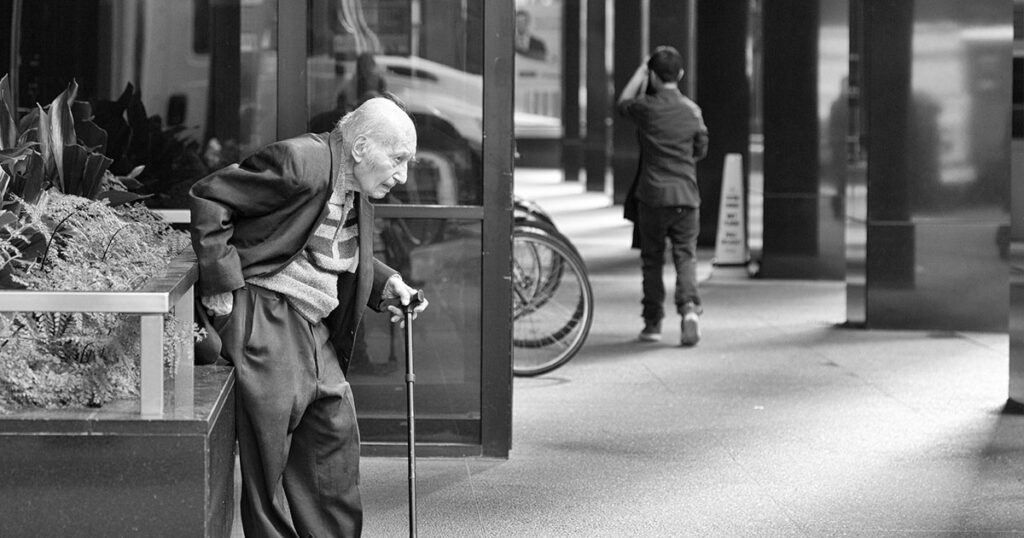
At the corner opposite the sports center where I turn left on my way through town, I saw an elderly man step off the curb and angle toward the crosswalk. He was not frail-looking, but he moved stiffly and advanced slowly, his walking stick in one hand and a bag of groceries swinging from the other. For all appearances, he was oblivious, in his own world. I put my blinker on but didn’t press forward: I wanted to give him time.
In addition to the sports center, one high school and two primary schools are on the block, and at two o’clock, when school lets out, the sidewalks are crowded with parents and children, and the street is full of cars, several always double-parked with drivers waiting inside. I had carefully maneuvered my car through the commotion, but around the corner, the sidewalk was empty, the street too. The older man, though he was on the edge of all that busy activity, was apart from it—as if he were in a different overlay on the grid of the town—not School Bustle but instead The Elderly Among Us.
I idled at the crosswalk, giving him plenty of time to cross. Suppose a car had come careening around the corner, as cars all over the world, not just in Spain, often do? This fellow would have been unable to jump out of the way. He could no more run than I could fly: We would both end up flat on our faces, should we try.
Watching him, however, I had the impression he never would have to run. His role wasn’t to avoid collisions with cars but just to be the moving obstacle that a car—mine in particular—would have to avoid. Not even an obstacle—more like a glitch in the progression. My slightly confused notion as I continued on my way was that the man wasn’t even engineered to be aware of cars. Rather than a real man, he was a facsimile. Buildings on the corners, signposts, a bench, a child darting into the street, a pigeon—these too were all pieces in the townscape to be eyed warily as I approached and then passed them. Behind me, they all evaporated, like dew on grass as the sun passes overhead. Yes, they glimmered, they glinted, then they were gone. That was my strange thought, as if they had all been set in place with a tiny nudge as I approached and tripped the switch. Needing to swerve wouldn’t be a close call but a trap avoided, part of the game, with points to be earned.
As I successfully glided by each bit of scenery or potential trouble, I became confident. And yet, was I really in charge? More than anything else, the situation suggested to me a toy train set, several engines on the tracks, and a little boy on his knees running them with his remote control, speeding us along, slowing us down occasionally in a moment of unlikely prudence before thrusting up the speed lever.
In the roundabout I slipped into my slot, then veered off onto my road. And thus it went, all the way to work, successfully advancing from one challenge to another, school zone to downtown to outskirts to highway to Gijón to the language school.
What a strange experience. And all triggered by the older man, moving heavily, focused on his cane and the crosswalk, on attaining the far side, stepping onto the sidewalk before I pressed the gas pedal to continue. Strangest of all was not the vision of the children and the older man as elements set in motion just in time to meet me on my course through town. That was strange enough. Really strange was seeing myself also as just another element in the game—hardly real and, though the point-of-view character in this round, not guaranteed a place in future games. Not even within The Elderly Among Us.
How did this strange reverie end? It too evaporated—about four minutes into my first class, when I ran into reality.