
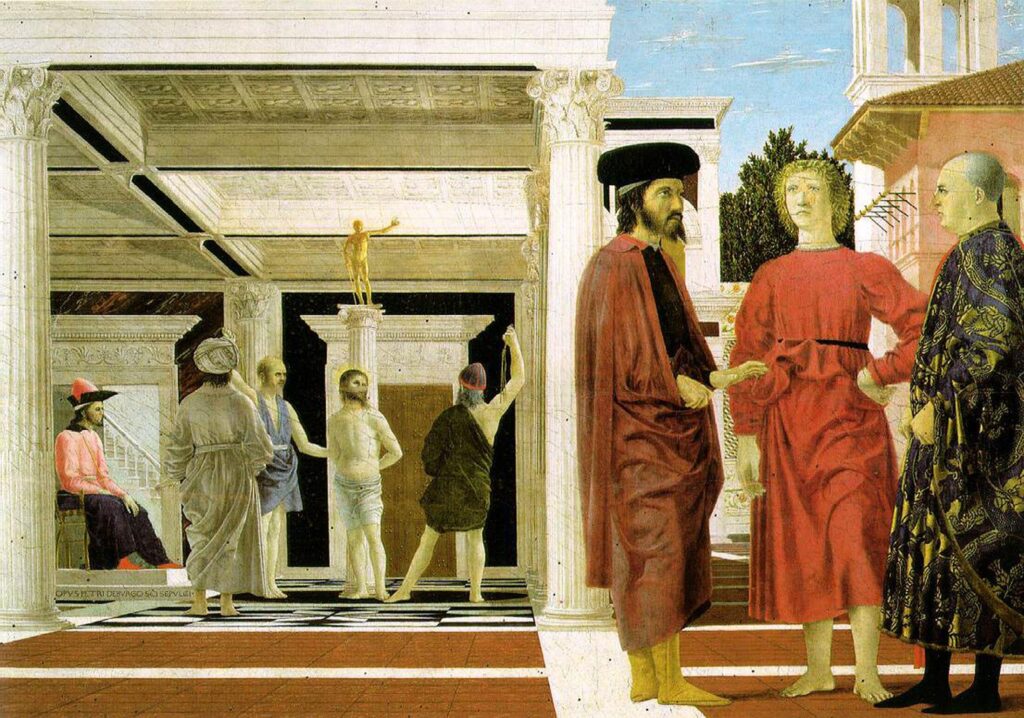
Facial expression is so unnecessary and sometimes so embarrassing that I often prefer a statue without a head.
—Bernard Berenson, Piero della Francesca: The Ineloquent in Art
The faces are famous,
partly because they seem barely variant
versions of one face—
as heavy-lidded
awake as asleep, forthright even when
gazing offstage,
unsmilingly mild
in fulfillment, unruffled by distress:
in a nutshell,
what they wish is less
to hide from expression than to express
their hiddenness.
*
Faces on a pillar
of neck always thicker than you’d expect.
Rock-solid rondure
in Mary, whether
openly pregnant or postpartum
with that hefty baby;
in Magdalene cradling
her jar of ointment, penitent;
in bearded Constantine
in his tent dreaming
between his pike-wielding sentinels;
in the dozing soldiers
not startled yet
by the torso-pierced Christ, burst from his tomb
with every limb taut and fit,
an iteration
even fitter than in life, when a younger
loinclothed ascetic
was baptized by John
in the barefoot, transparent freshness of
a swerve in the Jordan.
*
That last on the list
was my first Piero. London: back then
the revelation
was how the dove
of the Holy Ghost mirrors wing-like, white
cirrus clouds that turn
into spirit, as much
as the other way round; lately I’m thinking
of the tilted cup
above the head
of Jesus, one blessed water-drop
about to fall
(like the miracle
of rain out of the blue) in an undrawn
plumb line from
the bird’s diving beak:
a mathematician’s symmetries
dovetailed with meaning.
*
Perspective is,
Piero seems to say, impartial:
it’s the vanishing
point in history
for painting figures of importance
on a grander scale
than ordinary
others who happen to share their plane.
Which is how his late
and smallish panel
The Flagellation caught me, though
merely a plate
in black and white,
reproduced, reduced, in a book by someone
also mystified
by the composition.
Urbino, I read, was where to go—
to the ducal palace
of Piero’s patron
Federico da Montefeltro,
one of the few
of the artist’s subjects
peggable as a portrait, the boxer’s
broken nose
incongruous
as he knelt armored in prayer before
the Madonna’s crowd
of saints in Milan
or faced, in Florence, the serenely neutral
profile of his
dead wife brought to life
for eternal pairing. But I digress.
What I wanted
was to find the painted
torturers shown in their true colors,
to press my nose
as close as glass
or a guard would countenance, to see
if my first impression
held: that this
Italian master anticipated
Auden’s Brueghel,
who would bury the lede
about suffering largely by drowning little
Icarus in detail.
*
I went to Urbino.
For eight minutes or so, I was the sole
living person on
the planet to witness
the victim waiting in the wings
as in a corps de ballet:
feet in position
for steadiness, rounded arms with elbows
elegantly bent:
I missed at first
that his hands were bound behind that column.
Nobody came
to stop the two
flagellants, one on each side, or to stop
my looking. State-of-the-art
lighting, a bench
the proper distance away for study.
To be accurate,
nothing was happening
any more than in London, where the arm
of the soon-to-be-
beheaded Baptist
is forever raised to bless. But here
expectancy was fear,
the gruesome aim
to convince you that you almost want
the uplifted whips
to come down because
you’re human. Vicious. Violent.
Impassive Pilate
presiding on his throne
to the left; meanwhile the turbaned middle-
manager type
walking not away
but toward the action, his robes in flowing
folds behind him:
they may as well
be statues for all you could ask of them.
Above the tiny head
of Jesus, a sculpted
mystery even more miniature,
like a golden
athletic trophy,
grabs my attention: a hero holding
up in triumph
his own trophy of
the globe. Apollo? Anyway,
a bystander to forgive:
he’s a crafted thing
himself, he comes from before it happened.
I lean closer in,
can see the fluted
columns holding up the room
grooved in two different
tints of white,
constructing shape from shadow that
long ago began
to disintegrate:
the craquelure of paint like the threat
of an imminent
earthquake, when all
will come tumbling, crumble into dust.
But not yet: look—
*
Here’s a pack of kids,
twelve-year-olds, piling up on the floor.
Their gray-haired teacher
throws out some riddles
unsolved for more than five centuries:
why are these large,
anonymous men
in the right foreground just standing around?
Why do they turn
their backs to the crime
which, surely, they can hear behind them
through the open loggia?
Or do they live in a time
long after Jesus, like us? You noticed
they’re wearing clothes
of the quattrocento:
yes. But what about the angelic
one in the center
whose head is haloed
in curls and, behind them, the deep green leaves
of that laurel tree?
Why has he no shoes?
His robes are red: could that mean blood?
Bravi, ragazzi,
the young man is dead:
Federico’s half-brother, murdered,
some people said,
by order of
the duke himself … I know something about
where the story goes
from here, the ingenious,
mutually exclusive theories
involving names
even more arcane.
Regardless, that ethereal young
man not attending
even to the two
older counselors who go on droning
directly into
left ear and right
can’t help but rise (as beauty does)
to become the focal point.
And does he gain
in proportion now because the face
of Jesus is,
whatever it once was,
half-stripped? The skin of paint is slashed
away across
the nose and mouth,
some art restorer’s well-meant swipe
worse than the lash—
nothing to be done.
Erasure even for him. Pure ineloquence
finally has won.
*
Outside, the piazza
has filled with young men and women: today
the university
sent out into the sun
new graduates, not in mortarboards
but in the Classical
wreaths of laurel.
Every one of them looks like a god.
Stumbling, tipsy,
laughing at nothing
they’ll remember, they take central places
at long tables set
for what seems a last
pizza feast with each other, planned
and paid for by
forbearing parents
and, here and there, an ambassador
from a generation
almost gone:
grandmothers wobbling in heels unwise
for cobblestones,
old men in suits
telling tales with liver-spotted hands.
I’ve grown sentimental,
am liable
to break into applause when I hear
the honorees
teased with their titles:
Dottore! Dottoressa! How loud
and insistent living is,
how overwrought
its twisting postures—as in an immense,
overhasty canvas
by some justly minor
mannerist—after an afternoon
spent with the still-
unlocked Piero.
The wounded grace. The self-possession.
The refusal of any
final examination
of those faces: no answer at the end.
A gust of wind
and my eye is caught
by two laureates, barely out of girlhood,
saving the day:
a pink bow has come
untied, a wreath must be set again
atop the head
of the shorter friend—
both of the tall one’s arms, for a moment,
memorably suspended.