
Glorious Country: How the Artist Frederic Church Brought the World to America and America to the World by Victoria Johnson; Scribner, 448 pp., $35
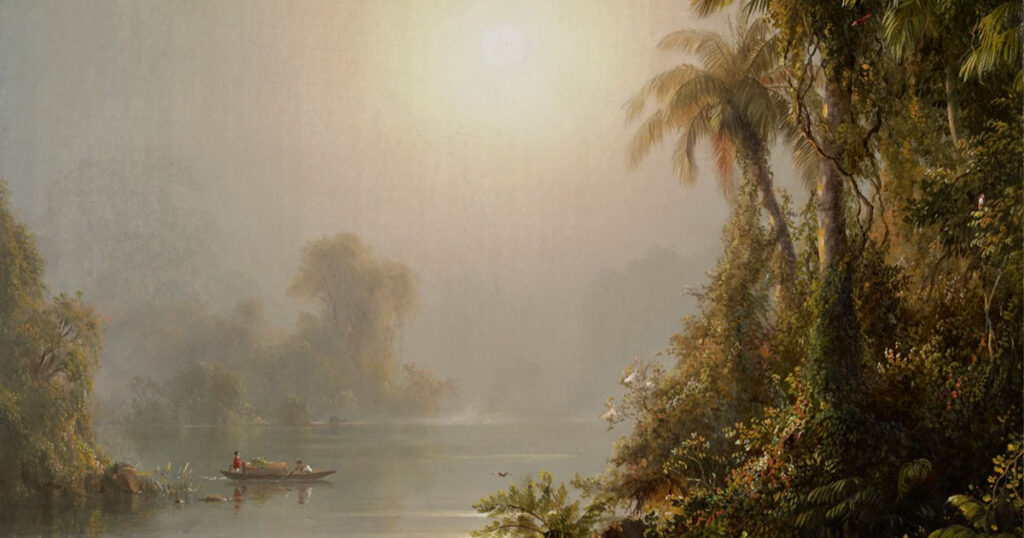
Frederic Edwin Church, born 200 years ago, was once the most celebrated artist in the United States. His mammoth canvases of the Maine wilderness, Niagara Falls, South American volcanoes, and arctic icebergs drew appreciative crowds, enthusiastic reviews, and eager buyers willing to pay what were then the highest prices ever commanded by a living American artist. Yet Church’s time at the artistic summit was brief. Having reached its peak in the 1850s, his reputation began to slip in the decades after the Civil War. By the time of his death in 1900, he had fallen into such obscurity that his New York Times obituary reported that “the fact that he was still alive has been almost forgotten by present day artists.” Not until the 1960s would his reputation begin to revive. Since then, a host of scholarly books, articles, and exhibitions have restored him to preeminence as one of the greatest American artists of the 19th century. Yet, in all this time, he has never been the subject of a full-length biography.
Now at last, Victoria Johnson has done full justice to this extraordinarily talented man who was both blessed and cursed by fate. The task that she set herself—“to access Church’s interior life”—was made challenging by the artist himself. His career coincided with the agony of Civil War and Reconstruction, and his landscapes address those fraught times through their depictions of gathering storm clouds, erupting volcanoes, and blood-red sunsets. In his writings, however, including a voluminous correspondence, he shared little of his thoughts and feelings about either public events or his private life. Even when he traveled through the South in 1851, he wrote not a word about his first encounter with slavery. Johnson, drawing on thousands of pages of letters, diaries, and newspaper accounts, has worked deftly around these silences.
In vivid prose, she draws Church’s character into focus. He was a devout Christian who observed the Sabbath even when traveling with Bedouin tribesmen across the Syrian desert. When he was at home, days always began with prayers and Bible readings. At the same time, he was charming and fun loving, rounding up friends to accompany him on adventures and filling his letters and conversation with lighthearted jokes and puns. His self-confidence and perennial optimism were supported by a lifelong cushion of financial support from his wealthy father. This sense of security contributed to a personal fault Johnson has discerned: Church’s seeming obliviousness to the economic hardships of others. A good friend, the painter Jervis McEntee, recounted a visit during which Church “told me of the carpets he had bought today and lots of other things. He has plenty of money and cannot conceive the wretchedness I suffer from the lack of it.” Beyond treating his friends to dinners, he seems never to have offered them financial help.
Church was an adventurer. He reveled in the challenges and dangers of the wilderness treks he undertook in pursuit of novel subjects for his landscapes. Johnson recreates in engrossing detail Church’s efforts to reach the peaks of Andean volcanoes, traveling through country gray with volcanic ash, struggling up barren, craggy slopes only to be beaten back from the rim of a smoldering caldera by a hailstorm. She also follows him, as an older man, into the Maine woods, where his companions marveled at his ingenuity when he “soldered up a hole in a teapot by melting a metal paint tube together with birdshot in a spoon.”
A friend wrote of Church in 1862, “I have never known a more fortunate man.” Three years later, though, his fortunes began to unravel. He and his adored wife, Isabel, lost their two young children to diphtheria. In recounting this devastating loss, Johnson, as she does throughout the book, nimbly works the couple’s life story into the larger canvas of American and New York history. “Deep in mourning,” she writes, “Church and Isabel suddenly found themselves surrounded by celebrating New Yorkers when word arrived of Lee’s April 9 surrender at Appomattox.” The grief-stricken parents sought to escape the scene of their children’s deaths: “Two days before Lincoln’s funeral train arrived in New York on its way from Washington to Springfield, Illinois, Church and Isabel boarded a steamship bound for Jamaica.”
The Churches would have four more children, but the eldest of these, Freddie, brought his parents little but anguish from his teenage years onward. An ominous note from his boarding school’s headmaster informed them that Freddie “knows of evil & corrupt ways.” He was suspended from Princeton for cheating. He fled to the West Coast, and his parents continued to hear of gambling debts, unpaid bills, and embezzlement scandals. Ill health began to shadow both Church and his wife. When he was still in his 40s, Church suffered bouts of debilitating pain in his right wrist, a sign of the rheumatoid arthritis that would so enfeeble him by his early 60s that a friend described him then as “a knotted skeleton all askew and covered with skin.” Tenaciously, Church continued to paint whenever he was able, though increasingly he turned his creative energies to the construction of his magnificent Persianate villa, Olana, and its grounds, taking delight in what he described as “Landscape Architecturing.” Situated on a bluff overlooking the Hudson River, his home still stands today as a New York State Historic Site, open to the public.
Church showed his largest, most spectacular landscapes in single-picture exhibitions that traveled around the country and abroad to London. Thousands of eager spectators paid 25 cents to gaze on them. Today they occupy prominent places on the walls of major museums, including the Metropolitan Museum of Art, the Dallas Museum of Art, and the Cleveland Museum of Art. The artist, ever reticent about his inner life, would surely have preferred that we keep our attention focused on his paintings. Fortunately for us, Victoria Johnson, in drawing his portrait in such vibrant detail, has given us a biography as richly rewarding and absorbing as his art.