
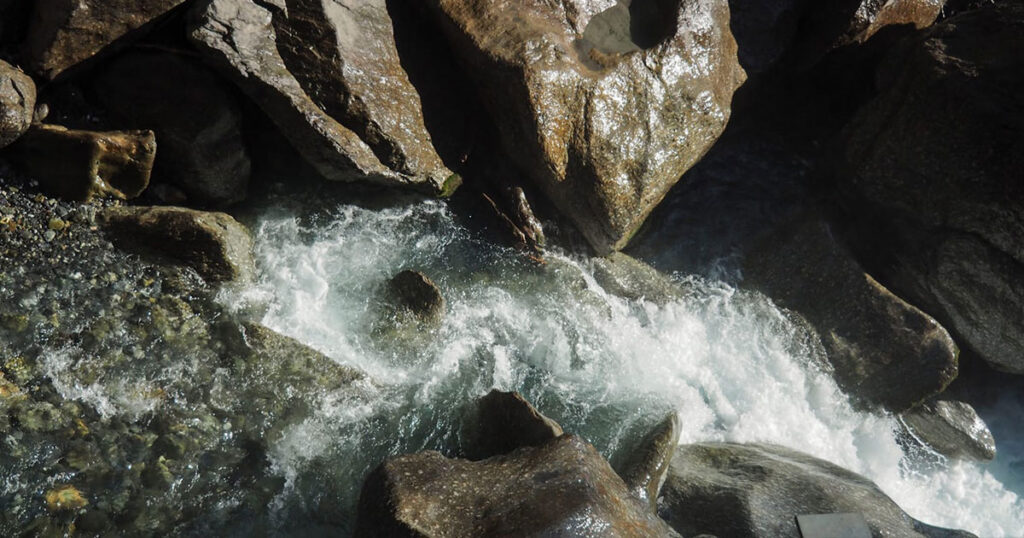
The river Nora flows past my town of La Pola, and on some winter mornings, after several days of rain, it is not smooth and silky but thunderous. From the river path, I can watch it charging along as I follow beside it for a couple of kilometers. On these walks, the river is always with me, yet always hurrying on ahead. Quite the miracle, even more natural—more fluid—than a dog running ahead and looping back and running ahead again.
Near the train station, the river and the path part ways. The path forks, one branch turning into town, the other heading into the hills, while the river, done with the town, ducks under a bridge and disappears into a wooded area. But first, the river widens and slows before it surges over a low cement ledge, breaking into rapids among the rocks and stones piled against the back side.
The water spreads over those rocks, digs between them, and splashes around them, always moving. Wonderful water! That trickling, glittering, dancing, gurgling, babbling, fabulous flow. When you see it, you want to gather it up in your arms. But you can’t—it slips away.
What do those rocks make of the turmoil? I don’t know. But people make a lot of it—flowing, tumbling, crashing water holds fascination, as I was reminded one morning when reading a profile of Nikola Jokić, who plays basketball for the Denver Nuggets. His movements on the court, according to the writer, are not silky, but he plays “the way water moves across rocks, finding the path of least resistance.”
What a fine metaphor! I knew this player only through the photograph accompanying the article, where he appeared clumsy, even slow, holding the ball while crouching adversaries closed in like wolves. I could intuit their movement from the photo, but not his. With the metaphor, however, he seemed magically freed from his frozen stance: Now I could envision him snaking between players or sending the ball through a crack, like water between stones. Just like that, he was changed into a powerhouse with moves, moods and strategies, and, above all, a knack for finding that path of least resistance. I read the line to my upper intermediate class of three teens. “What do you think?” I asked.
Basketball is a popular sport in Spain, though, as in most European countries, it trails far behind soccer. Still, even among schoolchildren, the stars are known, both of Spanish teams and the NBA. I made sure, though, and asked the students. The oldest, a boy, is a serious soccer player; another, also a boy and a year younger, is a dedicated student of music, enrolled in the local conservatory in addition to high school; and the third, a girl, the best student of the three, is such a quick and confident thinker that you wish she had an extracurricular interest like her classmates—ink-making in the Middle Ages, or optical illusions in Renaissance art. Any eccentric interest would work because, you feel sure, she’d make something of it without much effort at all. Yet her favorite pastime? Hanging out with her friends and watching television series on her laptop.
Of the three, only the soccer player had heard of Jokić. “Is that a good description of his playing?” I asked. He made a thoughtful face, raised his eyebrows, and nodded. Then his face relaxed into his customary open good humor.
What had I expected? That my enthusiasm would translate into an inspired display of poetic metaphors? The other two, who had never heard of the player and cared very little about basketball, just shrugged.
The students were taking a progress test that day, and I left them to it. But I wasn’t ready to give up. Similes and metaphors—aren’t they like candy? While the students worked on the test, I wrote a simple sentence for each of them to complete with a metaphor. For the girl, the sentence involved an actor; for the musician, a piece of music; for the soccer fan, a favorite player.
Two students finished the test with a few minutes to spare, and then tackled the metaphor. “Think about the subject you are describing,” I urged.
Their sentences were not inspired or inspiring—they were copies of the one I’d read to them.
Okay—so the students are not deft yet but, perhaps, only just becoming aware of the murmuring river of their own A) trickling possibilities; B) deepening understanding; C) slow, meandering progress. What do you think, Reader?
Meanwhile, I carry with me the joy I felt on reading that line, looking at that river, and practically seeing the photo on the page come to life. Is a picture worth a thousand words? Better than choosing between them is having both.