
The People’s Critic
Michael Steinberg’s profound insights on music transcended the ephemeral world of daily newspaper journalism
Defending the Music: Michael Steinberg at the Boston Globe 1964–1976 edited by Susan Feder, Jacob Jahiel, and Marc Mandel; Oxford University Press, 648 pp., $34.97
New York City at the close of the 19th century thrilled to an early heyday in the erratic history of American classical music. The presiding conductor, Anton Seidl, was a charismatic protégé of Richard Wagner. More than leading American premieres of five Wagner operas at the Metropolitan (and espousing performances of the composer in English), he ultimately presided over a nationwide Wagnerism movement: an arts wildfire. Conducting the New York Philharmonic, he premiered the New World Symphony of Antonín Dvořák, with whom he met daily at Fleischman’s Cafe near Union Square. As director of the National Conservatory of Music, Dvořák in 1893 prophesied that “Negro melodies” would anchor a “great and noble school” of American music. His Black assistant Harry Burleigh would play a pivotal role in turning spirituals into art songs. Seidl, meanwhile, led American Composers’ Concerts. The creation of an American concert idiom, of an American canon, was the presiding priority. The culture of performance that came after World War I, hypnotized by foreign-born conductors and virtuosos, would be a sharp departure.
The same fin-de-siècle moment marked the apex of American musical journalism. The big three critics—Henry Krehbiel of the New York Tribune, W. J. Henderson of The New York Times, and James Gibbon Huneker, who mainly wrote for the Sun—were a study in contrasts. Krehbiel was an impassioned Germanic windbag who preached art as uplift. Henderson’s prose was atypically lean; his specialty was vocal art. Huneker was a virtuoso stylist (H. L. Mencken was a disciple) heralding the coming modernist moment. What they had in common was community—with one another, and with the artists whose activities they observed, adjudicated, and shared. Huneker’s responsibilities included doing publicity for the National Conservatory; a fabled raconteur, he once went drinking with Dvořák and declared “such a man [to be] as dangerous to a moderate drinker as a false beacon is to a shipwrecked sailor.” Henderson’s musicales hosted the city’s prominent singers and instrumentalists. But it was Krehbiel who knew everyone and did everything. He wrote program notes for the Philharmonic. He composed exercises for the violin. His books, more than a dozen of them, included the most published musical primer for laymen and the first book-length study of “African-American Folksongs.” During World War I, he translated Wagner’s Parsifal into English for the Met. He wrote that “the power of the press will work for good”—and proved it.
Half a century later, the big names in New York musical criticism were Virgil Thomson of the Herald-Tribune and Olin Downes of the Times—antipodes. A chronic gadfly, Thomson was also a notable composer who thought nothing of praising conductors who programmed his own music. His first review, in 1940, blithely yet plausibly declared the New York Philharmonic “not part of New York’s intellectual life.” Downes was a populist who embraced mainstream tastes. His turgid prose was doggedly sincere. Compared to Thomson, he stood aloof from the artists and institutions he assessed.
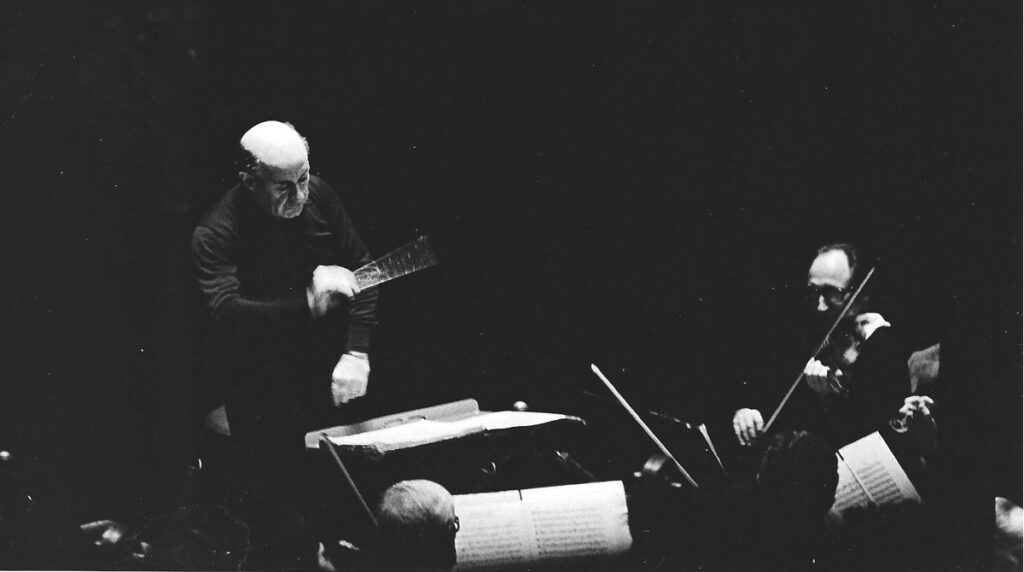
When I arrived at the Times as a young music critic in 1976, “objectivity” had become a fetish. We were not to consort with musicians and administrators. We were never to perform. At the opposite extreme stood Michael Steinberg of The Boston Globe—a practitioner of maximum engagement. Steinberg’s range of local acquaintances was more catholic than Thomson’s. So was his knowledge, and not just of music. His prose was impassioned. His decrees, take them or leave them, were fundamentally informed. Oblivious of reputation, he abjured the tug of mainstream taste. He called Olin Downes “a pompous arch-boor.” Preeminent among the American newspaper music critics of his generation, he was also a throwback to another, more culturally assured era. He recalled the virtues of Krehbiel, Henderson, and Huneker.
Born in Breslau, Germany (now Wrocław, Poland) in 1928, Steinberg was one of 10,000 Jewish children who in 1939 escaped via the Kindertransport. He lived in England, then Missouri. He obtained a master’s degree in musicology at Princeton. He was drafted and wound up in Germany. Upon returning to the United States, he headed the nascent music history department at the Manhattan School of Music. He was lured to The Boston Globe by its managing editor, Thomas Winship, and served as the paper’s music critic from 1964 to 1976.
The new Steinberg anthology, Defending the Music, collects some 500 pages of Boston Globe reviews, interviews, and essays. Scrutinizing a city’s cultural life, Steinberg is a terrific companion. His many causes included the composer Milton Babbitt and the pianist-scholar Charles Rosen, both of whom he knew at Princeton. His passion for the music of Arnold Schoenberg proved unquenchable. A master of infectious approbation, he raised a banner for Beethoven’s discarded 1805 version of Fidelio (“a work of surging vitality with a life all its own”), for Schumann’s Scenes from Goethe’s Faust (“a masterpiece, one of the nineteenth century’s very great ones”), and for Hans Pfitzner’s Palestrina (with Stravinsky’s The Rake’s Progress one of “two twentieth century operas I love most”).
These were all unpopular or esoteric enthusiasms, learnedly espoused. On the opposite ledger, Steinberg’s fundamental discontents included “the dry pseudo-Stravinskian crepitations that American neoclassicists were producing so plentifully in the ’30s and ’40s,” “the stupefied routiniers who run most of the world’s orchestras,” and “that claptrap about making concerts casual and friendly.” He castigated the inability of “the Boston public” to deal “even with the least forbidding sides of contemporary music.” He accused Puccini of taking “sadistic relish in the humiliation of his female leads, victims only of their own pitiful combination of passion and brainlessness.” He compared the smooth finish of Eugene Ormandy’s Philadelphia Orchestra to the silken pops fare of Mantovani.
Steinberg had barely begun his first full season when on September 26, 1964, he threw down a gauntlet: “The 84th season of Boston Symphony concerts began greyly Friday afternoon, with Erich Leinsdorf conducting. The program consisted of the Brahms Academic Festival Overture, the Symphony No. 1 by Shostakovich, and Beethoven’s Pastoral Symphony.” Of the Shostakovich, he wrote “When it is serious, it is merely gross”—and continued: “Neither [the Beethoven] nor the Brahms Overture was at all well performed, and for the reasons that often hamper Leinsdorf in the German classics. In the face of the expressive demands of certain kinds of music he becomes extremely inhibited—and he seems to fight off the inhibition with an irresistible desire to interfere with the natural flow of things.” Citing half a dozen specific passages in the Pastoral Symphony, including an even more specific measure number, Steinberg diagnosed both “technical” and “musical” carelessness. The previous February, in his third Globe review, Steinberg had skewered Leinsdorf’s predecessor, Charles Munch, who was making a guest appearance in his specialty: Berlioz’s Symphonie fantastique: “He gave it much as he always did, coarse in sonority, frenzied in temper. … All in all, I found it abominable.”
It was too much for the orchestra’s president, Henry B. Cabot, who in 1949 had been the man most responsible for hiring Munch rather than Leonard Bernstein, Serge Koussevitzky’s protégé and anointed successor. An outraged letter to the editor ensued. Steinberg replied with an “open letter” of his own, writing in part:
You say that “nobody in the field of musical criticism has a right to assume that he alone knows what is right and what is wrong.” I object to your implication that I have assumed that about myself. …
You write about the possible “damage Steinberg can do to the musical situation here in Boston.” You and I share deep concern for the musical welfare of the city. …
Last September … [y]ou made a speech in which you said … that since you did not wish to brag by claiming that the Boston Symphony was the best orchestra in the country, you would limit yourself to saying that there was none better.
Now any musician would like to live in a city that has the best orchestra in the country, and I am no exception. But I do not believe we can have the best orchestra in the country simply by saying that we do. …
There was a time, under Koussevitzky, when Boston orchestral playing represented, along with that in Philadelphia and New York, the best in America. That is no longer so. … I very much want Boston to regain the place it once held, but it is not likely to if no one points out what sometimes is wrong and if the only public statements are those which assume that our orchestra is the best around.
Steinberg’s subsequent reviews regularly praised and chastised individual members of the orchestra, most notably the concertmaster, whom he esteemed, and the principal clarinetist, whom he accused of “musical vacuity and bad pitch.” The reviews also disclosed personal relationships. When Leinsdorf departed in 1969, Steinberg’s farewell assessment, though not very favorable, was nonetheless fond: “In all, the seven years … are not likely to be remembered as the most glorious in the Boston Symphony’s history; neither, I suppose, will Erich Leinsdorf think of them as the happiest of his career. … His mission now is to rescue the musician in him, to let the musician function without the drain that goes with being a handcuffed administrator as well. In that, in everything else, and with gratitude for the beautiful and enlightening moments he gave us, we wish him the best.”
Steinberg’s tenure at the Globe happened to coincide with a historic decade at Boston’s New England Conservatory: the directorship of Gunther Schuller (1964–76). Schuller was a musical polymath—composer, conductor, and scholar—commanding a singular overview of American musical history, including jazz. Steinberg copiously covered the many NEC Jordan Hall concerts that purveyed repertoire unknown at the BSO’s Symphony Hall—an initiative another critic might have considered peripheral. These typically included the 1965 Boston premiere of Elliott Carter’s Double Concerto (1961)—“considered by many as the greatest achievement in American music so far.” The NEC faculty included the violinist Rudolf Kolisch, once a close associate of his brother-in-law Arnold Schoenberg; Steinberg was more than cognizant. Another galvanizing Boston fixture, at Harvard, was the composer Leon Kirchner, who was also a formidable pianist and conductor at Harvard’s Sanders Theatre. A 1964 Steinberg review of Schubert, Stravinsky, and Kirchner hailed “three ‘classic’ masterpieces revealed as only a composer’s understanding can reveal them.” And then there was Sarah Caldwell, who presided over a renegade Boston opera company. Steinberg’s gratitude for her stagings of rare repertoire, including Schoenberg’s Moses und Aron, was intense—and so was his frequent dissatisfaction with the manner in which her performances were realized. In short: Steinberg cut a wide and varied swath. Nothing important was out of the way.
Of all the Steinberg reviews and articles here collected, the most poignant are two dealing with Goeren Gentele, who was to succeed Rudolf Bing as general manager of the Metropolitan Opera in the fall of 1972. Steinberg credibly adduced an institution in decline, in need of new repertoire and better conductors, and burdened with a gargantuan Lincoln Center auditorium insensible to a growing shortage of big voices. It was not only Steinberg to whom Gentele seemed a veritable deus ex machina. But Steinberg had also quite obviously bonded with Gentele the man. For his opening night Carmen, restoring the original recitatives, Gentele had lured Leonard Bernstein into the pit. He was to direct that new production, and also very possibly Alban Berg’s Lulu and Ferruccio Busoni’s Doktor Faust—major 20th-century operas never before staged in Manhattan. He appointed a seasoned Central European of high consequence, Rafael Kubelik, as the Met’s music director—a position that did not previously exist. His most fundamentally far-sighted priority was a planned mini-Met. He told Steinberg:
Yes, of course we must do contemporary opera, but you know, you really can’t count things like Wozzeck and Lulu and Rake’s Progress as ‘contemporary opera.’ I know it will not draw as well as Verdi and Puccini and so on, and it is depressing to do such things in a one-third empty house …but then why is it necessary to do them in this immense house? We must in any case have a small theater for chamber opera, experimental works, and so on. … Lincoln Center is full of good theaters of different sizes, but of course I cannot yet speak of going to this or that one, to Juilliard or the Beaumont, with this or that work—it is very delicate and we are very early in our conversations. I think it is important that Lincoln Center works as a unit, that we take advantage of the possibilities.
Three months later, Steinberg wrote:
The death Tuesday night in an automobile-truck collision in Sardinia of Goeran Gentele … was news to hear with shock and incredulity. The shock is perhaps greatest for us in the United States who stood just before the beginning of what we hoped and thought would be a long period of friendship and Gentele-watching. The pain is the greater for the personal tragedy that took the lives also of his 21- and 15-year-old daughters, Anna and Beatrice, like their mother, the former actress Maria Bergson, and their older sister Janet, who survived in serious condition, young women of exceptional beauty and vitality. …
Directing was Gentele’s profession, and he had done much of it, in opera, film, and theater, before becoming director of the Royal Swedish Opera in 1963. The Stockholm company was the most distinguished of the European ones—the others included those from Vienna, Moscow, and Milan—that showed their wares in Montreal at Expo ’67. They brought what for many was the operatic experience of a lifetime, Ingmar Bergman’s production of Stravinsky’s Rake’s Progress, but also Gentele’s own productions of Blomdahl’s Aniara and Verdi’s Masked Ball, both profoundly intelligent, imaginative, and musical through and through. …
Gentele was a man of many parts. He knew theater and opera, but he also knew people and understood plenty about money. Quietly with tact and superb efficiency … he negotiated contracts with the nine unions the Met deals with, and without precedent, got everything settled before the expiration of the old contract. …
Everyone in the music world has seen Gentele’s appointment as a promise of life and excitement. Where the Met will go is impossible even to guess at, either in long range of in immediate terms.
Post-Gentele, Schuyler Chapin took over, then Anthony Bliss, Bruce Crawford, Joseph Volpe, and today’s Peter Gelb, not one of whom was or is an actual practitioner of operatic art. A mini-Met, more exigent than ever with ticket sales plunging, is no longer publicly discussed.
The hundreds of writings chronologically amassed in Defending the Music track an eventual leavetaking. For one thing, they disclose an impatience for systemic reforms not in the offing. For another, they increasingly question the place of the critic. In “Putting Reviews in Their Place” (June 21, 1973), Steinberg mulled:
It occurred to me that artists’ agents must be among the few people who care about keeping the review as in institution alive. It helps them sell, or they think it does. Other than that, who needs it? I submit that nobody does, really. … We must now question the assumption traditional to American musical journalism, the assumption that every concert—or as many as space in the paper and availability of writers permit—is followed by a review.
I shall not go to fewer concerts. … I do, however, want to find a new texture for these pages. … The traditional commitment to the review as the chief journalistic and critical form has … locked us into writing about many things that were not worth writing about.
Between the lines, Steinberg’s reviews confide increasing dissatisfaction with his job. In “The Power of Critics” (April 21, 1974), he writes to a disgruntled soprano unhappy with a review: “The critic can’t, for the sake of supporting a good cause, pretend to an enthusiasm he doesn’t feel. I wish it were otherwise. … Of course critics hope and like to persuade. We write to persuade, but even more to stimulate, to interest, to point out, to make people think. It’s a lot like teaching.” Celebrating the 100th anniversary of Koussevitzky’s birth (July 21, 1974), he peruses a career that mattered: “Koussevitzky was the first to see that an orchestra was more than a collection of players who gave concerts regularly, that it could be the nucleus of a musical university.” Steinberg took a leave of absence in 1975–76 to write a book about Elliott Carter—an unfinished project. He announced his resignation on September 19, 1976, in a low-key essay including a barbed aside: “By and large, journalistic criticism continues an irritant and a depressant.”
His new job, crossing over, was to write program notes for the Boston Symphony—in which capacity he also became an artistic advisor. He subsequently held the same dual position for the San Francisco Symphony and the Minnesota Orchestra. His program notes were also regularly used by the New York Philharmonic. He coached young musicians at festivals in Menlo Park, California, and Round Top, Texas. He continued to write. His entries for The New Grove Dictionary of Music and Musicians (1980) were typically personal—not really dictionary entries at all. The most notorious was “Vladimir Horowitz,” ending: “Horowitz illustrates that an astounding instrumental gift carries no guarantee about musical understanding.” (The subsequent Grove Dictionary of American Music [2013] carried a substitute Horowitz entry by Harold C. Schonberg.)
Steinberg’s Boston reviews bristle with insights into specific compositions—a contribution transcending the ephemera of the daily press. Anyone sensitive to, say, the art of Edward Elgar would want to save and savor Steinberg’s October 4, 1969 review of Elgar’s Symphony No. 2, reading in part:
Elgar’s music is of disturbing emotional depth and complexity, and its subject often is pain. The most nearly comparable figure among his contemporaries is Mahler, but Elgar, lacking Mahler’s relish for agony in public, masks his Weltschmerz and allows his music to be outspoken and explicit only in its moments of triumph and of nobility. Those seem to have become almost alien quantities to us today, and their representation in music so patently sincere, not completely purged of doubt, is no easy thing to face.
And so, three program note compendiums—The Symphony (1995), The Concerto (1998) , and Choral Masterworks (2005, published four years before his death)—constitute Steinberg’s most lasting achievement. These essays seamlessly combine musical analysis, cultural history, and sagacious personal experience and reflection. Compared to his Globe reviews, they are also less confrontational, more catholic in taste. Though they are (alas) today too sophisticated for what symphonic audiences have become, there exists no superior published guide to the standard symphonic repertoire.
Michael Steinberg was never intended to make a career writing concert reviews. He was ever courageously drawn to what would do the most good.