
Anniversaries are times for reflection and celebration. But they also offer the opportunity to speculate, to cast hopes and dreams into a future unknown. All too often, we imagine this future as a vast and shapeless void in which anything becomes possible if only we dare to dream it. But any future is invariably shaped by the now that we allow, and the past that we choose to forget.
As a scholar of science fiction—or what I prefer to call speculative fiction, for its more comprehensive implications—and as an administrator in higher education these past several years, I have spent countless hours considering the interconnectedness of the past, the present, and the future. Through the study of history, we are able to map patterns, recognize human tendencies, and with the benefit of time and distance, make sense of ourselves and the inherent contradictions of a humanity striving to reconcile the competing polarities that seem to dominate much of our social relations.
Our present circumstances reflect not only our past actions but also how well we have made meaning of previous experiences. The study and interpretation of history, then, defines our understanding of the present moment. Important decisions made at particular inflection points, pivotal occasions that mark some sea change for society—these are but punctuations in the persistent drumbeat of cultural beliefs and habits that drive the rhythms that make up our society.
This is the foundation from which any futures we can perceive may be imagined. The act of speculation is neither fantasy unmoored from reality nor mystical prediction conjured from thin air. It is the thoughtful, deliberate study of human complexity in historical contexts and present actualities. It demands a capacious exploration of the many and varied approaches to understanding the world and the human condition. And it is fitting, on the occasion of the 250th anniversary of the Phi Beta Kappa Society, to turn our collective gaze to the powers of speculation to meet the demands of our day and shape a future of promise. Looking back to understand our present, we may boldly cast a vision for the future that we hope successive generations will see.
Early in the life of the Phi Beta Kappa Society, its members presciently affirmed, “Here too you are to indulge in matters of speculation …” The impulse to question, inquire, try out unconventional and untested ideas formed the purpose for their convening. That purpose, worked out in practical terms, served them well as many entered public service and played decisive roles in shaping the principles enshrined in the Constitution and other foundational documents and governance structures.
The members’ resistance to simple acceptance of received knowledge gave way to a revolutionary set of behaviors in a time informed by and formed within a revolutionary culture. The extreme challenges of their age fomented change in countless ways, not the least of which revealed itself in our distinctly American form of what we now speak of as liberal—or broad, free-ranging—education, defined by the pursuit of knowledge, wisdom, and understanding. It was dangerous—indeed, very nearly treacherous—to question and critique conventional wisdom.
In taking up debate on the serious questions that defined their day, they fostered not only the critical thinking skills that form the bedrock of American education, innovation, and ingenuity but also a commitment to occasions set aside for “Jollity and Mirth.” The fine feelings of fellowship in the company of like-minded individuals pursuing truth through thinking, reason, and discussion were just as central to shaping the ideas and ideals that would influence their work in the emerging nation.
As the Society navigated perilous periods, sometimes nearing obliteration, it nevertheless survived through adaptation. When Ralph Waldo Emerson delivered his 1837 lecture to Phi Beta Kappa’s Alpha of Massachusetts chapter at Harvard University (thus designated for being the first chapter to be organized in the state), he elaborated on the role of men of speculation in meeting the demands of the present moment. Emerson spoke of the “Man Thinking,”
that man who must take up into himself all the ability of the time, all the contributions of the past, all the hopes of the future. He must be a university of knowledges. … In yourself slumbers the whole of Reason; it is for you to know all; it is for you to dare all. … This confidence in the unsearched might of man belongs, by all motives, by all prophecy, by all preparation to the American Scholar.
On this occasion, Emerson articulated a bright line distinguishing American individualism and exceptionalism from the received European modes of thought. And it is a distinction that has endured and served the nation well, in large part.
Overlapping waves of revolutionary change most certainly influenced Emerson’s thinking. Ideas emerging from the Age of Reason intersected with the technological advances of the ongoing Industrial Revolution in shaping labor, economics, and class relations. The concurrent rise of the Romantic period created a dynamic crucible that tested the scholar attendant to these shifts. Emerson recognized the moment during which he delivered these remarks as an age of Revolution, “when the old and the new stand side by side … when the historic glories of the old can be compensated by the rich possibilities of the new era? This time, like all times, is a very good one, if we but know what to do with it.”
What lesson might be learned from Emerson’s embrace of the change made possible by the challenges inherent to a period of revolution? Speculation paves the way for adaptation, invention, and innovation. The shape of the future requires “men of speculation” to act, to do something informed by “historic glories” and to seize the possibilities provided by the new and emergent. Both actions are required for the most advantageous effect “if we but know what to do with it.”
And therein lies the question that still pertains to us today: Do we know how to make sense of the revolutions our world is currently undergoing? What rich possibilities do we perceive in reconciling the perils and potential in the ubiquity of generative AI for labor, life, and the economy? Or the rapidly escalating shifts in climate change, educational access, and health care? Or the dramatic rehauling of governmental structures, laws, and policies? The challenges are grand and sweeping in their effects, with reverberations that will rock generations to come.
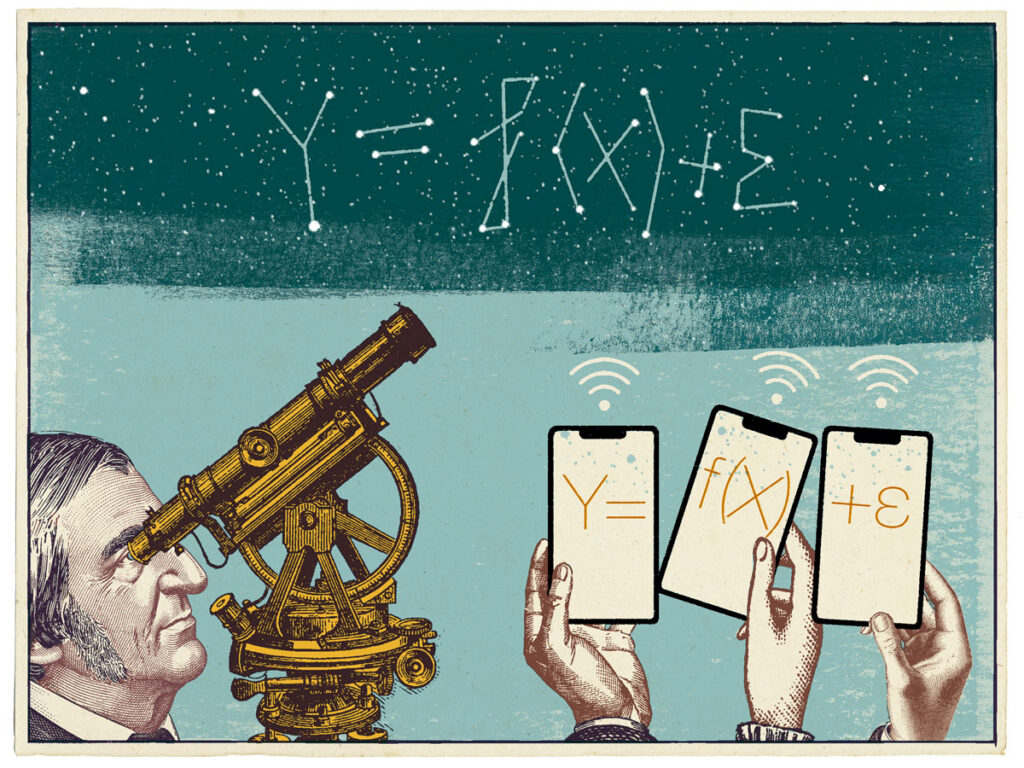
If past is prologue, we may find ourselves coming full circle in the present moment. Above all, speculation requires us to take stock of the conditions of the present and its historical contributing factors and to calculate a probable future state. Engaging history and as much accurate knowledge available to us as possible, we can “game out” various scenarios. In mathematics and data science, this is predictive modeling: Y = F(X) + ε. In literature, this is science and speculative fiction and is expressed in the syntax of the conditional: If X social conditions, human behaviors, etc. continue, then Y is the likely outcome.
At any given point in time, it is difficult to fully assess and make sense of all that is happening in the present moment. But studying the past helps to anchor the present and more forthrightly assess how the decisions we make now are likely to play out in our future.
Consistent with the cultural and legal norms of the time, Emerson’s clarion call to do a new thing in service to the common good was, unsurprisingly, made to men of letters. The status of women’s rights was a matter debated by members of the Society early on. When Emerson was addressing the Alpha of Massachusetts chapter, women’s education was only beginning to emerge. Mount Holyoke Female Seminary was founded in 1837, and that same year, Oberlin College became the first established institution of higher learning to admit women. Harvard College, meanwhile, would not establish its annex for women until 1879. This annex would later be chartered as the Radcliffe College in 1894.
The Society eventually adapted to meet the societal changes and expanded to include women, African Americans, and other groups historically ineligible because of legal restrictions or status, cultural practice, or social norms. The diverse perspectives from these groups contribute to an enriched expansion of our knowledge base, which, in turn, strengthens our capacity to game out different possible futures and their implications for the ever-complex textures of the world we are creating.
Today, the Society elects alumni and honorary members with a record of living the values of lifelong learning and serving the common good in their chosen fields of work. This practice further extends the Society’s influence. In this way, and countless others, the halo effect of the Society’s values reaches far beyond the elected membership. It suffuses the very fabric of American culture and genius.
In the 1990s, Octavia Estelle Butler published two works of speculative fiction set in the near-future United States. Parable of the Sower (1993) and Parable of the Talents (1998) imagine a country in dramatic decline, suffering through the pains of rapid social, political, and economic deterioration. The novels are primarily set in our time, the 2020s–2030s, a period Butler refers to as “the Pox,” an abbreviation for “apocalypse”—decades of chaos “caused by our own refusal to deal with obvious problems” in the intersecting and coinciding realms of climatic, economic, and sociological crises. All of the societal concerns are recognizable to the contemporary reader because we have been aware of them for many years.
The world Butler imagined 30 years ago is eerily resonant with our current historical moment. Some readers have characterized this series as “prophetic.” Butler herself would have likely rejected such religious and mystical undertones to characterize her works. They are, rather, the result of speculation and extrapolation: studying history with curiosity and viewing the present with clear-eyed attention to test out potential outcomes if we continue on a particular path unchecked. It is a thought experiment fleshed out in narrative.
In similar fashion, however, the works do not leave the reader to wallow in despair. The estrangement evoked by the unsettling fictional rendering of our contemporary conditions also creates opportunity to speculate on the necessary conditions to imagine our way out of trouble. Butler’s protagonist in both novels is Lauren Oya Olamina, a teenage Black girl from a middle-class family whose position of simultaneous social vulnerability and educational privilege offers one potential path forward.
Olamina’s father is a preacher and professor, and her family is able to persist, for a time, in precarious comfort despite the surrounding poverty. She anticipates—correctly—that her home will eventually be lost to this calamitous habitus. So she embarks on the practices of reading, learning, and teaching, gathering all the knowledge available to her—both philosophical and practical, in books and by experience—to survive the perils of the relentlessly hostile hellscape in which she has come of age.
Her drive to survive, once her home is burned down, demands that she prepare for the loss of the status and privilege that have protected her during her formative years. Her psychosomatic health condition of “hyperempathy syndrome” complicates the oversimplified notion that more empathy by more people would cure the ills that have allowed society to disintegrate. And she knows that she will need a community of care and connection if she is to survive. The communities she eventually builds survive through embracing broad knowledge and learning and by teaching others whatever they know.
I read Butler’s Parables alongside Emerson’s invocation of “The American Scholar” and see in both the same valorization of learning and education as foundational to meeting the demands of the day. Emerson calls the scholar to action, for “without it, thought can never ripen into truth.” Butler carries this forward: Olamina is compelled to translate knowledge into action because it is a matter of literal survival for one whose intersecting identities make survivability more difficult. In a point of departure, Emerson notes and extols the rise of individualism, of each man treated as a “sovereign state,” surrounded by “barriers of natural respect.” Butler, alternatively, proposes the necessity of communities of care and interdependence.
The question to pose here is not which of them has gotten it right. Rather, how do challenges and their solutions shift depending on our baseline understanding of what we know and how we are positioned? In these speculations, we may imagine many futures. We could not know the broad scope and expanse of all future possibilities without each author’s contribution to the project of speculation.
How, then, do we extend the influence of the Phi Beta Kappa Society to shape a livable, thriving future safe to sustain us all? I contend that we see this future not only in the key holders whom we count among our elite, rarefied membership, but also in the many products and beneficiaries of an educational system and a culture that promote love of learning, deep thinking, and the freedom to pursue one’s intellectual and creative interests. Both Emerson, the holder of a Phi Beta Kappa key, and Butler, the career science-fiction writer who attained an associate’s degree and took courses devoted to her craft, contributed to the world of ideas, the discovery of truth, and the force of action in service to a common good.
The vitality of our future lies, here and now, in our capacity to speculate, to imagine our way out of whatever the day demands of us. It was true at the time of the Society’s founding; it remains true today. The next 250 years of this society and this nation are yours and mine to shape. May we rise to meet the occasion.