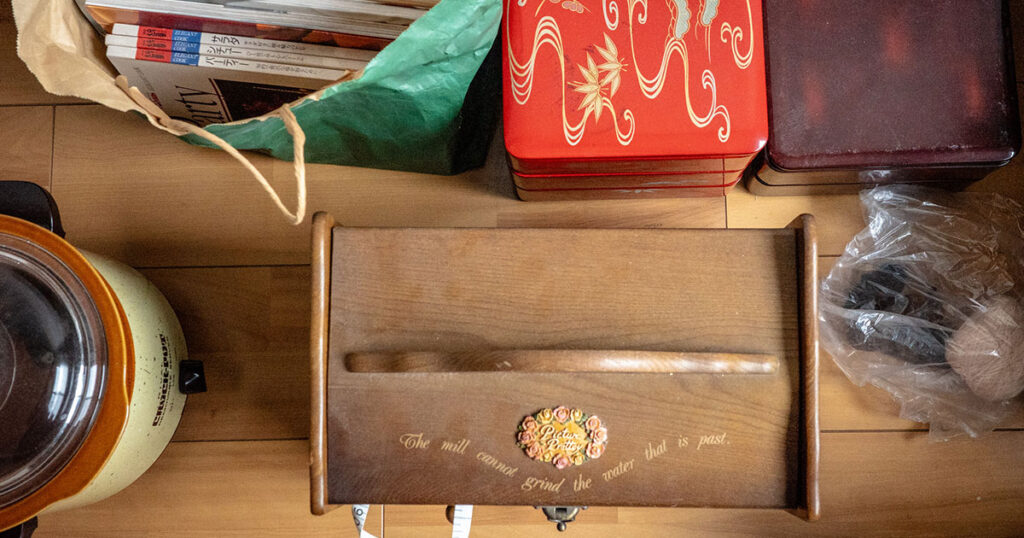
Some lucky few must find it easy to toss things out, lighten their load, simplify their lives. The rest of us do want to reduce the accumulation of stuff, but then we waver between the discard pile and the save pile. A never-used piece of clothing we’ve held onto for 10 years. An old birthday card from a deceased relative. Would it be fair to erase the traces of this person that linger in your life? Or the evidence of that trip to Scotland? Perhaps not, we think, reluctantly adding the card and the sweater to the save pile.
Why can’t we go where our better selves point—down the path through the overgrown field of stuff and into the stubble of a cleared field?
I think it has to do with fear of making the wrong decision. Throwing out cannot be undone, because what’s gone is gone. You need to be very sure. To justify saving, we might reason that it doesn’t have to be forever. Placing an item in the save pile is a stopgap; it gives you time. It isn’t so much a commuted sentence as a stay of execution. We’ll retry the case in a month, after a little more time for careful consideration.
Some saving is different from this insidious postponement. It is saving in the best sense: restoring to the fold. Yes, this cup will remain in use, with a place assured in the cupboard among the other cups. This promise often comes at a cost: A different cup must be sacrificed for the saved cup to remain.
But the majority of pieces in the save pile are not saved in the sense of being recognized as among the chosen; they are saved only in that they are not discarded. They are left in the limbo of “keep for now,” their final fate still unknown. Saving is really procrastinating.
Or is it? Maybe more than procrastination, it is a way to recognize fallibility—a way to rethink a decision, akin to buying a pair of shoes you can return. A smart move.
So putting off a decision isn’t all bad, though it certainly isn’t all good. But what if instead of a series of apologies for saving our stuff, we had a celebration? How might this happen?
Well, suppose, like my mother, you are determined to finally free yourself of stuff. All that clutter on shelves and in corners will be gone. Light and air will flood your home. Dust will still accumulate, yes, but not for long. Dust and cobwebs will be defenseless on the cleared surfaces and in the empty corners. So you ready yourself, and you enlist your daughter to help. Because of course she will be better at throwing out your memorabilia than you are. She won’t be sentimentally attached to it. She will be heartless when you would yield.
Such was our thinking as my mother and I sat down to clear clutter from her house one recent August afternoon. I was with her for my usual summer visit, to talk, read, gossip, debate, compare, complain, and to be the backbone for this most difficult of jobs. “What shall we toss?” was the question. A phrase from my college days came to mind. Tossing was a euphemism for throwing up that I learned as a freshman, specifically tossing your cookies. Sticky, clumpy, half-chewed cookies spewing forth. A stream of lumpy projectile vomit. But couldn’t it be like tossing rose petals at a wedding, or confetti and candy in a parade? Cookies! Flying through the air! Wouldn’t you want to catch a few?
But what if the celebration wasn’t to toss things away, but to toss and catch?
What shall we save, I rephrased, suddenly on the side of the things, not on the side of cleanliness and order. Clean and orderly—sterile and vacant. These objects were the loot of a lifetime—not gold and silver or jewels but, here in my hand, a snapshot of my grandfather in a white suit, so tall and substantial, standing beside my mother, his arm around her bare shoulder, squeezing her to him. She was grinning in her sleeveless black and yellow dress. The occasion was Easter morning, 1964 or ’65.
I’m not in that picture but must be around the corner of the house, if you could just peek: a two-year-old in a pale yellow dress with flounces. The rest of the family in the garden under a tree. Let’s not lose the trinkets and baubles of these lives, the photos and letters and ordinary things that, like stories we retell, are the real family heirlooms, the keys to the past. What good is the stash without the key?