
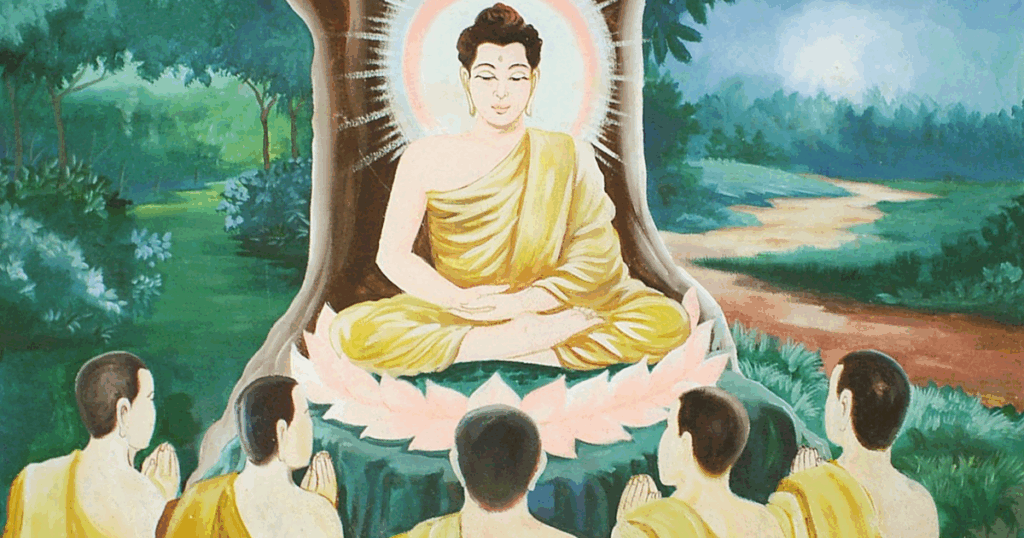
Buddha, Socrates, and Us: Ethical Living in Uncertain Times by Stephen Batchelor; Yale University Press, 352 pp., $28
“Raised in Britain as a post-Christian secular humanist and trained in Asia as a Tibetan and Zen Buddhist monk,” Stephen Batchelor writes at the end of his book, Buddha, Socrates, and Us, “I find that I can no longer identify exclusively with either a Western or an Eastern tradition.” Decades of dwelling in these traditions—each with its own intellectual, spiritual, and philosophical riches—have left him strangely homeless. Far from making him unhappy, though, this state of existential homelessness has given Batchelor access to what he sees as a higher life. For, while “unsettling and disorienting” at times, such “spaces of uncertainty seem far richer in creative possibilities, more open to leading a life of wonder, imagination, and action.”
At its core, Batchelor’s Buddha, Socrates, and Us may be read as a response to a simple, yet important observation: everything in life tends to fall into patterns, to settle into habits and routines. Not even matters of the spirit—religion and philosophy, beliefs and ideas, thinking and writing—seem to escape this fate. Such mindless repetition makes our lives easier and more comfortable, at least on the outside, but to do things mechanically and unthinkingly is to invite emptiness and meaninglessness into our existence. The older we get, the more spiritually ossified we become. Eventually, if nothing challenges us, our slumbered existence will be indistinguishable from spiritual death.
That’s what awakenings are for.
Batchelor focuses primarily on two masters of awakening: Gotama and Socrates. As chance would have it, they were contemporaries, even if they lived worlds apart. For all the cultural differences between fifth-century BCE India and Greece, however, Batchelor identifies a series of compelling parallels, from the merely anecdotical to the more substantive, which makes his book the delight of any comparatist of cultures. His narrative shuttles nimbly between the two figures, between East and West, the Indian world and the Greek one, in a compulsively readable way. Batchelor is not only a seasoned practitioner of Buddhism, and a great scholar of it, but a gifted storyteller to boot.
Central to any awakening is an experience of uprooting and disruption, of unsettling and uncertainty. As masters of awakening, both Gotama and Socrates could not but undergo such experiences themselves. When he was about 30, Gotama famously left everything behind (home and family, wealth and a pleasant life) in search of enlightenment, and he never quite settled down again, not even after he became enlightened (literally, “the Buddha”). One of his memorable exhortations (which Batchelor adopts as his book’s epigraph) reads: “Life is short, live like your head is on fire.” Gotama took his own advice: he was always on the move, an incurable seeker, his life truly a “work in progress.” An essential component of this work was “creativity,” which he regarded as a virtue of the highest rank. In the Buddhist understanding, creativity is “the human capacity to think outside the box of what is tried and tested to imagine something new, whether in the sphere of politics, work, relationships, art, or philosophy. In seeking to do things differently, creativity is the very opposite of reactivity, which seeks to keep everything the same.” As he approached his end, Gotama encouraged his followers not to betray him by settling down and founding a movement in his name, with all the rituals and ossifying routines. He wanted them to stay spiritually fresh and creative, independent of each other, “no two of them to follow the same path.” There is, then, considerable irony in that soon after Gotama’s death, a council of elders, as Batchelor writes, “sought to impose an orthodoxy to which everyone was expected to conform.”
In turn, Socrates knew a thing or two about disruption, unsettling, and uprooting. He thought of himself as atopos, which means both “out of place” and “perplexing.” He may have rarely left his native Athens, but he practiced foreignness at home, vigorously, to the point of not speaking the local Attic dialect. For, as he knew too well, foreignness (real or even feigned) can do wonders when it comes to philosophizing. Your outsider’s status puts you in a certain rapport with those around you, and under the excuse of lack of familiarity with the local culture, codes, and customs, you can subject them to the most rigorous of examinations. In his grand project of questioning everything, Socrates left nothing undisturbed in Athens, no established opinion unchallenged, no Athenian unprovoked. Eventually, he caused so much unsettling in the city that Athenians could no longer put up with him and democratically silenced him for good. (A court infamously compelled him to drink poison hemlock in 399 BCE.) Ever since Socrates’s death by democracy, Western philosophy has been inextricably tied to civic dissent.
It should come as no surprise that, taught by such great masters of disruption and dissent, Batchelor should become a disruptor and a dissenter himself. He was a young man when, unhappy with what the West had to offer him, he traveled by land to India, where he became a Buddhist monk in the Gelug (Tibetan) tradition. Later, not satisfied with Tibetan Buddhism, he went on to study Zen Buddhism in a Korean monastery. That’s where he met his future wife. Upon laicizing and marrying, he moved back to Europe, where he now practices what he calls a form of “secular Buddhism.” Through all this, the relentless seeker has remained himself—assuming, that is, that such a thing as the self exists at all. Batchelor proudly presents himself as someone who “criticizes Buddhist orthodoxy, rejects time-honored doctrines such as the Four Noble Truths, and regards his interpretations of the dharma as closer to the original intent of Gotama than many eminent Buddhist thinkers past and present.” Creative dissent from your masters may be the highest form of loyalty to them.
“I want to make Buddhist and Greek thought more than merely compatible,” Batchelor writes at the beginning of this book. “I am seeking a new language, a synthesis that would transcend the binary of East/West, Greek/Buddhist altogether.” But to find such a voice, he adds, “I first have to come to terms with the Greek and the Buddhist inside me.” The project has taken him a lifetime, and he is still on the road. The delay may be by design, though. For the point of a project like his may be never to settle into a destination, but to keep your head on fire for as long as you can.