
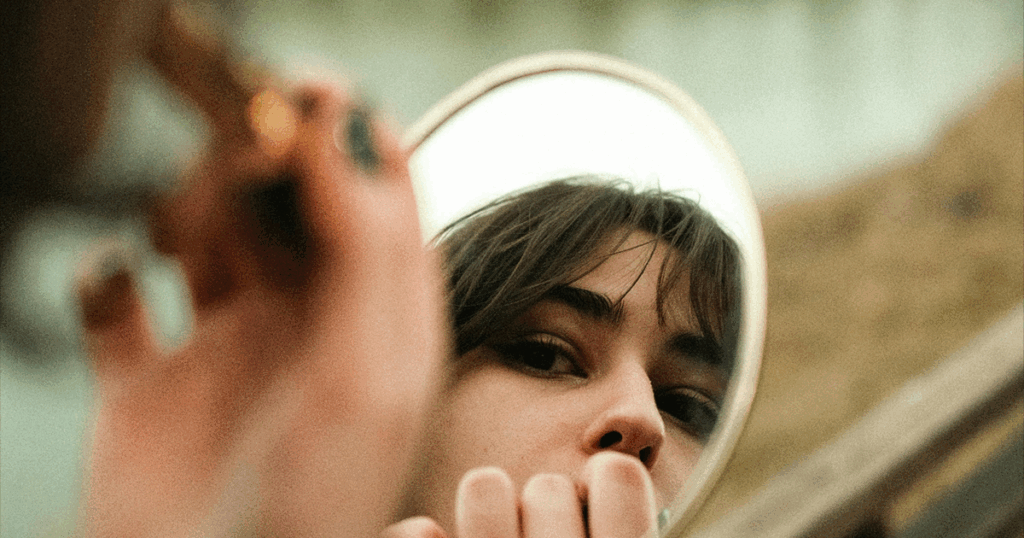
I sometimes wonder what it would be like to truly see myself. To suddenly catch sight of the real me—not just a glance, but a full-on, face-to-face encounter. To come around a corner of a building and nearly run into the woman coming from the opposite direction. In that moment of surprise, I might get a true look at myself. Most other looks—for example, envisioning myself as I am trying to stand up straight and hold my shoulders back—involve me in a collaborative effort rather than in pure judgment. Surprised appraisal, before the usual filters kick in, is best. To assess quickly and acutely this other face-to-face with me, I would need a stranger’s perspective, an ability to see myself without recognition.
Otherwise, how could I keep from either of my two habitual responses: giving scant credit or criticizing too readily? It’s either There you go, acting again when I look good, or when I fall short, Why do you keep doing this? Why do you keep being this way? In both cases, I’m caught in a bind. I don’t deserve credit for the good, and I don’t deserve any excuse for the bad.
I’d like to know the real me, not the me hovering at my shoulder to whisper in my ear her take on everything, including herself. I’m weary of her. Weary of watching myself watch myself, questioning every impulse, every performance. The unexamined life is not worth living, says Socrates, but what about the overexamined life? The one in which every action or thought is scrutinized endlessly?
And yet, I wonder, could the self-scrutiny itself be a form of authenticity? Maybe being aware of my “performance” is genuine, not just another layer of self-involvement. After all, if I comfort a friend and know I’m playing the role of a comforter, does that make the comfort any less real? Maybe there is no difference between trick and trait aside from my approval of the act. Or maybe I’m just going on at enormous length again. Oh, to escape myself!
Running leaves me no chance for overthinking. And a pair of back-to-back races is a fine opportunity to be free of myself. Thus I happily looked forward to a trip to a pair of footraces in Valladolid, the first held on Saturday evening and the second on Sunday morning. But the relief from self-scrutiny doesn’t last. With the races behind us, my running pal and I returned to Asturias, he driving and I relaxing in the passenger seat. At home, I put my running trophies and prizes away, threw my running clothes in the washer, and made a cup of tea. Then, just as I sat down, I got a call. My running partner had arrived home and now wanted to know if I’d seen the pictures he’d just sent of his copilot. “Is it Julia?” I asked, referring to his seven-year-old granddaughter, who often visits him at his place in Gijón.
“No!” he said with glee.
“Oh. Me? Me asleep?”
I knew I had drifted off several times on our return journey. I deserved to—all that running and a first-place trophy in my category for each race! He, in contrast, had been hampered by pain in his Achilles tendon and hadn’t placed. In fact, he’d been rather taciturn, even grumpy, on the drive home. Now, however, he sounded highly satisfied. “You should look,” he said smugly. I did.
There I was in the two almost identical photos, eyes closed, head back, mouth open, face gray. How horrible I looked! I’m not ashamed to say so, but I would not show those pictures to anyone. I called him right back. “Erase those right away!” He assured me he already had. Then I erased them from my phone. I had wanted to see myself unadulterated by my own awareness, like a stranger, and the sleeping me was the closest I have come to finding that stranger. According to some philosophies, the sleeping state is a break in the continuum of personal identity. If so, maybe that sleeping person wasn’t even me. Not until she woke up and groggily asked the driver beside her, “You okay?” As if! As if she were keeping track, doing her job!
The pictures are gone. But they have haunted me. The sleeper dead to the world somehow awakens, turns, either to sink back into slumber or to drag herself out of that pool of forgetfulness. No concern for her aspect motivates her, no curiosity about her whereabouts. The struggle is between the will to do what must be done and the desire to let go. I can watch the drama replay a hundred times in my mind, and I never wonder what the outcome will be. How confident I am! As if I know who always ultimately pulls harder—the one who wants to continue asleep or the one who will soon remember to live.
Meanwhile, someone should really have a word with the driver, surreptitiously snapping pictures while at the wheel. Otherwise the experiment might unexpectedly end. First with a bang, then a whimper. Then silence. I want to escape, but not that way. But if you could tell me, please, how to kill off just my other half?