
The Two Ladies of Vermont
In 1875, the debate over whether to induct women into Phi Beta Kappa exposed a crack in the foundation of Western education
By simple luck, graduation day at the University of Vermont—Wednesday, July 14, 1875—turned out to be “one of the finest days of the summer,” the Burlington Free Press reported with equal parts pride and relief. Less than a week earlier, a tornado had touched down just south of Burlington, home of the university, turning the sky white with hail and shattering hundreds of church windowpanes. But now the winds had calmed, the broken glass had been swept up, and summer had resumed in northern New England.
Commencement exercises always drew a crowd, and interest in this year’s proceedings was especially high: The university’s first women students were to receive their degrees. Already by nine a.m., seniors, families, professors, alumni, and townsfolk had begun to gather on the campus green, a mile uphill from the shore of Lake Champlain. Soon the academic procession would make its way down through the center of Burlington and into the College Street Congregational Church, where the ceremony would begin. Afterward, there would be a banquet at the American Hotel, the finest in town, to be followed by the last and arguably most important event of the day: the president’s annual party, which the university hoped would raise badly needed funds.
Yet even as the celebratory mood built on the green, inside nearby Institute Hall the atmosphere was clouded with unfinished business. There, members of the University of Vermont’s chapter of the Phi Beta Kappa Society had assembled for a most unusual third meeting in less than 24 hours.
The men gathered inside Institute Hall were all distinguished UVM alumni. Each of them had once been elected and inducted into PBK at a chapter meeting very similar to the one they were now attempting to conduct. These men had about an hour to resolve what a circumspect report in the Vermont Phoenix described matter-of-factly as an “interesting question” that had come up the day before. The question had derailed the society’s first meeting the previous day, stymied another in the evening, and had so far prevented the PBK members from doing what they had come to do. And now time was running out.
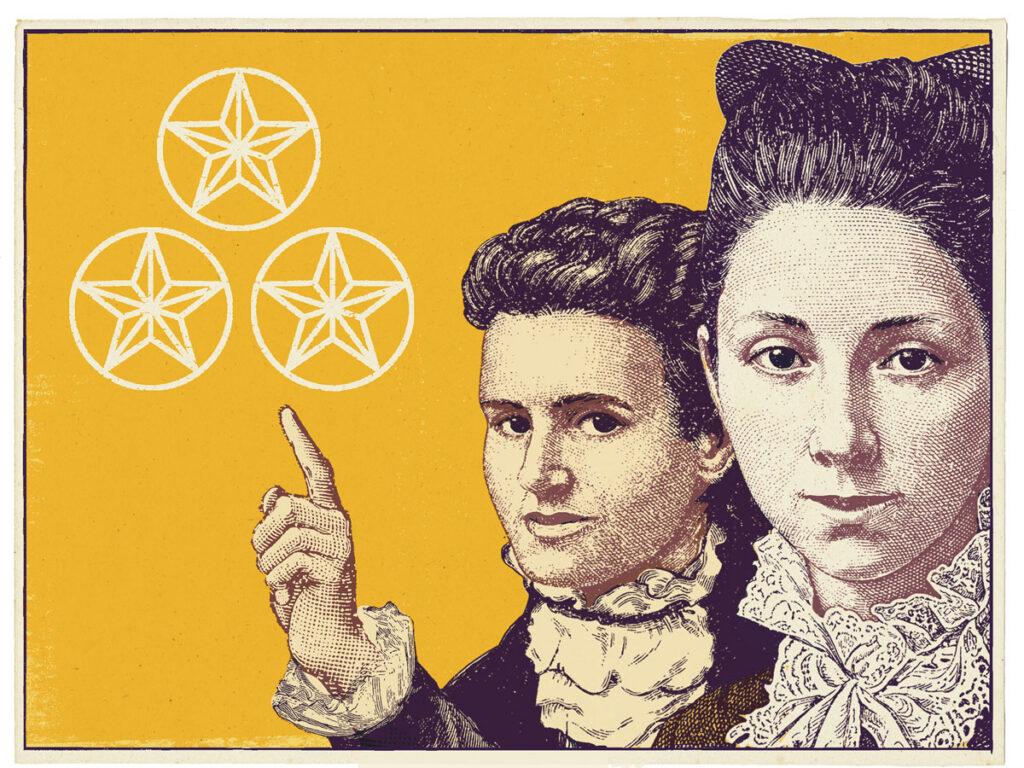
Phi Beta Kappa had been founded nearly a century earlier, in winter 1776, by five students at the College of William & Mary in Williamsburg, Virginia. The students first met in the Apollo Room of the Raleigh Tavern to hold wide-ranging discussions under the cover of public conviviality. Their membership was secret, like many other societies on campus and off, because secrecy allowed for freedom of thought and speech. Together the members debated “the advantages of an established church,” “whether any form of Government is more favourable to public virtue than a Commonwealth,” and “the justice of African slavery.” To distinguish themselves, they issued square silver medals bearing “SP” on one side, for Societas Philosophiae, and on the other, alongside three stars of friendship, morality, and literature, “PBK,” for Philosophia Biou Kybernetes, or “philosophy as a guide to life.”
From the outset, even when its numbers were small, the Phi Beta Kappa Society’s purposes were large: the “advancement of sound learning in our country,” not to “be confined to any particular place, men, or description of men.” By 1779, the Virginia chapter had extended charters to Harvard and Yale, forming a “Foundation of Continental Harmony and Union.” Over the next decades, PBK chapters had opened some events to public view (to combat suspicion of secret societies) and turned management of elections and occasions over to faculty (to keep up a scholarly reputation). Perhaps the most famous public PBK address is still “The American Scholar” (from which this magazine takes its name)—Ralph Waldo Emerson’s 1837 address to Henry David Thoreau’s graduating class at Harvard. By the 1840s, PBK was no longer a tavern debating club for undergraduates but an honor society—and not just any honor society but “the honor society of American academe,” as Richard Nelson Current put it in his diligent 1990 study, Phi Beta Kappa in American Life. By design, and through no little effort, PBK had come to represent an entirely uncontroversial standard of academic excellence and intellectual achievement.
The UVM chapter—chartered in 1848 as Vermont’s Alpha chapter (that is, the first in the state) and the 11th in the country—had always taken this standard seriously. Once a fortnight, its members met for discussions and lectures. The only rule was that “subjects of a partisan character,” whether political or religious, were entirely forbidden. Yet now, in the summer of 1875, this was precisely the sort of question the Vermonters were facing: highly partisan, and in some ways both political and religious. And though this question had been the subject of widespread and often bitter public debate for years, it nevertheless seems to have taken the members of the Vermont chapter by surprise.
The annual meeting of the UVM chapter of PBK had begun the day before, July 13, in the usual way. The society’s vice president—the Honorable Homer Hibbard, who had graduated from UVM in 1850 and made a career in banking in Chicago—called the group to order. He was standing in for the absent president, the Honorable George Benedict, class of ’47, a decorated Union veteran, a dedicated Republican, a former Vermont state senator, and the editor and publisher of Burlington’s most important newspaper, the Free Press. After the call to order, the chapter’s registrar, Professor J. E. Goodrich, who taught Latin, reported the standing of the year’s graduating class. Normally, the names of the highest-ranking students were put forward for election. Normally, those elected were then inducted at a second meeting held later the same day or the following morning.
But 1875 was not normal. The first student in rank of the class of 1875, comprising only 12 undergraduates, was Alfred Nathaniel Tagert. And that was as far as normal went, for the second in rank was Lida A. Mason. And the third student, tied with Frank Edward Woodruff, was Ellen E. Hamilton.
After these names were read, Selim H. Peabody, class of ’52, president of the UVM alumni association and a professor in Chicago, set off what later would be described as a “bomb” in the chapter meeting by moving “that persons eligible on the grounds of scholarship be admitted to membership without regard to sex.”
The proposal had no precedent. No woman had ever been elected to PBK at UVM or anywhere else. In fact, UVM was the first college with a PBK chapter to admit women to the same course of study as men, and Mason and Hamilton were the very first women to qualify for graduation there, having started on campus as sophomores in 1872. Both had amassed outstanding academic records, yet no anticipatory or peremptory steps had been taken to prepare for their graduation by the UVM chapter or any other.
Phi Beta Kappa then had chapters on 22 campuses around the country but lacked a central organizing body to set policies for the society at large. The chapters tended to consult one another when a question of policy or propriety arose, but this was an informal, unreliable process. The members of the UVM chapter had a decision to make about Mason and Hamilton—a decision connected to one of the most divisive social questions of the day—and they were effectively on their own.
On the one hand, there was no fixed rule that would have obligated the UVM chapter to elect and induct women. During the lean years on campus that followed the Civil War, when graduating classes sank low into the single digits, the PBK chapter secretary at UVM had written to his counterpart at Harvard to ask whether a required number of students needed to be inducted each year. The reply came back that there was no such quota, and in fact, small induction groups often proved to be quite congenial. In 1866, when there had been only three graduating seniors at UVM, just one was elected to PBK. Speaking just in terms of numbers, the members of the Vermont chapter were under no special obligation to induct anyone other than Tagert, the first-ranked student. On the other hand, even in the absence of a quota, students had conventionally been inducted in proportion to the size of the graduating class—the top third, for instance. Would deviating from that custom be viewed as an act of cowardly demurral?
In those days, Vermonters were often thought to be practical people who had learned through hard lessons of farm labor and long winters to value independence and to view women’s work as essential—and therefore likely to be sympathetic to campaigns for women’s rights and equality. In 1870, the American Woman Suffrage Association had held its national convention in Montpelier, in part for this reason. What would the state’s no-nonsense residents and newspapers say if PBK denied honors to a deserving student, Frank Woodruff, simply to evade the question of the eligibility of women? And if Woodruff got in, how could it be fair to exclude Mason and Hamilton, who had respectively bested and equaled him in the same course of study? Would inducting the women change the standing of PBK on campus and beyond? Were women even permitted to belong to fraternal organizations?
With those questions looming, Peabody’s motion to induct the women sparked “animated discussion” of precisely the sort the UVM PBK chapter had always sought to avoid. With the members divided, Peabody’s motion was “laid upon the table,” unresolved. Then Robert Dewey Benedict, the brother of the absent chapter president, brought the meeting back to order. He was a lawyer, a judge, and a member of a prominent Burlington family that had been closely connected to the university for generations. As a lawyer, Benedict would have been well acquainted with the usefulness of precedent in smoothing unruly present complexities, and he spoke up to propose a workaround. He suggested that the chapter go ahead and vote “for the two gentlemen who stood highest in the class.” Technically, it could be said that in past years, the members had also voted for and inducted the “gentlemen who stood highest in the class”—for in all prior years the class had been composed entirely of “gentlemen.” Under Benedict’s proposal, the men would be treated as they always had been, while the women would also be treated, in effect, as they always had been: as if they did not exist.
In response, G. L. Waterman, another Burlington lawyer, proposed an amendment to the motion that directly contradicted it: to add to the ballot the names of the two women who had made themselves eligible by virtue of their high scholarly achievements, and who after all did exist. Quickly this suggestion was struck down as out of order. Benedict spoke up again on behalf of his original motion to vote for the men. It passed, and their names were put to a vote. Alfred Nathaniel Tagert and Frank Edward Woodruff were elected to Phi Beta Kappa.
A publicly presentable, plausibly defensible outcome having been attained, Benedict now proposed two further resolutions. First, a formal statement to the effect “that in the opinion of this chapter all the graduates of this University should be eligible to membership in the PBK without distinction of sex.” Second, “that the Corresponding Secretary be directed to communicate the action of this chapter and a statement of the situation which occasioned it, to the other chapters of the order.” With another vote, these resolutions passed. From one perspective, these were progressive, fair-minded measures befitting men of learning and liberal values. From another, they were tinsel: mere window dressing to distract from the society’s inaction. With the membership still split, and Peabody’s motion still on the table, plans were made to reconvene that evening in the parlor of the College Street church, and the meeting was adjourned.
In most years, the UVM chapter of PBK held only two meetings: one for election, and the other for induction. Yet when five o’clock arrived and the members reassembled at the College Street church, they found themselves still unable to resolve Peabody’s earlier motion. The chapter secretary’s minutes say nothing of the substance of the meeting. No progress could be made toward a vote on the women, and no inductions were performed that evening. The members could only agree to adjourn once more, retire for the evening, think over the questions they faced, and gather again in Institute Hall at nine o’clock the following morning, for, at least, the induction of the men.
When Lida Mason and Ellen Hamilton graduated from the University of Vermont in the summer of 1875, few women in the United States had ever been publicly, formally honored for academic achievement and intellectual distinction by a national institution such as Phi Beta Kappa.
In 1841, naturalist and artist Lucy Way Sistare Say was inducted into the American Academy of Natural Sciences in Philadelphia. Six years later, Maria Mitchell of Nantucket discovered a new comet, and in 1848 she was awarded a gold medal by the King of Denmark, a passionate amateur astronomer. Later the same year, Mitchell was inducted into the American Academy of Arts and Sciences in Cambridge, Massachusetts, which would not induct another woman for nearly a century. In 1869, the American Philosophical Society also honored Mitchell, alongside Mary Somerville and Elizabeth Cabot Agassiz, as its second, third, and fourth women members, respectively. Its first woman member had been admitted 80 years earlier, when Benjamin Franklin nominated the Russian Princess Dashkova, president of the Imperial Academy of Russian Language, which she had founded with her friend Catherine the Great.
That short record of honors underscores what was at stake for the Vermonters. Mason and Hamilton were not merely two extraordinary individuals. As the first women graduates of the University of Vermont, they had achieved success that represented a larger shift. Oberlin had first admitted women on a coeducational basis in 1837, and in the years since, perhaps a quarter of the colleges in the United States had followed, but the change had not yet been widely felt in the world beyond campus. In 1870, there were perhaps 525 female physicians (out of more than 60,000) in the United States, and only five female lawyers.
Women wanted more. In 1873, while a professor of astronomy at Vassar, Mitchell had helped to found and lead the Association for the Advancement of Women, advocating especially for greater access to higher learning. Education was often seen as a proxy for other ongoing campaigns for women’s rights and equality—the rights to vote and to own property, and for marital rights, including divorce—and a referendum on women more generally: what they were capable of, who they could and should be. This was not only an “interesting question.” It was also, acknowledged Matthew Buckham—the president of the University of Vermont and himself a UVM PBK, class of ’51—a “much agitated” one.
In 1872, Buckham had presided over the admission of Lida Mason and Ellen Hamilton to UVM. Reviewing their outstanding academic records three years later, members of the university’s PBK chapter found themselves standing before a crack in the bedrock foundations not only of their honor society but of Western culture as well.
Two hundred and fifty years ago, the five teenage founders of Phi Beta Kappa named their association with Greek words and letters, making it the first such Greek-letter society in the country, because they had been taught to see ancient Greece as the highest ideal of civilization and learning. One founding member, William Short, went on to serve as private secretary to Thomas Jefferson, who had attended William & Mary in the 1760s. Jefferson, like many American elites of his time, also venerated classical Athens, a slaveholding society in which public life was the exclusive domain of men, as a model for the political and social systems of the United States.
Mason and Hamilton entered the University of Vermont in an age of bold challenges to the unequal institutions Jefferson and his colleagues had created. The 14th Amendment, passed in 1868 to protect formerly enslaved freedmen, affirmed birthright American citizenship and extended to all citizens the same unalienable rights to “life, liberty, or property.” This formulation in turn seemed to open new possibilities for contesting longstanding forms of discrimination, including those that had kept women out of the center of American public life.
But in the spring of 1873, as Mason and Hamilton were finishing their sophomore year in Burlington, the U.S. Supreme Court upheld an Illinois law barring women from practicing law, on the principle that a woman’s place, and her responsibilities, were in the home. Two years later, while Mason and Hamilton were in their last semester, the Court concluded that the franchise was not a right inviolably conveyed by citizenship, effectively denying women the ability to vote in national elections.
Obstacles to women’s equality were built into every level of American life. In 1875, PBK induction still required a demonstrated strength in Greek and Latin languages and literature. Even as more women attended college in the decades after the Civil War, however, most of them trained in separate academic programs designed to prepare them for teaching young children rather than for classical scholarship.
An Athenian ideal of the woman’s sphere as separate from and junior to the public realm of masculine life shaped not only the institutional structures of American education but also the very substance of its lessons. For Aristotle, whose works on ethics and politics were standards of the classical curriculum, women were like men in most respects but lacked the highest capacities of the soul, including advanced reason, and were therefore terminally inferior. “Phi Beta Kappa” stood for “philosophy as a guide to life,” but much of the philosophy available to the members of the Vermont chapter in the summer of 1875 did not fit the questions now before them.
Even if the UVM chapter had been able to immediately consult one of the other chapters to which it was accustomed to showing deference, especially Harvard, it might not have received a ready answer, for Harvard had no women students. The school that would become Radcliffe would not be founded until 1879. The tradition of discrimination that emerged from the celebrated schools of ancient Athens had been carried forward to the modern classrooms of Cambridge, Burlington, and beyond, where very many well-educated men, including those who had achieved the highest levels of academic distinction then possible in the United States, fiercely held onto its tenets, even in the face of accumulating evidence to the contrary.
Where is Vicksburg? Calcutta? Staten Island? How do you get from St. Petersburg to Sevastopol by water? What nouns form their plural in –es? Find the least common multiple of 10, 25¼, 2½, and ½. Who were the Nereids? Translate Book 1 of the Iliad, lines 503–10.
When Ellen Hamilton of Brandon, Vermont, took the test for admission to the University of Vermont in 1871, her examiner was Professor Henry W. Haynes, who was as classical as they came. Haynes sent the results of Hamilton’s exam to UVM President Matthew Buckham, who had taken office just weeks before. In turn, Buckham passed Hamilton’s results to his predecessor, James Angell, then starting a new job as the president of the University of Michigan, which had begun admitting women a year prior. Hamilton, Buckham reported to Angell, was “as good as the best we have.” He meant men, for at the time the University of Vermont had no other women.
And then, in 1872, they had two. Lida Mason, of Jersey City, New Jersey, started first, in January 1872. For one chilly semester, she was the only woman student on campus in Burlington, and she seems to have felt that her male classmates viewed her as a kind of “monster.” That was merely one variety of discomfort. Reporting on the admission of women to UVM, the newspaper in nearby St. Albans noted with a leer that the “only shadow of regret athwart the glory is that our college days are over.” In a letter to trustees, UVM President Buckham acknowledged that Mason’s position on campus “was a trying one.” Perhaps it improved slightly when Hamilton joined her in the fall of 1872. Yet for as long as they were UVM students, Mason and Hamilton were also living spectacles, and symbols of the question of women, on campus and in the world.
Despite those pressures, they shone. The University of Vermont required each sophomore, junior, and senior to give a public speech at the end of the academic year. When Mason was abruptly called out of town in April 1873, Hamilton was left as the only woman in that year’s sophomore exhibition, and the first woman ever to speak at the university’s public exercises. The Burlington Free Press reported that she “took her place upon the stage with modest self possession, and read from her manuscript titled ‘Socratic Arguments for the Immortality of the Soul,’ an essay which was more like a Senior than a Sophomore piece, acquitting herself so creditably that the question, if there was any, of the propriety of the young women taking their share in the College Exhibitions, must have been set at rest in the minds of all present.” Yet such questions are rarely if ever set at rest, and when the next year’s public exercises came around, the women were again a novelty. The Free Press reported: “A peculiar feature of the occasion was the first appearance, at a Junior Exhibition of this University, of ladies, who acquitted themselves creditably.” Hamilton’s address was “A Day in Athens, 444 B. C.,” and Mason gave a talk titled “The Puritans and Art.”
Hamilton for one had been brought up to stand out, but only in ways befitting her sex. Her father was a homeopathic physician who encouraged her to strive for membership in the universal brotherhood of man—at the same time maintaining that a woman was supposed to be “a light set on a Hill. A check to the passions of man … Worshiped by her Husband. Adored and honored by her children.” When Hamilton was just starting at the university, he told her to “cultivate all the graces that make a woman lovely.”
By all indications, both Hamilton and Mason did so. For years after graduation, they would fondly recall the friendships they had made with male classmates and teachers. Yet in their hours off from school, they were most strongly drawn to each other, and later to the few women students who joined them on campus in the next two years. UVM had no dorms for women, so Mason and Hamilton boarded with local families who had been approved by the administration. Hamilton lodged at the home of a local merchant, while Mason lived in the brick parsonage of the First Baptist Church with the pastor and his family. The two spent many afternoons by the hearth of the parsonage, talking, laughing, and above all studying. Together, they were doing something for which the university had not planned. They were excelling.
The University of Vermont had not admitted women so that they could be excellent. It had admitted women because for the entirety of its early history, stretching back nearly a century, the university had experienced severe shortages of students and money. To make matters worse, the comparative financial success of nearby Middlebury College meant that in the mid-19th century, merger was often proposed as the best course of action in a state that counted about 25,000 farms and 314,120 people.
Then came the Civil War. More than 30,000 Vermonters served in the war, and more than 5,000 died—an unusually high proportion of the state’s population. As a consequence, the university itself nearly perished. In 1861, 25 men had graduated from UVM. In 1866, three did. The fence around campus was falling down. The green could have been a hayfield. Faculty salaries had been sharply cut, but even so, university bank accounts were empty. When Middlebury considered admitting women students early in 1871, UVM had virtually no choice but to do the same.
On August 1, 1871, all but two of the university’s 18 trustees voted to admit women. The holdouts were concerned that “the admission of women students would raise questions about the rigor of the University’s reputation, perhaps making it in some people’s eyes a mere ‘bundle of whimsies.’ ” The dissenters worried that women were reaching beyond their proper sphere, and that college training might “ ‘addict’ them to professional life” and thereby pull them away from their homes and families. One trustee, the Reverend C. Carroll Parker, feared that college courses would prove too strenuous for “the womanly mind and womanly physique” and cautioned that the “attempt” to educate women at UVM would be “perilous in the extreme.”
Those prejudices were so widespread that they were often mistaken for biological facts, even by proponents of coeducation. For instance, the St. Albans Messenger concluded that women at UVM would probably be just fine in the end because Burlington, unlike Boston, was generally safe. And in truth the last thing the trustees of UVM wanted was to “educate women ‘into men.’ ” Instead, they wanted women to gain “a higher standard of intellectual culture” to pass on—at home, to their families, and in schools, to their students. If this came to pass, as UVM President Buckham put it not long after taking office, the “experiment” of coeducation, “and the sacrifice, if any there be, will not have been made in vain.”
Buckham and others worried that life on campus might prove too much for the women who entered their university. Yet never did any of UVM’s trustees, administration, or faculty go on record to raise the possibility that the women they admitted might come to view the university’s existing academic culture as unsatisfactory.
The first female students at the University of Vermont pursued their own ideas of “the womanly mind.” In 1874, Mason, Hamilton, and the few other women on campus founded their own Greek-letter organization, Alpha Rho. They felt a “need of a more general culture than [was] afforded by one curriculum of study.” They wanted “a wider sympathy with the progressive spirit of the age; a more extensive knowledge of the results of modern thought.” They wanted “the contact of mind with mind in the mutual comparison of ideas and friendly criticism.” They found none of these things on campus in sufficient measure.
Alpha Rho met in the Women’s Reading Room, which hadn’t existed before the members asked the university to create it. There they maintained subscriptions to Popular Science, The Atlantic, Harper’s, and the New York Weekly Tribune, alongside copies of Webster’s Dictionary and Smith’s Dictionary of Antiquities. They performed Shakespeare. They presented essays to one another, including an imagined “Speech Before the U.S. Senate,” and a commentary on “Bad Grammar and Slang Overheard in and Around the University of Vermont with names of Students and Professors Using the same.” After one debate, the members of Alpha Rho decided that women should be permitted to speak from the stage of the university chapel, as men were. But they were hardly radicals. After another debate, they concluded that the Bible should be read in public schools. They deemed the fashions of their grandmothers preferable to their own. Individually and together, they found their voices.
In March 1874, Mason, Hamilton, and other members of Alpha Rho put their names on a women’s petition for temperance that was published in the Burlington Free Press and addressed to the city’s men:
We appeal to your regrets over miseries that are now past remedy, to your sympathy towards sorrow that you now can relieve. … We ask you to believe that we have not been eager to put ourselves forward in this movement. We have long been waiting, hoping that the work would be done by you, and now while we are willing to assume our share of the responsibility, we ask you to join us in undertaking the work which you and we have already too long neglected …
The point of such petitions was to use the collective voice and the public forum to say what was riskier and more difficult to say in private.
In its exasperated and downcast depiction of men, the petition to ban the sale of alcoholic drinks sketches a picture of life on campus for Mason, Hamilton, and other women students at UVM that opens another perspective on the proceedings of the PBK chapter in July 1875. Though coeducation was often framed as a referendum on the abilities of women, it was just as much a referendum on the men who had got there first. The “interesting question” faced by the members of PBK at UVM was not just about the achievements and eligibility of Mason and Hamilton, or even about the proper station of women more generally. With a very old system—one that had always been slanted in their favor—showing cracks, how would the men respond? Would they attempt to dismantle the old institutional disadvantage women had faced? Would they try to reinforce it where it stood? Or would they simply stand back and watch and wait for whatever was to follow?
Perhaps, as members of a society with 21 other chapters, including many that were older and arguably more venerable than theirs, the Vermonters simply believed that the election and induction of women to PBK, whatever it would ultimately signify and precipitate, lay outside their jurisdiction and beyond their authority. Yet if they had come to campus in the summer of 1875 expecting to enjoy the luxury of abstaining from the question, they were bound to be disappointed, because Selim H. Peabody would not give it to them.
At nine a.m. on July 14, with the day’s commencement ceremonies set to begin in an hour, the members of the Alpha Chapter of Vermont reconvened in Institute Hall to take up once more the “interesting question” that Peabody’s motion had forced before them, and which they had so far been unable to resolve. Yet overnight something had shifted. Peabody seems to have continued his campaign for electing women through the previous evening, for in the morning he was named president pro tempore and installed as the society’s chair.
Perhaps Peabody was in a unique position to understand what life on campus had been like for Mason and Hamilton. Three decades earlier, during his own student days in Burlington, he had been an outsider too, poor and lonely. For his entire first semester, no other student entered his embarrassingly spartan room, furnished only with a plain bed, chair, and desk. Yet even while surviving on a barrel of hard crackers and foraged apples, Peabody thrilled to his studies and dreamed of being a professor. He graduated third in the class of 1852 and was elected to PBK. The same year, he married and began teaching.
In adulthood, Peabody found a way into university life that had been closed to him as a student: He became president of the UVM alumni association. In July 1875, Peabody had come back to campus in this role—to attend the annual meeting of PBK, to sit onstage during the commencement ceremonies, and to speak at the fundraising banquet to follow.
With Peabody now presiding over the Alpha of Vermont, his motion from the previous day was raised from the table: that eligible students be considered for election to PBK without regard to sex. This time, the proposal was brought to a quick vote, and it passed unanimously. Lida Mason and Ellen Hamilton were put up for election, and they were voted in.
Though the action of the society was now decisive, the outcome had not been a foregone conclusion or a mere formality. Neither Mason nor Hamilton had been summoned to Institute Hall that morning for induction, as their male classmates had. As a result, with only minutes to spare before the commencement procession was to depart, Alfred Tagert and Frank Woodruff were inducted into PBK, while the women would again have to wait.
Once the academic procession made its way downhill from campus into town, where a standing-room-only crowd was waiting in the College Street church, President Buckham opened the day’s ceremonies from the pulpit. First were student presentations, with Mason and Hamilton slotted near the end, just before Woodruff and Tagert. Mason’s address was titled “True Excellence: Conformity to Principle”; Hamilton’s, “The Value of an Appeal to Common Sense.” “The essays of the first young lady graduates were good,” reported the Burlington Sentinel, with “Miss Hamilton deserving especial praise.” A correspondent for the New-York Tribune thought that the whole program attained “a standard higher than in former years; a standard which would task well some of the Phi Beta Kappa men of 20 and 30 years ago to reach.” Each speech was greeted with applause and flowers, and “the two ladies” in particular were “literally covered with floral offerings,” Mason with a basketful of flowers, and Hamilton with a bouquet two feet in diameter.
When public exercises concluded at two p.m., the president, trustees, and distinguished guests moved on to the American Hotel for the banquet. After dinner there were more speeches, the last of which was given by Peabody, in his capacity as president of the alumni association. “We find now the beginning of a new era,” he said. “For 70 years the old order has prevailed; on the 71st we have a new sort of graduates. There are women among them—and I use a term, the holiest, noblest and sweetest I can employ—whose scholarship is proved by their record.” For Peabody, scholarship mattered more than biography—almost. He went on:
I am happy to say that the Phi Beta Kappa, this morning, reconsidered their dilatory action of yesterday, and placed the names of the women, too, upon their roll. These graduates show themselves thinkers; they speak easily and bear themselves gracefully—they take their place among their brothers—and we welcome them to a place among the Alumni. Let the women have whatever we have of good and of culture; they are to mould and educate the children—and all his life long will the man talk the tongue he learned when little at his mother’s knee, his mother-tongue. I believe that the Institution is to be congratulated on a step forward, and that it will reap abundantly from the seed now sown.
After the banquet, at five p.m. in the parlor of the American Hotel, while the president’s annual graduation party was getting underway, the UVM chapter of PBK convened for the fourth time in that unusual year. Elected that morning, celebrated at commencement, and just recently mentioned in fundraising appeals, Lida Mason and Ellen Hamilton were finally inducted into Phi Beta Kappa.
Being honored by a society, no matter how distinguished, is different from being honored by society.
As Peabody recognized, Mason and Hamilton had proven themselves to be as good as the best male students at the University of Vermont—and yet they were not equal, especially off campus. The coeducational “experiment” had succeeded on precisely the terms it aimed for. It had not turned women into men. Instead, it prepared women to better do the things that women were then permitted to do. Just as Peabody had said, women graduates were meant “to mould and educate the children,” and they had little choice in the matter. There was one career path for women after college—teaching—and it ended either in marriage or in retirement, and often in both at once, for married women were generally not permitted to teach, lest their classroom duties impinge on their domestic ones. This was “the marriage bar.”
After graduation, as they began teaching, Mason and Hamilton kept up their friendship by mail. Across the first years of their new lives, their letters express frustration with their limited options through gentle disapproval of each other’s choices.
Mason taught for a year in Burlington and then married a dentist, S. D. Hodge, whom Hamilton didn’t much like, at least at first. Hodge bought the downtown parsonage where the women had spent so many afternoons studying together, and he and Lida made it their home. When Hamilton finally visited them there, she softened on Hodge and observed Lida in a new role: “busy little housewife,” as Hamilton put it in a letter. “All of her earnestness and talent is tuned now to keeping the home bright and pleasant.” Lida had been trying to keep up with her reading, working through Faust with a fellow Alpha Rho and UVM graduate, but then the latter went off to teach high school in Cleveland.
Hamilton took the other path, sticking to her teaching and, in 1878, becoming the first woman to earn a master’s degree at UVM. At the same time, she carried on a tentative courtship with their classmate and fellow PBK inductee Frank Woodruff, who had gone on to study at Union Theological Seminary. As it happened, Lida wasn’t wild about Hamilton’s choice, either, until Woodruff stopped to visit her at the parsonage on his way through Burlington. Then she saw how much he had matured in manner and appearance in the few years since they had graduated. “You must get domesticated my dear,” she wrote to Hamilton. “Not that I think you wild exactly but you have taught long enough.” Each woman viewed the other’s chosen path with skepticism.
Yet Woodruff was proving hard to pin down. Letters he wrote to Hamilton after graduation rebuffed even her modest intimacies, saying that she had mistaken their friendship for love. While Woodruff studied in New York and then Europe, calling himself a “Cosmopolite,” Hamilton stayed near her childhood home in Vermont and taught school. In letters, she confided to Woodruff how eager she was to “forget that [she] was a teacher,” and to “throw off all responsibility and assumed dignity which is exceedingly disagreeable to me,” and to be “my real self. Have I ever mentioned to you our Shakespearean readings?”
Over years of letters, Woodruff’s reluctance to commit softened into apologies for his coldness, and then into declarations of love and a marriage proposal. In spring 1882, nearly seven years after their graduation, Hamilton sailed to join him in Europe. While Woodruff completed his doctorate, she learned to paint plates. While he traveled to Athens, she stayed in wintry Berlin. Sick and lonely in January 1883, she joined him in Greece, and finally they were married at the home of the American ambassador in Athens.
When the two returned to the United States at the end of 1883, Woodruff was ordained as a minister and took a chair in sacred literature at Andover Theological Seminary. The next year, they had their first child. “Ask Ellen what in the world she is ever going to do with a baby,” Lida wrote in congratulations to the new father. “Tell her that she must not tie it in the highchair before it is a week old.” Three years later, Woodruff accepted a professorship of Greek language and literature at Bowdoin College, in Brunswick, Maine. Woodruff would become the college’s longest-serving professor while also serving a term as the town’s superintendent of schools and, in 1920, winning election to the Maine state legislature. When he died of a heart attack two years later, the Bowdoin Orient published an obituary lauding his many and varied accomplishments but made only slight mention of the other third-ranked student in the UVM class of 1875: “He is survived by his wife.”
Being honored by a society is different from being honored by society—but isn’t that the very point of a society? To celebrate and advocate for the wider recognition of a special set of values so that they might in time reshape society at large? The election of Lida Mason and Ellen Hamilton to PBK in the summer of 1875 did mark a historic transformation in American education and life, though not the sort of transformation that the advocates of coeducation—or its opponents, for that matter—had predicted.
By 1883, eight years after the induction of Mason and Hamilton, only 23 more women had been inducted into PBK chapters nationally. Ten of those had been at UVM, eight at Wesleyan, and five at Cornell. Yet as college attendance in the United States took off in the late 19th century among men and women both, the number of women PBK inductees increased at a rate that first seemed disproportionate, then ominous, and then perilous. By 1900, 532 women had been elected to Phi Beta Kappa, including 179 who had been elected retroactively as alumnae of Vassar, which gained a chapter in 1899. In 1913, the numbers of new inductees were nearly equal—567 men and 563 women—but then the balance tipped, even before war took many men away from college. In 1914, at the 51 coeducational colleges with chapters, 770 women were elected, compared with 603 men. In 1918, women made up nearly two-thirds of new members in coed chapters.
For the leaders of Phi Beta Kappa, which had in 1883 formed a national governing body, this was nothing short of a “crisis” that jeopardized its standing as an elite honor society. They feared, as the author of a 1910 book on the Great American Universities put it, that in “coeducational institutions, if [PBK] is to be awarded strictly according to grades, it is apt to be monopolized by the more diligent sex and goes by the name of the ‘woman’s club.’ ” In this case, “diligent” was not a compliment. The implication was that women, unlike accomplished young men of active and diverse interests, had nothing better to do than homework. No one would want to join the “woman’s club.”
In 1916—the same year the first woman took her seat in the U.S. House of Representatives—the Secretary and Treasurer of Phi Beta Kappa, Oscar Voorhees, suggested that the “preponderance of women” was due not to the academic superiority of women but to an uneven playing field: “A larger proportion of women than men … take the courses now accepted as leading to eligibility.” Long ineligible, women were not merely joining in but crowding men out. PBK’s existence, Voorhees concluded, was in peril.
However well women performed in classrooms, the world off campus was still mostly closed to them. Top collegiate honors were thus going to women students who were largely blocked from elite professions after college. This not only made for a strange, dissonant scene at graduation time, it also meant that the majority of PBK inductees would never earn large salaries that could fund annual donations or occupy public positions that would reflect prestige on the Society. Voorhees believed that PBK’s “reputation must come from its men [rather] than from its women members. The way must be kept open to the men …” To that end, he proposed that the standards of membership be altered to favor men: a shift away from classical academic rigor toward a broader social fluency of the kind valued, for example, in business and other male-dominated fields.
Today, nearly 250 years after the founding of PBK, male enrollment and graduation rates lag well behind those of women. Seventy percent of high school valedictorians in the U.S. are female. Almost 60 percent of college students are women. The contemporary “crisis” of men and boys, in higher education and beyond, has sparked new proposals to recalibrate the structure and focus of the American education system. But as the UVM chapter’s debate over its first female members shows, for at least as long as women have been permitted access to coeducation, men have struggled to come to terms with women’s achievements, fearing to find themselves falling behind. And so, as Voorhees suggested, men have tweaked the system to keep pace and stay ahead.
In 1919, PBK appointed a national committee to address the crisis it perceived in its membership. The committee found that many chapters had already adopted a workaround. In 1900, Brown University had set up a separate women’s PBK section for graduates of its sister college, Pembroke, so that “membership therein should in no wise diminish the number of men eligible for election.” In 1901, Columbia did the same for Barnard students. Many small colleges, including Middlebury, had also begun segregating elections by sex: inducting a fixed percentage of male students alongside an equal percentage of female. The national committee recommended this strategy be adopted widely, though final decisions would be left to the individual chapters.
Following the induction of Lida Mason and Ellen Hamilton in 1875, the University of Vermont chapter never again formally sectioned off women and men. Yet for the rest of the 20th century, in chapters on many other campuses around the country—including Harvard, where the practice continued until 1995—Phi Beta Kappa honors would be separate but equal, because men and women were not.