
My first rattler was in southwest Colorado, at the ranch of some friends. I was on horseback and never got near the snake. My second and third came half a century later. The two snakes were entwined in the middle of the trail, engaged in a mating ritual, apparently unaware of my running partner and me pounding down an old jeep trail in the Magdalena Mountains, headed directly for them. But we saw them. It took just seconds to come to a full standstill, staring at where they lay, a ropey, writhing mass of flesh, 10 feet ahead of us. “Look! Look! That’s the rattle! There’s a head!” we exclaimed. My friend wanted a picture. I wanted to get away.
Snakes do not scare me particularly. In Asturias, where snake encounters and bites are rare, the snakes are small; few are venomous. What I’ve seen mostly are grass snakes—no bigger around than my thumb, and reclusive, never a threat. I watch them slither away.
But triple the size, and I’ll rethink an encounter. Snakes that are five or six feet long and as big around as my arm give me pause, even when they aren’t venomous. We skirted the rattlers, both of us skittish because we had to step off the trail and into the brush. Two rattlers in plain sight in the road suggested to me a mountainside crawling with snakes. And almost running into a pair of snakes suggested how easily we might almost run into a pair of bears, or even cougars. Danger could be lurking behind every rock or tree.
It lurked behind none—no more snakes on that visit.
This past July, I was back in Magdalena for my annual visit. On my first morning, I took my customary run up to the old Kelly Mine. The long view of the plain below was glorious. Then I started back. Close to town, I saw a dark object on my side of the road. I slowed.
Stick? Piece of hose? I came closer.
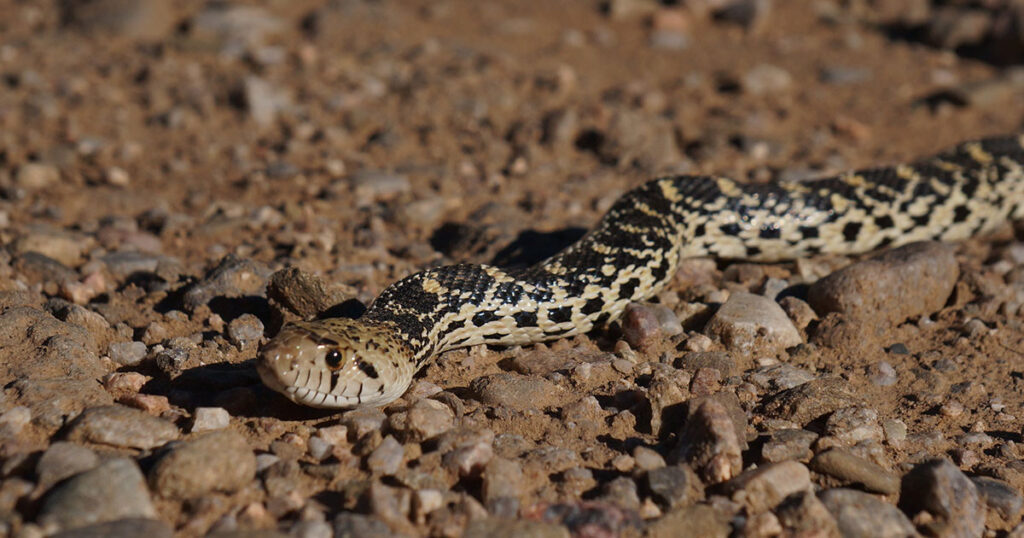
Not a stick or piece of hose but a snake. Alive. Big. Halfway across my lane, headed toward the other, not moving but clearly alert. It had not been there 30 minutes earlier, when I’d been going in the opposite direction.
I looked around for a stick to prod the snake off the road and into the field. But not a one did I find on either side of the road. The snake still wasn’t moving. I found a chip of wood and tossed it toward the snake in hopes of startling the creature into movement. Anywhere was better than the blacktop. My hunk of wood landed short and made no impression on the animal. I gathered up some gravel from the edge of the road, and scattered it toward the snake. Again, no reaction. I looked around for some tool to use to goad it into movement, but saw nothing.
While I stood there, in the right lane, looking at the snake angled toward me in the left lane, a vehicle from Pierson Road arrived at the intersection with Kelly Road. It was going to skirt me, which would put it in the snake’s lane. Quickly I switched lanes to protect my snake while the truck went by.
But it didn’t go by. It headed straight for us and stopped, straddling the two lanes, and a big man with a cowboy hat leaned over his open window. He didn’t even look at me, but down at the snake. So did I.
“That’s just a bull snake,” the man pronounced after a minute. “It won’t hurt you.”
“It won’t hurt me?” I repeated. “I just want to get it off the road before a car comes and squashes it.”
The man opened the door of the pickup and stepped into the road. He took a step toward the snake, then raised his booted foot. Not to harm the snake, as I’d momentarily feared, but to shoo it off the road. “Go on,” he said, poking with his toe. “Go on. There you go. Go.” And the hissing snake turned back and slithered off the pavement.
“There you go,” said the man to me, climbing back into his truck.
“Thank you!” I said. He started the truck up and turned it back into his lane and drove on toward town.
I looked for the snake, but it was gone, vanished among the tufts of grass and weeds along the road. So I resumed my run, trailing the man. But he was gone, too, disappeared into the morning sun.