
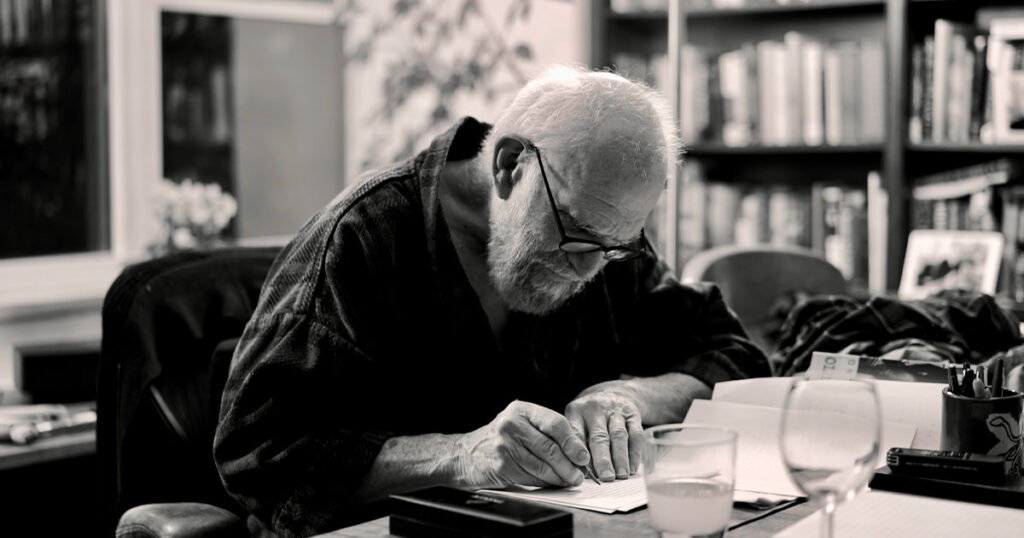
When Oliver Sacks and I first started seeing each other romantically in the spring of 2009—the year I moved to New York City—every time we met up, he would give me a photocopy of an essay he’d published in the past, often in an obscure journal, not in one of his books. Oliver was quite shy, and this was his way of inviting me in, letting me get to know him better.
Like most people, I had known him primarily as the author of The Man Who Mistook His Wife for a Hat and Musicophilia, best-selling collections of neurological case histories, and I remember being struck by the wide range and differing tones of the “occasional” pieces he shared with me. There was “Colorado Springs Revisited,” for instance, a bittersweet memoir about his motorcycle travels across America as a 27-year-old in 1960, and “The Elephant’s Gait,” an essay that drew on his deep knowledge of the history of photography. Sometimes Oliver gave me forewords he’d written for others’ books, or chapters prepared for medical textbooks I would never otherwise have seen. He’d inscribe them with little messages of affection and appreciation for me.
I have several folders full of these pieces, each dated and signed, which I rediscovered shortly after he died of metastatic cancer on August 30, 2015, at age 82. In the process of emptying out the apartment that we shared, I found them in a drawer where I’d also stashed photos I’d taken of Oliver, tape recordings he’d made, and a box in which he’d saved cards and letters I’d written to him.
Anyone who has lost a partner, spouse, or family member knows what it is like to sort and give away, or throw away, or decide to save all of the things the deceased person has left behind. It can be excruciating, and it can, sometimes, bring great joy. Having gone through this already, after my partner of 17 years, Steve, died unexpectedly in 2006 at age 43, I knew well enough not to rush the process, but to follow my gut; it would all get done eventually.
The most daunting task I faced was to sort Oliver’s personal library—around 10,000 books housed in custom-made, floor-to-ceiling bookcases lining nearly every wall of the apartment. Books meant everything to Oliver; they were his only material indulgence. Moreover, reading shaped his thinking, which shaped his philosophy about medicine, which shaped his writing, which shaped his sense of himself.
I sorted the books in stages. As Oliver had instructed me before his death, I first gave a few selected volumes to friends and some of his botany works to fellow members of the American Fern Society. But that still left a hell of a lot of books on the shelves. I couldn’t find an institution interested in taking Oliver’s entire library, and I couldn’t possibly keep it all myself.
I decided to weed out books he likely had not read—some of the dozens of books sent to him yearly by publishers seeking a blurb—and to pick out those I wanted to keep for myself. One day, I got up on a chair to reach a top shelf and began turning pages until, thousands of books and many months later, I reached the end of my task. Along the way, I discovered something astonishing: Oliver had been a prolific annotator of books—marginalia, notes to himself, critical comments, and so on. I’d had no idea of the extent of this practice and how far back in his life it went—to his university days at Oxford in the 1950s.
During our time together, I never saw Oliver annotating a book, and he never spoke about the habit; I don’t think he gave it a second thought. This was just the kind of reader he was: He would spontaneously jot down his reactions, his inner thoughts, in the margins—left, right, bottom, top—or on the endpapers or title pages, often using colored felt pens (red, green, purple, blue), sometimes switching colors on the same page. Oliver’s annotated books began piling up in tower after tower on the floor; ultimately, I found around 500 of them. I felt like I had uncovered a beautiful secret; I knew that I must be the first person (other than Oliver himself) to be reading these long-forgotten thoughts and ideas. Sometimes a book was filled with annotations, cover to cover, and sometimes just a few lines prompted him to take pen to page. To my delight, the public and scholars will be able to discover, decipher, and interpret these “secrets,” too: The New York Public Library now holds Oliver’s annotated books as a complement to its extensive Oliver Sacks archive, acquired in 2024.
Oliver’s annotations fell into four broad categories: journal-like entries and musings (unrelated to the book itself) that might fill the endpapers of a book; thoughts on medicine or neurology; insights related to something he was working on at the time; and philosophical thoughts and ideas. This last category is especially fascinating, for Oliver went through a period in the 1970s when he seemed to consume volumes by nearly every important philosopher, theologian, and thinker in the Western world—Plato, Spinoza, David Hume, Bertrand Russell, Simone Weil, Martin Buber, Paul Tillich, and many others. He often engaged in emphatic agreement or disagreement with the writer in question.
In Immanuel Kant’s Prolegomena to Any Future Metaphysics (1783), Oliver sounded almost comically exasperated as he responded to a rambling critique Kant makes of David Hume (whom Oliver revered): “Immanuel,” he wrote, as if speaking directly to the philosopher across the centuries, “you are totally confused!”
He had conflicted feelings about Sigmund Freud, all of whose published works lined his shelves. Oliver recognized Freud as the genius and groundbreaker he was. And as a writer, Oliver was clearly inspired by Freud’s published case histories. But he did not always agree with Freud’s theories, often commenting “No!” in the margins of a book and stating why he felt Freud had gotten something utterly wrong.
Sometimes, Oliver was moved enough by what he read to suggest to Freud a concept of his own. In the margins of Jokes and Their Relation to the Unconscious, Oliver responded to the closing of chapter four, “The Mechanism of Pleasure and the Psychogenesis of Jokes,” by posing a provocative question (which he revised, striking through one word and replacing it with another): “Beside ‘conceptual’ jokes can one (not) have ‘natural’ jokes—jokes in Nature. … One can certainly have Humour, Wit, and Fun—which are certainly infinitely economical: indeed this is the heart of the world—its wit, its fun. … But this is not a Freudian ‘unconscious’ of depressed affect; but a primordial ‘preconscious’ of polymorphous potential—an Original Jest.”
Oliver was more often in agreement with the writings of Friedrich Nietzsche. In an edition of Beyond Good and Evil (translated by Walter Kaufmann), which he read in 1975, Oliver responded to a chapter titled “The Free Spirit” in which Nietzsche writes, “We are born, sworn, jealous friends of solitude, of our own most profound, most midnightly, most middaily solitude: that is the type of man we are, we free spirits! And perhaps you have something of this, too, you that are coming? you new philosophers? —”
“What a voice, what a proposal, what piercing nakedness of mind,” Oliver, a kindred free spirit, wrote at the bottom of the page. “I feel N. [Nietzsche] calling to me.”
Among Nietzsche’s “Epigrams and Interludes” published in the same volume, I found a poignant note next to Epigram #157, which reads, “The thought of suicide is a powerful comfort: it helps one through many a dreadful night.”
In tiny handwriting, Oliver added: “Yes, indeed!”
He was 42 at the time. Although he had already published two books—Migraine (1970) and Awakenings (1973), both well received but not yet commercially successful—he was struggling to complete a book about recovering from a serious leg injury suffered while hiking the year before: the complete severing of his quadriceps muscles, which required several surgeries and a full plaster leg cast. (It would take 11 years and dozens of drafts before Oliver published the book, A Leg to Stand On, in 1984.) Although Oliver had been a practicing neurologist for nearly 20 years by that point, “the leg incident,” as he would refer to it, further deepened the empathy and admiration he had for the position of an ill patient—or a person with a neurological-psychiatric disorder of any sort. In a copy of Michel Foucault’s Madness and Civilization: A History of Insanity in the Age of Reason, Oliver jotted a lovely line on the book’s final endpapers: “Patients illuminate the extremities of being. They shine like stars … they allow an astronomy of the human firmament.” “Doctors must be navigators,” he added. “Instead we put on white coats, sterile gloves, professional airs.”
As I went through Oliver’s many marked-up books, I understood that the art of annotation is, almost by definition, impulsive—you have to get your thoughts down now, right now—even if it means turning the book upside down to complete a thought. There’s no time to find a pad of paper, no time to turn the page, no time to pull out a journal. (Over his lifetime, Oliver filled more than 600 handwritten journals and notebooks.)
In early 2006, a few years before we met, Oliver’s exuberant marginalia in books came to a sudden end. I think I know why. One month before, he had been diagnosed with a rare cancer, a tumor in his right eye. Although the treatment had initially been successful in eliminating the tumor, his eyesight—never great in the first place—was badly affected, particularly his central vision. For a few years, he still had pretty good vision in his left eye, but then a dense cataract began to occlude that as well. He had to resort to finding large-print versions of books.
One of his final annotations came in an otherwise forgettable novel by Herman Wouk called A Hole in Texas. Oliver inscribed his name on the inside front cover, dating it “Jan ’06.” On the facing blank page, he wrote in large blue letters: “The first LARGE PRINT book I have bought—in deference to the visual horror which has visited me.”
Oliver despaired that there were very few large-print books of quality available, other than in genre categories that didn’t interest him, like romance novels or Westerns. He had never used (and indeed resisted resorting to) an e-reader, on which type size is easily adjusted, so Oliver began using magnifying glasses of various sizes and strengths to read. He would hold a magnifying glass in his right hand—his writing hand. He couldn’t hold the book and a large magnifying glass, plus a felt pen, all at the same time.
Despite his declining vision, when Oliver and I first started seeing each other, he was still driving short distances. He was a very good, careful driver. And then one weekend afternoon in August 2009—I’ll never forget it—the vision in his right eye went completely dark. It was as sudden and instantaneous as a blink of the eye. The ophthalmic surgeon who had treated him in 2006 tried various remedies and procedures—one required Oliver to keep his eyes cast downward, head bent over, for 48 hours afterward—but nothing worked. He was now blind in his right eye.
Stoically, he handed his car keys over to me, and from then on, either I or an assistant drove Oliver everywhere he needed or wished to go, including to his twice-a-week analysis sessions, always held at six a.m. He also never stopped reading or writing. He read voraciously, always with a magnifying glass in hand. If he wanted to make notes, he wrote on a pad or in his latest journal. For his books—he wrote three during our time together—an assistant would transcribe his prose, handwritten on yellow legal pads, and type up a final manuscript. Likewise for Oliver’s articles and many essays.
Now I’ve taken on the task of transcribing annotations from the hundreds of books I found on Oliver’s shelves—or, I should say, trying to transcribe. Unlike Oliver’s neatly inscribed pieces in my file folder from early in our relationship, his jottings are sometimes barely legible or so cryptic as to defy understanding. Some are undated, too. Ten years after his death, though I wish I could ask Oliver what he’d meant when he had written this or that—and when exactly—I also kind of like that I may never know. The more I’ve studied the annotations, the more I’ve come to see his marginalia as a pure expression of thinking, thinking for its own sake, not necessarily meant to be reread or remembered even by Oliver himself. These are his thoughts—his “eruptions,” as he would say to describe sudden flashes of insight—generated by his mind, his brain, his experiences, whatever he was going through at a certain moment in time. I can’t help but think of Pompeii: The volcano has exploded, time has stopped, the dust has settled, but a brilliant mind’s musings are forever preserved.