
Twain Town, U.S.A.
Samuel Clemens is everywhere in Hannibal, Missouri, but is the story the town tells about its favorite son grounded in reality or myth?
It’s the Fourth of July 2025, in Hannibal, Missouri, and what appears to be the town’s entire population has gathered in the sweltering heat to watch the annual parade. It’s an event befitting “America’s Hometown,” as Hannibal likes to call itself. This is where Samuel Clemens—better known by his pen name, Mark Twain—grew up, and the parade is part of the annual National Tom Sawyer Days, now in its 70th year. Just about every local organization has decorated a vehicle: the Cub Scouts, the volunteer fire department, a power-washing business with the slogan “Nothing too mean for us to clean!”
The crowd erupts in cheers at the sight of a boy and girl, both age 13, who wave from a convertible. The boy wears a straw hat and a button-down shirt with a Peter Pan collar; the girl’s hair hangs in long braids underneath a bonnet that matches her ruffled dress.
They’re this year’s “Official Tom Sawyer and Becky Thatcher,” chosen from a pool of around 100 local seventh graders. The rigorous application process for the Tom and Becky Program, as it’s called, lasts six months and involves interviews, evaluations, and presentations in which the children demonstrate their knowledge of Twain’s works and the history of Hannibal. For the rest of the year, the selected pair will serve as tourism ambassadors, greeting visitors off riverboat cruises, strolling around the historic district and posing for pictures, and cutting ribbons around the community. “Growing up in Hannibal, that’s probably the most exciting thing you can do,” Ainsley Ahrens, who served as Becky in 2024–25, told me.
Hannibal is a company town, and the local industry is Mark Twain. Just about every location associated with his childhood has been developed into a potential source of revenue. The Mark Twain Boyhood Home, filled with memorabilia, is bordered by a whitewashed fence like the one made famous in The Adventures of Tom Sawyer, in which Tom, a mischief-maker whose antics range from wickedly ingenious to borderline sociopathic, tricks his friends into doing a tedious chore for him by pretending it’s fun. There’s the Mark Twain Cave—where Clemens himself played as a child and which inspired the one where Tom is trapped for three days along with Becky, his sweetheart—now electrically lit and accessible to visitors on an hour-long guided tour. The list goes on: the Mark Twain Casino, Becky’s Old Fashioned Ice Cream Parlor & Emporium, Clemens General Store, and more. Even a bottled-water vending machine bears a quote from Twain: “High and fine literature is wine, and mine is only water; but everybody likes water.”
Twain is a complex figure: A child of slave owners, he married into an abolitionist family and ultimately wrote Adventures of Huckleberry Finn, which is generally acknowledged as one of the greatest works of American literature, with a deeply antiracist message. At the same time, the book has been criticized and even banned for its frequent use of the n-word and perceived racial stereotyping. The runaway success of Percival Everett’s 2024 novel James, a retelling of the Huck Finn story from the perspective of Jim, the enslaved man who is Huck’s companion, shows that interest in Twain remains high even as contemporary readers increasingly acknowledge the ways in which his books inadequately represent the experience of Black people. “Part of the continuing fascination with Mark Twain is that he combines in his person both the best and the worst of our national culture,” Ron Chernow, the author of a new Twain biography, has said.
But you wouldn’t know it in Hannibal, where the perfume of manufactured nostalgia hangs heavy in the air. With their dogged focus on Tom Sawyer, a book that depicts an idealized version of Clemens’s childhood, the town’s cultural institutions avoid recognizing its history of slavery. “Mark Twain’s Hannibal is a palimpsest that yields diverse and often contradictory meanings,” Shelley Fisher Fishkin writes in Lighting Out for the Territory, her study of Twain and American culture. “It is also a microcosm of America itself—its promise and its potential, its guilt and its shame.”
Much of today’s Hannibal, like the Walmart just off the highway or the sports bar showing a Cardinals game on its big screen, would be alien to Mark Twain. But as a skilled and shameless promoter of his own work—he liked to advertise his lectures with lines like, “The trouble begins at eight o’clock”—he would recognize, and likely admire, the strenuous marketing around his own persona.
Hannibal’s main commercial area, which occupies just a few blocks along Main Street and Third Street, offers a mix of blatant tourist traps and businesses catering more to locals. Famous lines spoken by Tom Sawyer, Huck Finn, and Jim, with images of the characters, are printed on banners that hang from street lamps. Tom’s quote is from the whitewashing episode: “Like it? Well, I don’t see why I oughtn’t to like it. Does a boy get a chance to whitewash a fence every day?” Just up the hill, a giant root beer mug advertising the Mark Twain Dinette rotates during the restaurant’s opening hours.
It’s July 2, and I’m headed to Java Jive, which calls itself “the first coffee shop west of the Mississippi” (the river is a block away). The wall is plastered with photographs of past Toms and Beckys and a picture of the site as it was 50 years ago. Now the café occupies two long, narrow rooms painted peach and decorated with lava lamps and original artwork by local artists (for sale). There’s a huge menu of sugary drinks, as well as assorted tchotchkes that wouldn’t be out of place in my Brooklyn neighborhood: a desk sign featuring a Taylor Swift lyric, a sippy cup that reads, “I like big cups & I cannot lie.”
I’m here to meet Ellie Locke, who was the official Becky Thatcher in 2016–17 and just graduated from the University of Arkansas in Fayetteville. She’s working a summer job near the Lake of the Ozarks but is back in Hannibal for Tom Sawyer Days. “My dad is the youngest of nine, my mom is one of three, my grandpa was one of seven, and my grandmother one of seven or eight. And they’re all very close-knit still,” she explains over a lemonade.
Like all students in Hannibal, Locke was assigned The Adventures of Tom Sawyer in her seventh-grade English class. “Partly to learn about the story, but also for the history of Mark Twain,” she says. Her cousins had been participating in the Tom and Becky Program for years, and she always knew she wanted to be a part of it. At age three, when she was supposed to be napping, her parents discovered her in the living room giving a speech, as if she were trying out for Becky.
The speech is the first hurdle in the process. Each would-be Tom or Becky has to speak for five to 10 minutes to a group of judges, as well as the current year’s official couple, about why he or she would make a good ambassador for the town. Twenty-four semifinalists—12 girls and 12 boys—will spend the next few months studying for a test “on everything Mark Twain, Hannibal, tourism, the book,” Locke explains.
After the test and an interview to assess the contestants’ knowledge and people skills, the group is narrowed down to 10 finalists. “Which is when the costumes come into play,” Locke says. For the Toms, the costume is relatively simple: a button-down shirt, a pair of pants, moccasins, and a big straw hat. For the Beckys, it’s an elaborate affair that can cost well over $1,000.
“You start with your pantaloons,” Annie Webb, one of this year’s Becky finalists, tells me later that afternoon at Mark Twain Elementary School, where her mother, Katie, is the music teacher. A vivacious 13-year-old who attends Hannibal Middle School, Annie has long light brown hair and green eyes. Today she’s wearing a floral tank jumpsuit and earrings with Becky charms, but she has brought her entire Becky outfit to show me.
The ritual begins with a visit to the Hickory Stick, a fabric store in the center of town, where the proprietor helps each girl pick out material for her dress and then stows it away to prevent duplication. Annie’s is red with tiny white dots, accented with navy blue trim and yards of white lace. Atop the pantaloons comes a crinoline—“a pouffy layer that poufs everything up.” Next is an apron-style overskirt, which may be split at the back to reveal the layers of ruffles underneath. The outfit is topped off with a matching bonnet, parasol, and handbag. The entire getup is custom-made by a seamstress.
Each Tom and Becky carries a bag filled with items that represent moments from the book or aspects of their characters that they’ve invented. The kids, who must be in character at all times while performing, use the objects as props to help them tell stories. Annie carries an old-fashioned cup-and-ball game and a string with 99 buttons on it. The story goes that the boy who gives a girl her 100th button will be her true love. “I’m kind of hoping Tom might give me my 100th button,” she says, in character.
Are these modern girls ever frustrated by Becky’s secondary status to Tom? “In the books, you don’t really hear about Becky having anything in her bag,” admits Koryn Miller, a poised 16-year-old who was the official Becky in 2022–23. But they tend to see Becky’s blankness as an opportunity rather than a limitation. “It gave me room to create this character in my head of how I think she should have been brought to life,” Koryn says. “You get to really make her your own.”
Although one boy and one girl will be chosen as the official Tom and Becky, there are so many events requiring their presence that the eight other finalists will also be pressed into regular service over the course of the year. Though they always perform in pairs, the kids rotate: The official Tom might be matched with a Becky finalist, or vice versa. “Being a Tom, it’s always on the spot,” says Mason McIntyre, a garrulous teenager who was a Tom finalist in 2023–24.
I’m visiting him and his sister Malaina, an incoming Becky, at their grandparents’ home in a tony neighborhood high on a hill northwest of downtown. There’s a model of the Robert E. Lee riverboat on the table in front of us and an antique gramophone in the corner. Mason, who speaks very quickly with a heavy Southern accent, wants to quiz me on life in New York City. He’s most curious about the subway. “So you don’t drive anywhere? … That’s goofy.”
When I can get a word in edgewise, I ask Mason what he most enjoyed about being Tom. “If I can make someone smile, if I can get that smile upon them, that’ll be a positive of the day. Ladies especially say it was a highlight of their day,” he says cheerfully.
His sister, in a blue-flowered T-shirt, khaki shorts, and gold watch, is as cool and polished as Mason is exuberant. “There’s a lot of history in Hannibal because Mark Twain was a very big part of modern-day literature,” she says, speaking clearly and rather formally. “It’s a very homey place. We want people to feel welcome whenever they come to Hannibal.”
I ask both siblings what it’s like to be in character all the time. “They have this saying, ‘You’re never tired, you’re never hungry’—what was it?” Mason says. (He’s referring to the Tom and Becky Program’s unofficial motto: “Never hot, never tired, never thirsty, never hungry.”) “You can’t complain. It’s not that it’s a hassle. It’s very fun. Well, with the heat advisory …” The thermometer will reach the upper 80s every humid day of my visit to Hannibal.
It’s hard work for the parents, too. For each event, at least one parent must volunteer time driving and supervising the kids. For the official Tom and Becky, this is a major financial commitment: They visit Twain festivals in Calaveras County, California (site of the original jumping frog contest); Carson City, Nevada, where Sam Clemens and his brother Orion lived briefly; and Hartford, Connecticut, where Twain’s mansion has been turned into a museum. The kids’ travel is covered, but parents and other family members pay their own way.
The parents I speak to consider it a worthwhile investment. “It’s definitely an experience that will bring out some skill sets for him for the future,” says Koryn’s mother, Sarah, who runs Bark Twain, a pet-sitting company. And it’s good for the résumé, since local businesses like to hire former Toms and Beckys. “They’re always good kids, good in school, well-rounded,” Koryn says. “No human is perfect, but everyone that is a Tom and Becky tries their best.”
“A book a day keeps reality away,” reads a sampler in the window of Clemens General Store. This wasn’t Twain’s philosophy—in Huck Finn above all, he aimed to depict the realities of racism—but it could well be the town motto. Not only does Hannibal’s elevation of Tom Sawyer as an icon of American boyhood marginalize Huck, a more developed and ultimately more admirable figure, but it also deliberately obscures the difference between the author and his fictional creation. “I probably didn’t find out Tom Sawyer was not a real person until I was like 10,” says Preston Miller, Koryn’s brother and one of the incoming Toms.
Poking around the complex of small buildings that make up the Mark Twain Boyhood Home, I can understand why. The museum’s official line is that “Mark Twain transformed his memories into literature through the power of his creative imagination.” But over and over, it insists on identifying Sam Clemens the author with Tom Sawyer the character. “Here stood the board fence which Tom Sawyer persuaded his gang to pay him for the privilege of whitewashing,” a plaque outside informs the visitor. Inside, a sign points to a bedroom window from which “Tom Sawyer would jump” when sneaking out at night.
Among the Clemens family paraphernalia and nostalgic descriptions of Sam’s childhood antics is a single panel about enslaved people. In Clemens’s time, about a quarter of the residents of the county, or 2,800 people, were enslaved. Forty-four percent of white families owned slaves; others rented them. The museum does not mention that Sam at one point shared his childhood bedroom with an enslaved boy named Sandy, who slept on a pallet. He also spent time on his uncle’s farm in nearby Florida, Missouri, with an enslaved man named Daniel Quarles, who is believed to be one inspiration for Jim.
The Huckleberry Finn House, a small white hut inside the compound, is a re-creation of a home in which Tom Blankenship, a local urchin often said to be a model for Huck, once lived with his family. The exhibits treat cursorily some of the controversy around the novel, emphasizing Twain’s use of both humor and realism in telling the story. “Should it be banned?” the exhibit asks, and answers, “Decide for yourself. Read it.”
Mark Schneider, a curator, tells me that the museum was last renovated nearly 30 years ago and that a new update is on the horizon, potentially to include a Mark Twain hologram. Perhaps it will replace the current mockup of a gigantic sculpture containing 28 figures from Twain’s works that was planned to commemorate Twain’s 100th anniversary in 1935 but was never built. Tom and Huck both appear twice, whereas Jim is relegated to the far right corner, kneeling and looking up at the King and the Duke, the two con men who will eventually turn him in. A line of Huck’s featured on the panels hung around town echoes in my head: “Right is right, and wrong is wrong, and a body ain’t got no business doing wrong when he ain’t ignorant and knows better.”
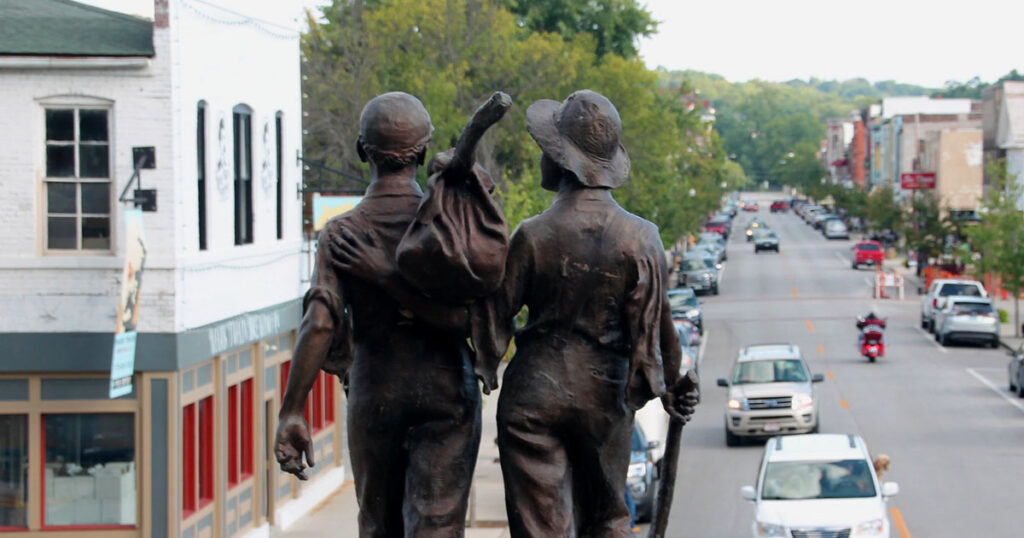
First thing in the morning on July 3, the 10 incoming Toms and Beckys line up on the east end of Main Street, behind a statue of Tom and Huck. They all have numbers attached to their chests so that the judges can easily tell them apart. The moms hover, adjusting the kids’ costumes and commiserating about how impractical it is that the girls have to wear white gloves. “I feel highly uncomfortable,” complains Tom #5, a small kid with very short hair and round glasses. One person sports a T-shirt bearing the slogan “Sawyer’s Painting Company.”
A photographer asks the girls to pose while twirling their parasols, but they’re standing too close together and the parasols keep colliding. Meanwhile, the Toms are getting restless. Tom #3, in a yellow shirt, shoots his slingshot at one of his fellow contestants.
After the photographs, it’s time for the kids to greet tourists under the blazing sun. The girls can wear ice packs under their costumes, but the boys have only their hats for protection. In pairs they start down the hill, fanning out onto Main Street. “Bye, Becky—good luck! See you at lunch!” Annie’s mom calls. Tom #1 tugs at the arm of Tom #3. “We have to wait for our Beckys!” he cautions.
One of the judges approaches Tom #1 and Becky #1 and asks for tourism advice. “I think you should start right here! The Mark Twain Boyhood Home is the main attraction in Hannibal,” chirps Becky #1. Tom #2 offers directions to the Mark Twain Cave and recommends purchasing a souvenir rat on a string from the gift shop. Becky #2 considerately offers a sweating judge her parasol. Tom #4 and Becky #4 are asked to move so that workers can weed the sidewalk in front of the whitewashing fence in preparation for tomorrow’s festivities. Meanwhile, Tom #5 and Becky #5 act out the engagement scene for another judge. He seems a little lackluster, but she’s into it.
Rereading the novel for the first time since my own childhood, I found this scene disquieting. At first Becky resists Tom, but he gradually breaks down her resolve. At one point, Twain tells us, Tom takes her “silence for consent” and whispers sweet nothings in her ear; when he tries to kiss her, she runs away and hides under a desk, but he tugs at her apron and hands until she gives in. “By and by she gave up, and let her hands drop; her face, all glowing with the struggle, came up and submitted.” (The kids hold out Tom’s hat and duck behind it so that it only appears as if they’re kissing.) During our conversations, I asked some of the Beckys whether they were troubled by the gender dynamics, but no one took the bait. Now, Becky #5 explains to the onlookers that “it was love at first sight, but she was playing hard to get.” They applaud and cheer.
Melissa Cummins, the program’s longtime director, ushers all five pairs onto the shady side of the street, where they wait hopefully for tourists to show up. Alas, it’s a sleepy Thursday morning, and the street is nearly empty. My nine-year-old daughter, whom I’ve brought along, steps in to fill the void. Tom #1 gives her a stick of candy, and she asks him what he likes to do for fun. “I love to swim and fish and play in the woods with my friends,” he says. “He finally caught a fish,” Becky #1 chimes in. “It was this big!” She pulls out an antique tape measure from her bag and measures about three inches. One of the judges, looking on, guffaws.
In front of Becky’s Old Fashioned Ice Cream Parlor, Tom #3 shows bugs to my daughter while Becky #4 rolls her eyes. I ask him about a piece of paper he’s holding, a picture of “Injun Joe”—another of the novel’s now-regretted stereotypes. “He’s wanted for murder,” Tom #3 says, his eyes glittering. “We’re out here fearing for our lives!” Becky #4 adds. Tom takes the opportunity to throw her under the bus. “Becky’s terrified of everything,” he says.
Planted in front of the Blue Daisy gift shop, Tom #2 and Becky #3, twirling nervously from side to side, try to engage with tourists, who smile and wave. “I wish I had a horse and buggy,” he says to her. “You would probably crash it,” she retorts.
One of the judges is John Maupin, a retired lawyer from St. Louis who was Tom himself in 1963. He and his Becky traveled to New York City to dedicate the Missouri pavilion of the World’s Fair, he tells me. Dressed in their costumes, they took the subway all the way from Grand Central Terminal to the fairgrounds in Queens. “We told people there were days we couldn’t go to school because buffalo herds surrounded our house. They believed it,” he says.
Becky #2 shows another judge the matches and collapsible cup she’s carrying in her bag: If she’s ever stranded in a cave again, she says, she’ll be able to collect water. These Beckys seem determined not to be caught unprepared; they certainly won’t need to depend on their Toms, who don’t seem equipped for survival in a cave. Tom #5 looks on forlornly—his Becky has disappeared. Meanwhile, Tom #2 enthusiastically demonstrates how to use a dead cat to drive away warts—another plot point in the book. “Spunk water, spunk water, swallow these warts,” he chants, hurling a stuffed cat by its tail. A father and daughter heading into the ice cream parlor look on. He was the official Tom in 2000, he tells the kids. “Do you ever miss it?” Tom #4 asks. “I loved meeting the boats with people from out of town,” he says wistfully.
Maupin is quizzing Tom #3 and Becky #3: “When the steamboats came here, what were they bringing?” The kids have no clue. “Coal?” Becky tries. Tom vamps, “If I hadn’t had to go to school, I could have seen.”
After an hour of this, the kids are starting to fade. “You’re all still out here?” asks an older woman with a panting pug, pausing to straighten Tom #2’s collar. “You’re lookin’ awful good,” she adds. Becky #3, whose family is planning a trip to New York, has been asking me for travel tips, but she snaps back into character when a woman walks by wearing a sun hat festooned with military pins. A substitute teacher in the local schools, she tells me that the whole town takes responsibility for Tom and Becky. “When I see them somewhere and I think their mom’s not paying attention, I say, ‘Becky, are you supposed to be here?’ ”
Megan Rapp, the executive director of the Mark Twain Museum, appears in a black-and-white print dress and a button that reads, “Peace Love Twain.” Behind her, the trolley goes by, tourists leaning out the windows. My daughter has Annie’s cup and ball and is trying determinedly to get the ball in the cup without hitting herself in the head. Maupin is talking to Becky #4 and Tom #5 about growing up in Hannibal. “Your friends from then will be your friends forever,” he says. “Everyone knew not only me but my parents and grandparents. You couldn’t get away with anything.”
Feeling woozy from the heat, I give in to my daughter’s pleas to check out Clemens General Store. The wares include old-time board games, puzzles, novelty salt and pepper shakers, a cookbook by Snoop Dogg and Earl “E-40” Stevens called Goon with the Spoon, and a cutting board that reads, “Don’t be afraid to cut the cheese.” “They have everything anyone could want,” my daughter says, awestruck. At the counter, before I can stop her, she eats most of the fudge samples, including a purple goo called “Huckleberry Haze.”
“People that like American literature … are some of our brightest people,” G. Faye Dant tells me. “But they go right over there to Huck Finn’s house and don’t walk across the street to Jim’s place. A lot of people don’t want to make that connection.”
We’re standing in the one-room museum Dant opened in 2013. Called “Jim’s Journey: The Huck Finn Freedom Center,” it chronicles Hannibal’s Black history, starting with the story of Daniel Quarles, the enslaved man whom the young Clemens got to know on his uncle’s farm. Through painstaking archival work, Dant has managed to trace Quarles’s story back to Virginia in the 1800s. “That’s a sketch that I came across,” she says, her speech deliberate but animated as she points to an image on the wall of enslaved people walking from Virginia to Tennessee. “And he would have done that very same thing.”
Tom #3 and Becky #3 may not have known what the steamboats that came to Hannibal were bringing, but one answer is enslaved people. Twain’s father, John Marshall Clemens, could be brutal to his slaves, including a woman named Jennie who once saved the young Sam Clemens from drowning. Once, after she pulled a whip out of his wife’s hands, John Marshall Clemens punished her by beating her. Twain later said of the enslaved children he and his friends played with, “We were comrades, and yet not comrades.”
Dant found a photograph in the Library of Congress, taken by the local photographer J. R. Shockley, of two enslaved boys on Main Street in Hannibal, steps from where we are standing. Dressed in ragged clothes, their feet bare, neither of them meets the camera’s gaze.
“Hannibal took the position that we don’t have to talk about slavery because we’re gentler, kinder,” Dant says. Still, even in Tom Sawyer, slavery is present. Tom uses the n-word blithely in conversation, and his Aunt Polly owns an enslaved boy named Jim (a different character from the grown man in Huck Finn).
In Hannibal, too, the traces of slavery are evident to those who look. The little stone building that houses Jim’s Journey was built by enslaved people in 1837. In its front yard stands a memorial wall Dant made out of bricks donated by a local resident who found them while renovating her property, which had originally belonged to an enslaver. On a few of the bricks, the handprints of the enslaved people who made them are still visible.
A fifth-generation Missourian, Dant and her husband are both direct descendants of enslaved people. When she was growing up in Hannibal, she says, the only public acknowledgment of a Black character in Twain’s writings was a metal plaque, dating from the 1930s, that supposedly marked the spot where “Huckleberry Finn and [n-word] Jim stopped for a few days on their way down the Mississippi.” (The slur is sometimes used incorrectly as part of the character’s name, though Twain never refers to him that way in the novel.) The marker was donated to Hannibal by George Mahan, the son of an enslaver who was then the president of the State Historical Society of Missouri. He also purchased and donated to the city the building that is now the Boyhood Home. “That gives you a sense for Hannibal,” Dant said in a recent podcast interview. “Most of the politicians, most of the businessmen, most of the people—white people, I’ll say that—in leadership roles, are descendants of enslavers.”
Dant’s museum is built on donations. One wall is nearly covered with pages from the 1927 Colored Directory, a listing of Black-owned businesses that helped Black people navigate segregated cities. Another is devoted to artifacts documenting the Quarles family: pictures, newspaper references, a passage from a slave narrative. The perfectly preserved Navy uniform of a Black veteran is part of a display commemorating Black members of the armed forces. Some of this material appears in Dant’s recently published book, Hannibal’s Invisibles.
Dant’s museum isn’t part of the official Mark Twain complex. “They acknowledge me now, but they don’t support this effort,” she says, telling me that some local business owners won’t let her put flyers in their windows. “I don’t know if they think it’ll scare off their customers or if they just don’t want to act like they’re supporting us,” she says. When she approached a former director of the Boyhood Home about including Jim’s Journey in his promotional materials, she says that he told her, “We’re not a Huck Finn kind of town. We’re a Tom and Becky town.”
“A few years ago, we had a biracial girl” as Becky, Dant says now. But otherwise, in a school district that averages about 80 percent white, virtually all of the Toms and Beckys are white. Only two of the current contestants have visited Dant’s museum. “I don’t do Tom and Becky,” she says. “I do Samuel Clemens.”
On the morning of the Fourth, every single person in the breakfast room at our motel is wearing the colors of the flag. A little girl has red, white, and blue ribbons wound through her braid and glitter that makes her hair and cheeks sparkle. My daughter looks at her own purple T-shirt self-consciously. “We look like we’re not from here,” she says.
I’m a little surprised that this is the first time she has noticed. We’re Jewish, and Hannibal’s culture, like that of most small towns in America, is relentlessly Christian. Some of the Tom and Becky contestants can easily rattle off their favorite Bible verses; crosses and T-shirts with Christian slogans are omnipresent in town. Meanwhile Hannibal’s former synagogue, a brick building with a stained-glass Jewish star and the Ten Commandments in Hebrew on its façade, was sold to the New Hope Gospel Center in the 1970s. The temple’s congregation merged with one across the river in Quincy, Illinois. The Quincy synagogue closed its doors in 2019; the nearest active congregation is now nearly 100 miles away, in Columbia, Missouri.
The parade won’t start until 10 a.m., but people are already starting to gather in Hannibal’s business district an hour beforehand. A few blocks up the hill from the tourist area, it’s shabbier, with numerous shuttered storefronts. Hannibal’s population peaked at roughly 22,000 in the 1930s and has been steadily trending downward ever since. But the town is thriving in comparison with others in the region. An English teacher I met tried to follow Huck and Jim’s journey down the Mississippi in her own kayak and discovered that most of the towns along the river were in ruins. In one, the only buildings open were a library and a church; in another, the entire main street had burned down. The Mark Twain industry, a pillar of Hannibal’s economy since the 1930s, is keeping the town alive.
We leave our rental car on a side street and join the crowds jostling for position by the post office, where the incoming Toms and Beckys have assembled in an old-fashioned trolley. Seeing their excitement, I am surprised to find myself choking up. I blow a kiss to Annie, but she doesn’t see me.
The vehicles go by: police cars, an antique Ford Bronco, decked-out Harleys. There’s a cancer charity and a unicyclist. Bleigh Construction Company, celebrating 75 years. Heartland Towing. Point Pest Control. Pageant winners: the 2025 Miss Hannibal and Miss Mark Twain, Mister Hannibal, Miss Marion County. A group called Build Our Country on Christ on a float made out of cardboard blocks decorated like Legos. A girl wearing a red, white, and blue T-shirt that reads, “Everybody in America Parties on My Birthday!” The Gracie Barra Brazilian Jiu-Jitsu team. Almost everyone is white. In a marching band playing “Three Cheers for the Red, White, and Blue,” I count three Black kids among more than 50 musicians.
As the parade wraps up, the onlookers start moving to “Central Park,” a plot of grass a few blocks away. Vendors are selling hot dogs, tie-dyed clothing, and a brand of barbecue sauce made with moonshine. All the seats close to the bandstand are already occupied by the families of the Toms and Beckys.
It’s Melissa Cummins’s last Tom and Becky ceremony as program director, and she’s so emotional, she can barely speak. “This is not just a Hannibal tradition. It is loved around the world,” she says. The woman next to me nods her head sympathetically. “She’s put her heart and soul into it. Those tears are real,” she says.
After the outgoing Toms and Beckys share favorite memories of their year, each of the incoming kids delivers a short speech. “My name is Becky Thatcher, but some of you may know me as Annie Webb,” begins Annie, nearly bubbling over with excitement. “I feel like I just stepped out of the papers of Mark Twain’s book,” Malaina says, “and let me tell you, it’s already been an adventure.” In addition to thanking their families, their teachers, and their seamstresses, several contestants offer gratitude to God: “Without him, none of this would be possible,” one of them says.
The judging is “based on what the kids know about Hannibal, about Mark Twain, how they interact with visitors,” Stacey Mueller, the incoming director of the program had told me earlier. “Looks have nothing to do with it. Tom and Becky are universal.” Finally, when I think I can’t stand the heat for a moment longer, Cummins taps Thatcher Johnson, the tallest and perhaps most conventionally handsome of the group, as the official Tom Sawyer. He circulates around the Beckys till he finds Malaina. When he kisses her cheek to designate her as official Becky, her mouth drops open in a perfect O of surprise and delight.
On July 5, our last day in Hannibal, we head over to the frog-jumping contest, which my daughter has been looking forward to all week. Inspired by “The Celebrated Jumping Frog of Calaveras County,” Twain’s most famous short story, kids “rent” a frog from a giant bucket of the amphibians (collected by the Boy Scouts), place it in the center of a bull’s-eye-shaped mat, and prod it till it jumps. The frogs get three tries to reach the outer circles.
The competition takes place around noon on yet another blindingly hot day, and the frogs need more encouragement than one would expect. Some try to escape, but most lie there pathetically, legs splayed, looking confused. “It’s too hot for this!” a dad complains as a cute blond boy around five tries unsuccessfully to get his frog to move.
Thatcher, newly anointed as Tom, is performing his official duties for the first time, with Annie as Becky. They give up on encouraging the little kids and stand in front of the cooling fan. Tom hands a piece of “pirate treasure” to a girl in a rainbow T-shirt. “Found it in a cave with my friend Huck,” he says, still in character.
A man I haven’t met before addresses me out of the blue. “How’re you liking Hannibal?” he asks without introducing himself. “Pretty different from New York?”
I respond with something noncommittal.
“Kinda gross,” he volunteers, gesturing at the scene around us.
I look around at the kids handling the frogs, which they don’t seem to find particularly gross. Frog 91 is currently on the lily pad. My daughter’s number is 118. All I can think about is how eager I am for her to take her turn so that we can find some shade.
An older man, maybe the grandfather of the kid with frog 91, yells, “Boo!” at the frog. It doesn’t move.
“Inhumane,” my interlocutor adds.
When he says that, something shifts.
My daughter, overhearing him, feels it too. “It’s frog torture,” she says slowly. “You’re scaring the frog to make it move.”
A tiny girl next to us in blue Crocs has her hand around the neck of a frog nearly the size of her arm. “That frog looks mad,” my daughter stage-whispers to me.
The little girl hears her. “I don’t want to,” she says to no one in particular.
There can be no doubt: This ritual is inhumane. Incredibly, my first reflex is to justify it. I don’t want my daughter to feel bad. It’s a Hannibal tradition, sponsored by the Boy Scouts, and what could be more wholesome? It must not be pleasant for the frogs, but maybe they aren’t really suffering. It lasts only a short time.
Right is right, and wrong is wrong, and a body ain’t got no business doing wrong when he ain’t ignorant and knows better.
It’s time for my daughter to select her frog. She gently places it on the mat, where it takes a few reluctant steps. We won’t be winning anything today. We say goodbye to Tom and Becky and head back to our car.