
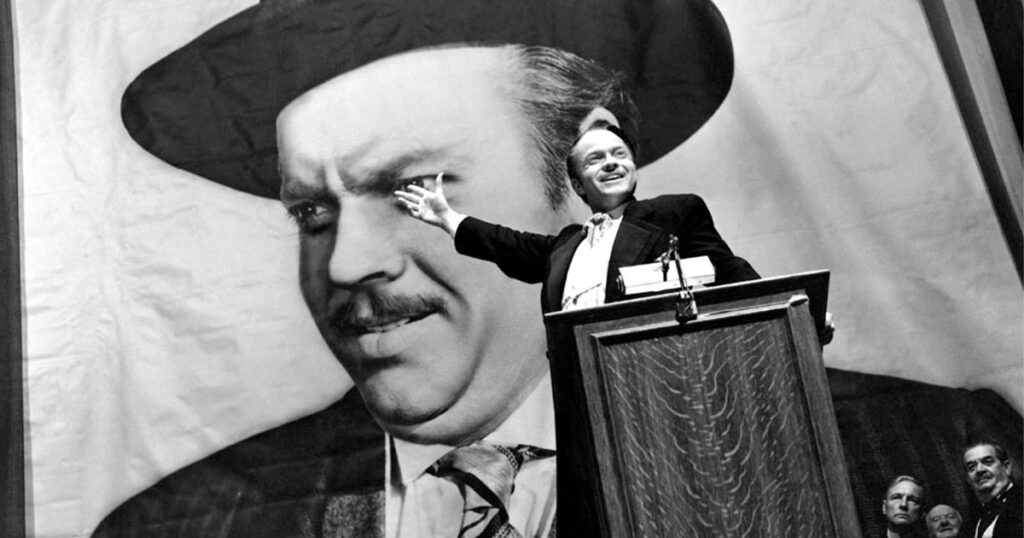
These questions about classic movie moments were created with readers (or viewers) born in the 21st-century in mind. I haven’t taught formally since retiring from my academic appointment in 2018, but it was several years before then that I was startled to find that none of the students in my graduate poetry seminar—all of them born after 1990—had seen Citizen Kane. It seems to me that once-famous films may have started to slip not merely into the valued past but into oblivion. So, being one who loves puzzles and challenges, I concocted a quiz designed to tease readers and lure them to watch these movies—if nothing else, think of it as a list of recommendations. Some of these questions are lay-ups; other are three-point shots from the corner. The aim is not just to test you, but to quicken your curiosity.
1) A headline in one of Preston Sturges’s films reads: “MUSSOLINI RESIGNS: ‘Enough Is Sufficiency,’ Screams Il Duce.” Name this very funny 1943 film and the event that brings Mussolini to a boil.
2) Which beloved movie features a spontaneous group singing of “La Marseillaise,” ends at an airfield, and has the word “beginning” in its last line of dialogue?
3) A Billy Wilder movie ends with a card game for two in which the male player proclaims his adoration of Miss Kubelik, who replies “Shut up and deal.” Name the movie and the actors in the scene.
4) In a Hitchcock movie set in Santa Rosa, California, a man hectors his niece: “Do you know the world is a foul sty? Do you know if you rip the fronts off houses you’d find swine? The world’s a hell. What does it matter what happens in it?” Name the movie and the actors playing uncle and niece.
5) Martha enters the house she and her husband live in and says, with disgust, “What. A. Dump.” What movie, who directed it, who plays Martha, and who plays her husband, George?
6) Which of Stanley Kubrick’s movies ends with a four-letter word that arguably articulates the movie’s meaning? (Hint: Shostakovich.)
7) Two Allied soldiers bury a third at a Japanese POW camp in 1943. One of them says the dead man gave his life “for the greater glory of …” He stops, pauses, and asks, “What did he die for?” Name the actor who says this, the movie, the director, and the last words spoken in it.
8) Mimes play tennis with an invisible ball at the end of what memorable 1960s movie? What is the occupation of the film’s protagonist, and in what city does the movie take place? (Hint: In the background in one scene early in the movie, you hear the Lovin’ Spoonful sing “Did You Ever Have to Make Up Your Mind?”)
9) In which 1950 movie does a fabled Broadway actress command all and sundry to “Fasten your seatbelts. It’s going to be a bumpy night”? Who plays the actress, who plays her husband, and what was their relationship off the screen?
10) The popular 1941 song “Tangerine” is background music in two Barbara Stanwyck movies. In one of them she is involved with Fred MacMurray; in the other, Burt Lancaster. Name the movies.
I’ll give you two weeks to come up with answers—and to share, in the comments field, thoughts about the recommended films. Then I will file a piece giving the correct answers and briefly stating the critical importance of the lines or scenes to which I refer.
Deadline: June 4.