
The Six Minute War: Reagan, Russia, and the Race to Automate Armageddon by Michael Dobbs; Simon & Schuster, 352 pp., $30
The enigma of the war scare of 1983 is that in the end, nothing happened.
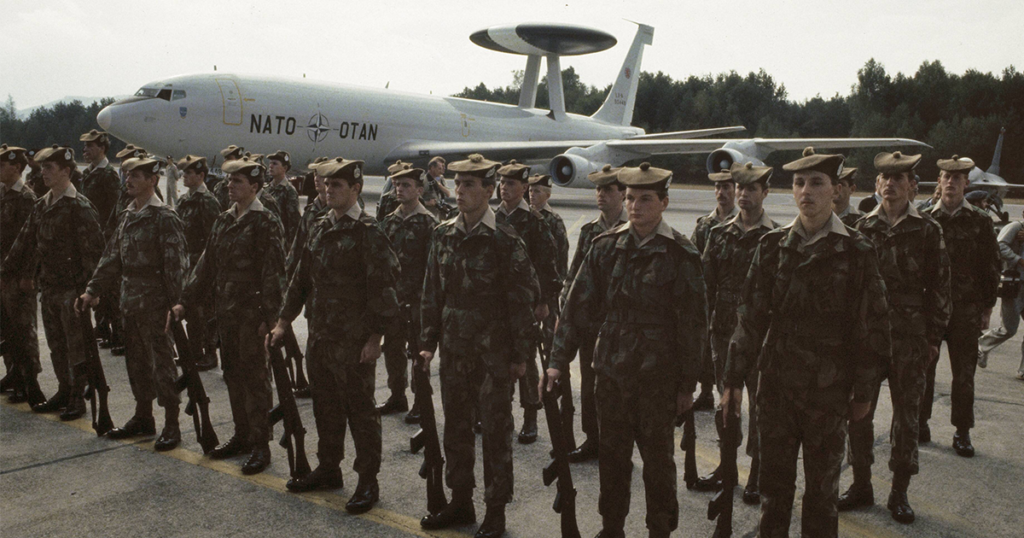
NATO completed Autumn Forge 83, a series of massive war games culminating in November with a command-post exercise called Able Archer 83, and then everyone packed up and went home. To the extent Ronald Reagan was worried about nuclear war, it was thanks to having screened the made-for-TV movie The Day After, which aired that month on ABC. Only later did Americans grow alarmed at how the exercise had appeared from Moscow’s perspective, thanks largely to Oleg Gordievsky, a KGB officer secretly working for British intelligence. Gordievsky later told the British that Able Archer 83—contrary to the sanguine attitude in Washington—had brought the world closer to nuclear war than at any time since the Cuban missile crisis of 1962.
Leaders in Moscow and Washington sensed the danger in 1962, but in 1983 they had no such shared reality. This makes the war scare contentious and subject to endless litigation in book after book—Gordon Barrass’s The Great Cold War, Taylor Downing’s 1983, Marc Ambinder’s The Brink, Nate Jones’s documentary collection Able Archer 83, Simon Miles’s Engaging the Evil Empire—as well as journal articles, podcasts, and even a prestige television series called Deutschland 83.
Enter journalist Michael Dobbs, who covered the collapse of Communism from Moscow for The Washington Post. His 2008 book, One Minute to Midnight, gave the Cuban missile crisis its most readable hour-by-hour reconstruction. Now, with The Six Minute War, he applies the same craft to the events that culminated in the war scare of 1983: the Soviet shootdown of Korean civilian flight KAL 007, the false alarm indicating an American nuclear launch that Soviet air defense officer Stanislav Petrov did not believe, the deployment of U.S. nuclear-armed missiles in Europe, the collapse of nuclear negotiations in Geneva, and finally the Able Archer 83 exercise itself.
Any author ultimately must choose how to tell a story, and Dobbs tells this one in chronological order, as best he can piece it together. Some scholars are skeptical about how much the Soviets really feared that the United States was about to launch a nuclear attack in 1983, but Dobbs does not spend time quarreling with them, apart from a passing dismissal of those who say the crisis was a myth. Instead, like any good journalist, he attempts to reconstruct events as accurately as his sources allow, guided by his own judgment. He also—and this is no small thing, given how many times this story has been told—writes wonderfully. If you want a straight, engaging account of what many people believe happened in 1983, The Six Minute War is a fine choice.
The only caution is that no one experienced this story in order. If there was a war scare in 1983—and I suspect there was—it happened only on the Soviet side. At the time, the Americans dismissed Soviet expressions of concern as propaganda. Worries about nuclear war emerged only slowly as the intelligence community considered signals intercepts and other intelligence showing a wide array of unusual and alarming Soviet activity. The slow pace of declassification has further muddied things. Dobbs’s chronological narrative, written from an objective vantage point, imposes on events a degree of order and clarity unavailable to any of the participants.
He can hardly be faulted for trying to tell the story in a coherent way. The Rashomon-like character of the war scare, however, is precisely what should worry us about it. A U.S.–Soviet nuclear exchange would have been so devastating to both countries—to say nothing about the rest of the planet—that no sane leader would ever choose it except in the most dire circumstances. As Dobbs himself contends, the only plausible route to war is some sort of accidental escalation. But if everyone understood the stakes in Cuba in 1962, events in 1983 reflect a different, more unsettling route to Armageddon—a panic in which even sensible, cautious leaders struggle to think clearly. If the Soviet Union really placed a portion of its nuclear forces on alert, scrambled a mobile command train, and prepared for the worst without the United States noticing, the sequence of events hints at how crises might escalate in surprising ways. It is not clear which was more dangerous in 1983—Soviet paranoia or American obtuseness.
Such panics may be more common than we imagine. In the autumn of 2022, the Biden administration became convinced that Russia might be preparing to use nuclear weapons in Ukraine. Some administration officials reportedly placed those odds at 50–50. In the end, as in 1983, nothing happened, but no one can doubt that there was real fear in Washington in 2022. Some U.S. officials believed deterrence worked. Were the Russians really on the verge of using nuclear weapons? Or was it just a panic in D.C.? And if it was “just” a panic, does that make 2022 less frightening, or more?
Dobbs has written a fine book about 1983. It is also, like every other book about the war scare, as much about now as then. With the return of a sense of nuclear danger, Dobbs fears that we remain far more focused on a deliberate attack by Russia or China than on safeguarding against miscalculation, misperception, or simple bad luck. Underneath this worry is a sense that artificial intelligence systems will now make the situation harder to control, just as computerization in the 1970s led to a rash of false alarms, including the one in 1983. In the end, Dobbs gives the last word to Petrov, the Soviet officer who refused to believe the false alarm that might have turned the 1983 scare into a real war: “It’s absurd. We have learned nothing from the past.”