
What Is an American Hero, Anyway?
Lists of great artists say more about the list-maker than the artist
One of the kookiest battlegrounds of the latest American culture war has to be the National Garden of American Heroes, President Trump’s proposal for a park filled with monuments to 250 notable Americans who found fame in sports, art, music, entertainment, business, or politics.
There’s no real logic to the list—Herman Melville is on there but Nathaniel Hawthorne is not. Miles Davis is included, but there’s no Nina Simone. Trying to make sense of the list by identifying a specific ideology can be quickly disproven by an anomalous inclusion. Simone’s exclusion doesn’t seem explicitly racist or sexist after noticing there is plenty of representation for both notable Black Americans, women, and Black American women. It’s an arbitrary list in an arbitrary way, seemingly based on nothing more than momentary whim.
It’s worth trying to think through what’s going on at the Garden of American Heroes, though, because so much of the president’s popularity and so many of his actions have been based in cultural grievance. The Kennedy Center takeover, the taskforce for making Hollywood great again, the battle against Ivy League universities—all are fights against the “elites” and the multicultural spaces they have nurtured.
The rise of diversity in the arts coincided with the fall of the so-called “high” arts in public spaces and in universities. In the 1990s, arts and music education started disappearing from public schools, attendance at opera houses and symphonies began to decline, and university humanities departments went into budgetary crises. This had more to do with the end of Cold War-era funding, which had gone toward literary magazines, the visual arts, and arts education. But some saw conspiracy instead of coincidence, as if the reason why the “Great Books” curriculum lost favor was directly attributable to the rise of gender studies departments.
For example, New York’s Lincoln Center ended the longstanding Mostly Mozart Festival in 2023, which programmed classical compositions from around the world, and replaced it with “Summer for the City.” The new roster included a celebration of hip hop, “the world’s first LGBTQIA+ mariachi group,” and other musical acts whose primary selling points were related to identity. The reasons for programming decisions like this are complex, but some critics saw a direct correlation. Cicero is being replaced by Sandra Cisneros. Mozart is being replaced by SZA. Cultural collapse is imminent.
And for people trapped in cultural grievance, the hope is that through “elite replacement”—not to be confused with the “great replacement” conspiracy—we will make art great again. The problem with the culture, some believe, must be the wokeness of it all, the dominance of women and other previously marginalized voices—even in spaces that used to be safe for white men: The story of our Founding Fathers, for example, is now being told by Hamilton. Thus, Project 2025’s plan to put conservatives in charge of the institutions that maintain our cultural production. The problems of American culture, however, go much deeper than that, and “elite replacement” doesn’t really work if there’s no Leonard Bernstein waiting in the wings with a big vaudeville hook to drag Lin-Manuel Miranda from the stage.
American culture is run by a nonprofit system dependent on major foundations and donors to survive, which means that curation and programming has to meet the preferences of the mega-rich. Institutions are top heavy, so the stars and leaders are paid millions while the workers who play the instruments, hang the art, and write the material are barely scraping by. Arts and musical education have been disappearing from public school systems for decades, meaning that both the audience and the workers are more likely to come from the upper classes with access to private schooling or well-funded, urban-based institutions.
In the name of meeting goals related to diversity and to satisfy the wealthy donors’ desire to be seen as altruistic and politically involved, producers and programmers have increasingly relied on gimmicks like “racially blind casting”—a Black woman playing Hamlet in an otherwise traditional staging—or on first-person narratives about oppression and hardship (#OwnVoices). There is also the long tail of Hamilton: Risk-averse producers prefer to greenlight material that is a slight variation on the last thing that made a lot of money, meaning that because people went to see a hip-hop musical about the Founding Fathers, they must want to see a similar musical about our founding mothers, the Suffragettes. (Spoiler alert: they did not.) In the name of “burning down” the patriarchal or white supremacist canon, much more attention has been given to long dead “forgotten” or “overlooked” artists, from painter Hilma af Klint to composer Florence Price, giving the arts a nostalgic rather than propulsive feeling.
The Garden of American Heroes seems like an attempt to end this conversation about the canon, any suspicion against greats of the past, and any accusations that the United States might still be racist, sexist, or otherwise unfair to its citizens. These are the good ones. There are no others. The canon is closed.
Perhaps this haphazardly constructed list of great Americans is the closest we can come to establishing some sort of MAGA-approved artistic canon here. A shapeless mass of “genius,” with no clear boundaries between traditions, media, genres, or forms. Everything bleeds into everything else. Like, you know, a melting pot.
A great number of the people on the list are not, strictly speaking, American. Alfred Hitchcock, for one. He’s British, famously so. Nikola Tesla was Serbian (by which I mean, Yugoslavian. By which I mean, born to Serbian parents in the Croatian part of what used to be Yugoslavia). America is not unique in countries claiming individuals as their own after their death renders them unable to protest—Ireland’s tourism economy relies heavily on the “Irishness” of the many artists and writers (Beckett, Joyce, Wilde) it persecuted and vexed until they were driven into exile—but their inclusion here signifies a real confusion about what American greatness might be, and how it might be fostered to create new greatness in the future.
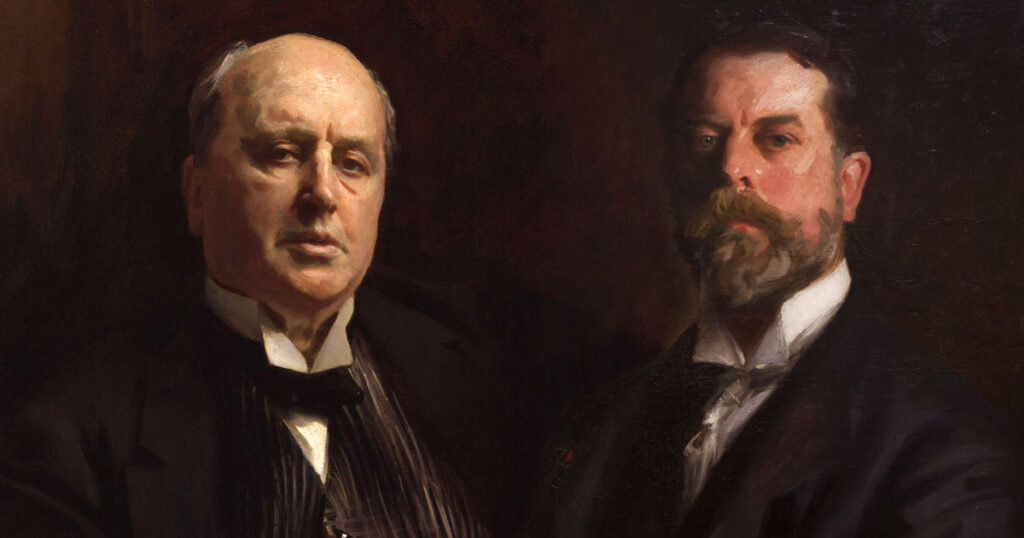
Yet one man on the list may allow us to discern the logic behind the effort. John Singer Sargent, a painter who was born, was raised, and died outside the United States, is included in the Garden of American Heroes. He is frequently and casually referred to as American, without anyone interrogating too thoroughly what that might mean.
But as Henry James—not included in the Garden of American Heroes—asked in his 1887 essay about the painter, “Is Mr. Sargent in very fact an American painter?” (And would James consider himself to be an American, given how infrequently he visited, his frank disgust with its society and art, and the relinquishment of his American passport out of frustration with his native country’s decision to remain neutral in the early years of World War I?)
As far as Sargent goes, he was born to expatriate American parents in Italy, had an itinerant childhood across Europe, trained in Paris as a young man, and lived most of the rest of his life in London. The only really American thing about him is his parentage, and his parents seem to have rejected the United States themselves in their move abroad.
None of this dissuades James from classifying Sargent as American. “It is a very simple truth, that when to-day we look for ‘American art’ we find it mainly in Paris.” In the late 19th century, Europe was simply where one became an artist. It is not only where the finest schools and the most exacting audiences could be found, it was the birthplace of the artistic traditions Americans followed.
This idea of a European artistic lineage still holds sway in the American imagination, despite efforts to foster artistic connections within a multipolar world. As much as American institutions have made space for the cultures and traditions of South American, Asian, and African groups, art is still somewhat defined by European standards. At this year’s Sargent in Paris show at the Metropolitan Museum of Art, I wondered if this was part of his lasting appeal as an “American” painter—his Europeanness. The show focuses on the years leading up to Madame X (1884) and the scandal it caused, which were years spent almost entirely in Europe, and the show includes both some of his most famous portraits but also street scenes and landscapes from his travels across the continent.
There’s no real development of style during this arc of years. Sargent is and was always Sargent. His hand seems to be a direct extension of his eye, the brush an extension of his gaze. And everything seems to be perceived as if he were wine being consumed well into the evening, with the glow and romantic haze that comes with the sound of the second cork of the day being wrenched loose. Patterns that seem from a distance to be horribly complicated—the details of a dress’s petticoats, jewels, the placement of a hand—are revealed upon closer inspection to be rendered with just a few strokes of paint. Even that part of Sargent’s technique seems infused with a drinker’s desire to cut through the fuss and get straight to essentials.
In the penultimate room of the show, the Met hung portraits painted by Sargent’s peers. The juxtaposition is a bit of a shock, like walking out of a dark bar into the light of day. The works by Carolus-Duran, Édouard Manet, and Charles-Alexandre Giron do more to explain what is singular about Sargent than a monograph ever could. The portraits are quite formal, the gazes of the wealthy women staring down at us imperious. Behold greatness, they say. Behold wealth.
And this is where Sargent’s Americanness started to reveal its shape to me. His gaze is democratic. The fisherman, street girls, children, and dancers he paints on his travels are given the same dignity and friendliness as the rich women in their salons. He paints his subjects less like they might want to be seen, prettied up and posed, and more as he appears to see them. Small details, like the tension in a hand gripping a table or the slight turn of the head, reveal not only their personalities but also the dynamic between painter and painted.
Sargent picks up ideas as he goes along, something from the Impressionists here and something from Spanish court painting there, each element pocketed as easily as a seashell plucked from a beach. His Americanness lies in his ability to cross boundaries, pick up what works and discard what does not, feel unburdened by the long shadow of history and tradition, and meet his subjects—no matter their social status—with a friendliness and curiosity that feel like the best part of the American character. This approach can often lead to a shallow, shopping-cart approach to art-making and a provincial form of cosmopolitanism, but occasionally, as with Sargent, it can turn into greatness.
This vexing question of where Sargent belongs—which has been a part of the discourse around Sargent for more than 100 years—can only mean that he belongs truly to the United States. The inability to place him, firmly and neatly, in one category, is both the blessing and the curse of American identity.
But these questions—Who counts as an American? What counts as greatness? Is there an identifiably American tradition carried on today?—do not interest the architects of the Garden of American Heroes. And our new cultural gatekeepers seem largely uninterested in correcting the considerable deficiencies and excesses of the past few decades of the world of art and letters.
There are those—coattail riders, grifters, disaster capitalists—who are trying to ride out the vibe shift and make it work for them. In literature, grumbling has built for years against the international turn in writing, against the “disappearance” of the straight, white male writer and the emergence of others as cultural icons and celebrated creators. They find support in the emergence of rightwing publishing—already visible with projects like Passage Publishing, which puts out, among other things, a memoir about the Spanish Civil War by someone on the fascists’ side.
When the National Endowment for the Arts announced the discontinuation of grants for small publishers like Deep Vellum, which mostly used the grants to fund translations of literature into English, there was a certain gleefulness among figures looking to Make American Literature Great Again. These grants were not bountiful—Deep Vellum received around $20,000 a year—nor was the audience for its publication of European, South American, Asian, and African literature overwhelming: Something like three percent of all books published in a year are in translation. But for some of the straightest and whitest if not the malest of our cultural commentators, it was still too much.
One way for these figures to wrest control of the cultural conversation away from the diversified elites and back to where it belongs is to make lists. Substacker Alex Perez, for example, has offered a list of “traditionally American-masculine coded writers,” like Raymond Carver and Ernest Hemingway. Professor Aaron Gwyn regularly tweets out lists of great books on social media, like his list of “Favorite Novels About America,” which included Denis Johnson, Cormac McCarthy, and William Faulkner.
None of these writers, of course, needs an advocate: Carver, Faulkner, and Hemingway are in the Library of America; Johnson and McCarthy appear on undergraduate syllabi; all are enshrined in the canon. And it doesn’t really make sense to use Ernest Hemingway—who fought in Spain, lived in Paris and Cuba, spoke French and Spanish—as some pillar of pure Americanness. Let’s also leave aside the fact that these lists often feel preserved in amber, relics from a time when Harold Bloom held sway. What’s interesting is that these are lists, not explanations: the choices don’t need to be explained or contextualized but are simply presented as fact. As if the work of cultural maintenance and cultivation is merely deciding what is in and what is out, what is good and what is bad. And this is what reveals the emptiness of those on the reactionary side of the culture war. Instead of trying to be Leonard Bernstein they just want to be the emperor in the movie Gladiator, there to give the thumb up or the thumb down. It’s like the literal-mindedness of someone who declares Sargent “American” because of his passport or his parentage.
If we can learn something from Sargent, or his friend Henry James, it is that culture-making is not about authority. It is about attention and care. The shocking quality of Sargent’s portraits is their friendliness, the love and kindness he bestows upon his subjects with his gaze. The essay James wrote about Sargent isn’t an act of enshrinement, a thumbs up, a name scrawled on a list. It’s based in an act of seeing something interesting in a painter and having the curiosity to think through what he is doing alongside the why and how.
Whatever happens to the Kennedy Center or the Garden of American Heroes, this is likely to be an era of unremarkable and flimsy cultural production. Because to produce something that lasts, first the producers would have to care.