
Sixty years ago, Richard Hickock and Perry Smith were executed for the murders of the Clutter family of Holcomb, Kansas—crimes famously depicted in Truman Capote’s In Cold Blood. The chilling story of the home invasion and subsequent killings of the family of four continues to absorb the public, so much so that cellblocks such as the one where Hickock and Smith were held—and where Capote conducted the interviews that formed the basis of his true-crime classic—will now be open for guided tours.
This announcement, made last fall, triggered memories that I had long tried to suppress. When I was a teenager, my family also experienced a brutal home invasion—but with this crucial difference: we lived to tell the tale. Whether any of us ever wished to tell that tale was another matter. None of us wanted to revisit the terror-inducing details of being handcuffed, gagged, and held at gunpoint. Neither did we want to address why we had become the target of such a crime. Or how broken our pretend-perfect home already was, long before it was physically invaded.
The facts were reported in the January 13, 1968, edition of The Baltimore Sun under the headline, “Doctor, Family Bound as Home Is Looted.” As the article recounted, “A northwest Baltimore physician and three members of his family were handcuffed and gagged by a pair of bandits who barged into their home at 7:15 p.m.” The physician was my father. The three other family members were my mother, my 16-year-old brother, and me, age 15. My other brother was away at college.
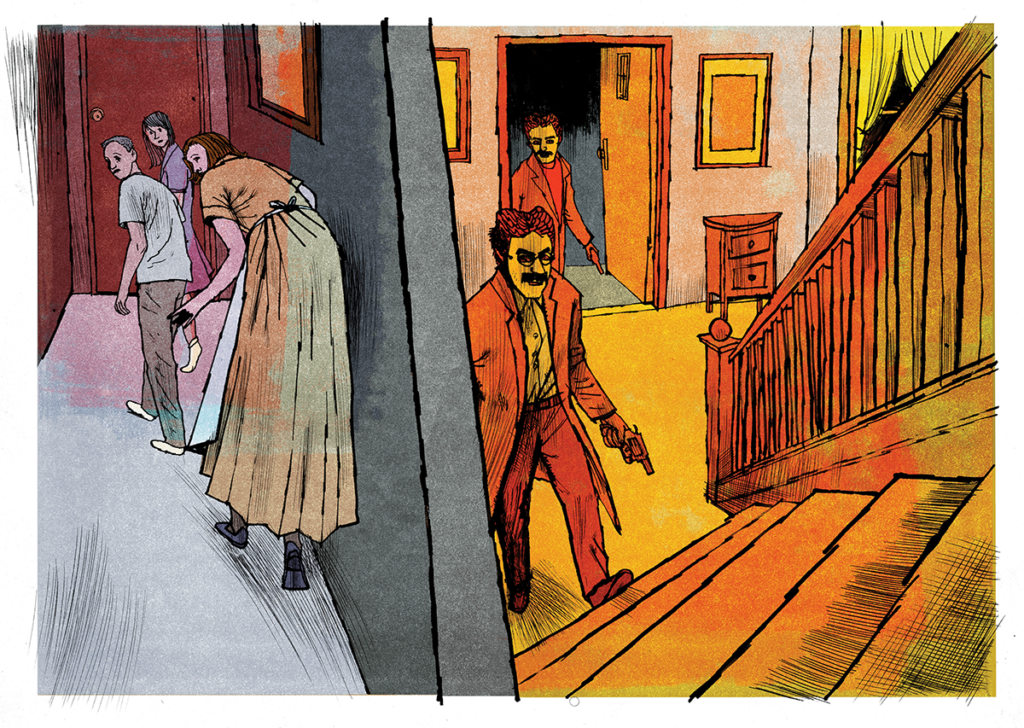
The evening had begun as normal. Because Dad worked late most nights, he wasn’t home when our doorbell rang—a normal enough occurrence. Dad’s friend, the owner of a small pharmaceutical company, would often stop by around dinnertime to drop off boxes of unspecified medical supplies. That evening, however, it wasn’t Dad’s friend at the door but two men wearing Groucho Marx Halloween masks. They pushed their way inside and pointed their pistols at us.
“Dr. Cole? Dr. Cole!” they shouted. Clearly, they knew whom they were looking for. But what did they want with Dad?
We would learn the answer to that question about a month later. “Patients Flock to Diet Doctor for Pills,” blared a headline in The Baltimore Sun on February 11. According to this exposé, my father had been dispensing amphetamines to his patients. Meth. Speed. A large accompanying photo featured a spilled goody bag of pills and capsules in assorted shapes and sizes. I read the story from start to finish, then began reading all over again. So these were the medical supplies contained in the many boxes delivered to our home. By April, federal agents had seized 834,500 diet pills from the three offices in Dad’s practice where each week thousands of patients were seen, most of them women. The burglars had the scoop on the Sun. They knew what my father the diet doctor was up to.
“Mrs. Cole? Mrs. Cole!” they called out. “Where’s the safe?”
Mom’s eyes bulged in disbelief. “A safe? We don’t have a safe.”
Behind their eerily unfunny masks, the burglars ordered us to place our hands behind our backs, then clicked around our wrists the pairs of handcuffs they pulled from their coat pockets. They ordered us upstairs and into my parents’ bedroom. There they sliced through the telephone line, directed my brother and me to lie face-down on the bed. They commanded our mother to sit on a pink leather footstool, ordering her not to turn away, not to cast her eyes down, but to keep her ever-moistening eyes open and stare straight ahead, where we, her children, were lying prone on her marital bed, with guns pointed at us.
Then came the screech of duct tape being unrolled and cut, strip after strip, the first few pieces used to bind our ankles. The burglars taped shut my brother’s mouth and mine. But not Mom’s. Once more, they demanded that she reveal the location of the safe.
“We don’t have a safe.”
“Don’t play dumb. This isn’t a game. You want us to hurt you? Your children? Where’s the safe?”
Their threats were punctuated by the crash and clatter of dresser drawers being yanked open and smashed on the floor, with papers, files, keepsakes, and jewelry scattering everywhere. On a nearby bookshelf sat In Cold Blood. I had read the book, and the gore had given me nightmares. Now we were living through a variation of that story. I remembered that when I was five or six, I had plotted out an escape route from my upstairs bedroom, just in case … in case of what? I couldn’t recall. Not that it mattered. There seemed to be no escaping now.
Just then, we heard the front door whoosh open against the January chill. The burglars shouted, “Dr. Cole? Dr. Cole!” and raced downstairs. What I next heard were the sounds of a scuffle and what I assumed was the click of handcuffs around Dad’s wrists. Then came the thrum of steps up the stairs and a gasp as Dad was shoved to the floor, followed by another screech of tape being unfurled to bind his legs.
“Where’s the safe!” One burglar positioned his pistol at my father’s temple, while the other circled around, pointing his pistol to my mother, my brother, and me.
“There is no safe,” Dad moaned. But, he said, even more softly, there was cash hidden in his clothes closet, in business envelopes, in the inside pockets of the suit jackets that were now flung across the floor.
Quickly the burglars went to work, retrieving the stacks of $20s, $50s, and $100s, then scooping up whatever else they could—earrings, baby rings, the 19th-century pennies that my great-grandfather had given my mother, the lockets that opened on family photos from the Old Country. I’m not sure how long this went on. At some point, police sirens began to sound, louder and louder. “Don’t move! Stay quiet!” the burglars hissed.
Motionless and silent, we waited, and we listened. I heard the burglars head downstairs, then up, then down once more. Finally, I heard our front door closing—those police cars had headed elsewhere, but could the sirens have scared the burglars off? Dad stood up, his legs still taped together, hopped downstairs, outside, and to our next-door neighbor’s house to call the police. I glanced at the clock sitting atop my mother’s dresser, one of the few things not to have been thrown to the floor. It was almost 10 p.m.
Yes, the ordeal was over, the two police officers assured us when they arrived, minutes later, huddling around us as if to protect us after the fact, as we recounted our story.
Our burglars were never caught. Dad, meanwhile, never accepted his guilt. “I’m being crucified!” he repeatedly declared as the case dragged on. Neither would he ever acknowledge that his actions had led to the invasion of our home. Perhaps that was not surprising, given his obstinacy and the way he treated our mother. For as long as I could remember, I had overheard Dad belittling Mom, “You’re nuts!” He would accuse her, as she served dinner, “You’re trying to poison me!” And in the middle of the night, he’d wake her (and me, in the bedroom directly across from theirs) to demand she look at the nonexistent rash on his back—his “evidence” that he was allergic to her. At any rate, he pled guilty to one charge (reduced from 15) of illegally selling prescription drugs and keeping insufficient records. He was sentenced in October 1969 to medical probation and a brief stint in jail.
Remembering this period of my life now, I still cringe at the memory of the day when my biology teacher lectured our class about the misdeeds of “that quack Dr. Cole.” And I grieve for my mother anew as I recall the look of unbearable horror on her face while she was forced to bear witness to the possible murder of two of her three children. She endured her troubled marriage to my father seven more years, until her death at the age of 58. Dad lived until he was 90, surviving yet another tangle with the law in his 80s. Even now, my brothers and I cannot comfortably discuss our painfully differing views of our deeply flawed father—who was, despite those flaws, still our father.
At any rate, I can still feel the vibrating jolt as the police cut through the metal handcuffs to free me that bitter-cold January night in 1968. Years later, I would understand trauma psychologist Bessel van der Kolk’s mantra, “The body keeps the score.” So does the psyche. The emotional wreckage remains all these decades later, silent witness to how the already rickety myth of family harmony was, without a shot being fired, shattered in cold blood.