
Little Blue Dot: How GPS Shaped the Modern World by Katherine Dunn; Bloomsbury, 384 pp., $29.99
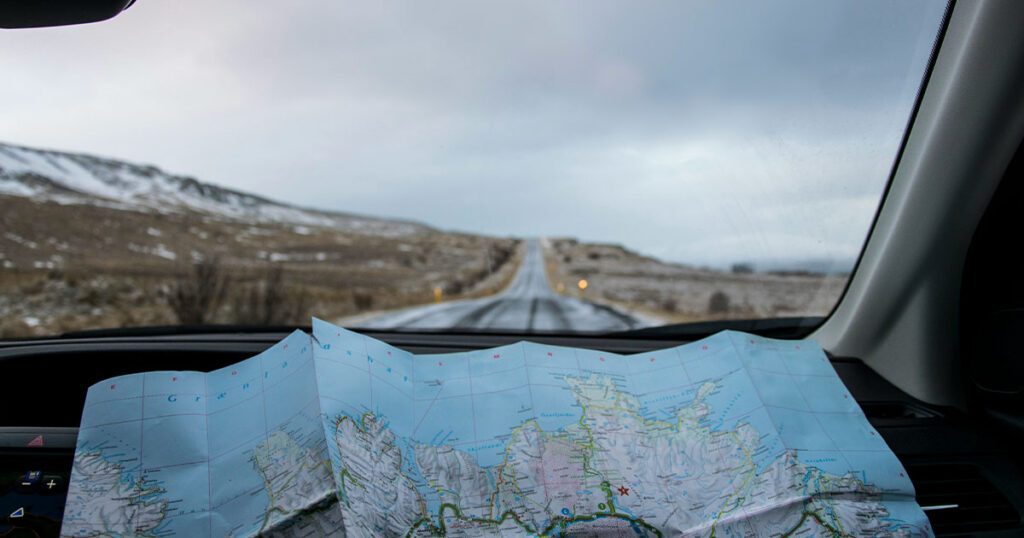
Not so very long ago, getting from here to there involved the awkward origami of unfolding a large paper map in the confines of a car, or depending on the kindness of strangers. Only in the past two decades have we shifted our allegiance to the electronic maps easily accessible in our dashboard or pocket. But our confidence in maps, our belief that they mean only to serve us, has always been somewhat naïve. In his classic How to Lie with Maps, the geographer Mark Monmonier explained how maps and their makers have, intentionally or unintentionally, led us astray, whether from the distortions of their projections, from their biases or ignorance (“Here Be Dragons”), or in a desire to favor some information and obscure other information for one purpose or another. Some degree of favoritism is unavoidable: As Denis Wood argues in The Power of Maps, every map is defined by what it omits.
Given our near-universal reliance on apps like Google Maps and Waze for driving, Uber and Lyft for being driven, and AllTrails and Gaia for navigating any land left unroaded, now is the time for an explanation of both what makes digital maps possible and why our trust in them should be something less than absolute.
Katherine Dunn’s Little Blue Dot offers a concise, popular history of the development of a technology that has become deeply integrated into nearly all aspects of our lives. Beyond its civilian functions, GPS has become critical to freight rail networks, international shipping, financial trading, filmmaking, seismic activity monitoring, the U.S. power grid, and of course warfare, adding drama to the discussion. Dunn provides a warning about how vulnerable GPS is and, by extension, how vulnerable we are.
GPS—just one of several global navigation satellite systems (GNSS)—is an outgrowth of the use of radio waves as a tool for military aviation, which allowed Germany to bomb Great Britain in darkened skies during World War II. The desire to destroy targets more precisely is directly responsible for our ability to track our morning run in real time.
The story Dunn tells covers some familiar ground—Marconi’s work on wireless radio transmission, the race between the Soviet Union and the United States to launch a satellite, the failures of precision bombing throughout the Vietnam war—and reminds us of some not-so-distant milestones, including the first production-line car with GPS navigation (Mazda’s Eunos Cosmo, unveiled in 1989), the first GPS-guided cruise missile deployed (1991), and the debut of Google Maps (2005), which catapulted to popularity on the iPhone.
Dunn focuses much of her story on people, from Wernher von Braun and Fred Whipple to Bradford Parkinson and Roger Easton, the latter two having each been credited as the “inventor” of GPS. Rather than take sides, Dunn makes clear that GPS was developed, improved, promoted, and implemented by scores of people. She takes particular interest in lesser-sung heroes like Charlie Mary Noble, namesake of Fort Worth’s Noble Planetarium, a high school math teacher who became legendary for her promotion of astronomy; Gladys West, the Black mathematician who worked to improve the accuracy of missile trajectories by studying variations in Earth’s gravitational field; and Maria Berlinska, a Ukrainian woman who cofounded a free training school for drone pilots in 2015.
Ultimately, the true focus of Little Blue Dot is where things stand now. Although we might appreciate being able to track our luggage or dog with an AirTag, we are understandably wary of being trackable whenever our phone is in our pocket or purse. More ominously, in the less than two decades since so many of us became dependent on GPS, any number of individuals, governments, and criminal networks have been working to undermine it. Some of the most compelling passages in the book are about how GPS has necessitated an ever more precise measurement of time, and about “spoofing”: co-opting a GPS signal and replacing it with false information.
Early on, the U.S. government restricted the use of the most accurate GPS data—after all, it was developed for military purposes—and offered a degraded version to the public. That changed in 2000, not only making readily available locations more accurate but also making the location of an object accurate to within 40 billionths of a second. The GPS signal on a smartphone is, under optimal conditions, accurate to within roughly 16 feet; high-accuracy GNSS can pinpoint a location within two inches.
Spoofing can change the perception of both where something is and when it has passed that location. Dunn describes a 2012 experiment in which a spoofed signal caused a drone’s autopilot to “correct” its course and plunge toward the ground, and another in 2013, when a spoofed signal effectively took over control of a yacht. But those experiments pale compared with the spoofing of navigational signals in Russia, which has led cabs and ships astray and, Dunn writes, allowed Vladimir Putin’s government to protect him from drone attacks; the creation of an electromagnetic “Iron Dome” around all of Israel; and the spoofing in today’s news that allows a ship to disguise its identity, origin, and location in the Strait of Hormuz.
Spoofing and signal jamming have become commonplace in areas of conflict and can also be used to disrupt mobile phone signals. In response to the threat, the U.S. Naval Academy is once again requiring celestial navigation as a core competency, land-based radar towers have been installed, and pilots are being trained, as before, to fly by sight. But the possibility of large-scale interference remains. Some experts say China’s BeiDou satellites have the ability to jam or spoof navigation systems anywhere in the world, even as they offer an advance in two-way communication.
So there it is, yet another double-edged sword—one whose edges are likely to become only sharper as it is wielded in the near future.