
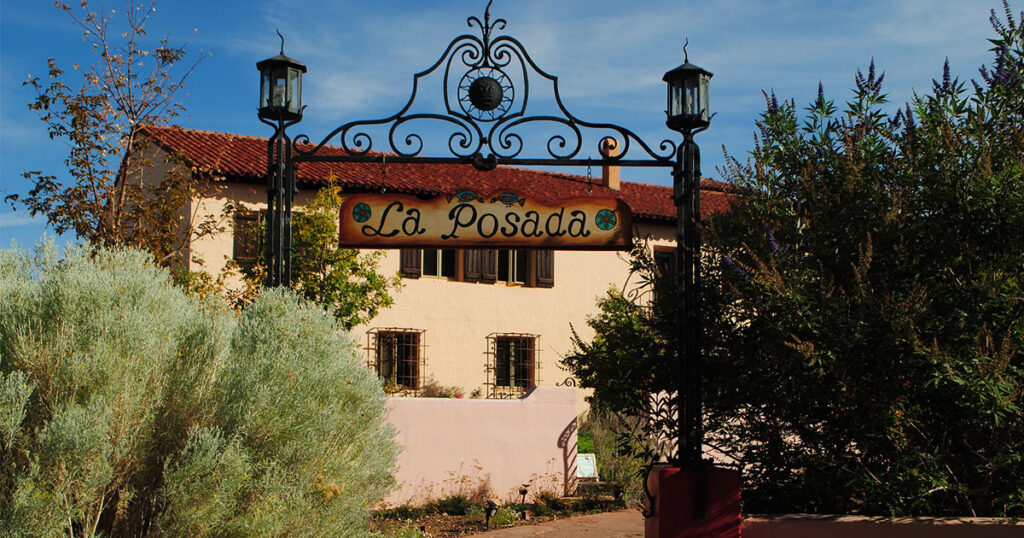
I didn’t run into Johnny in the Turquoise Room at the La Posada Hotel in Winslow, Arizona.
But I almost did.
I was stepping away from the bar, where I had ordered a glass of water and a glass of Mont Gravet, to return to the small round table and my waiting mother. The bar, in an alcove just inside the restaurant entrance, was already crowded, stools all occupied, and the bartender was making drinks for her customers plus the guests in the dining room. She was half-frazzled. I could tell it might be a while. She said she would set the drinks on the counter when ready. Not a problem—our table was three steps away. The dining room proper was on one side, beyond two great arches, and on the other side was the host table, where guests would wait to be seated. Reservations were recommended, and we had one—for the next evening. That first night we were merely scoping out the place.
“Oh, sorry,” I said as I almost bumped into a pleasant-looking man leaving the dining room. He had become aware of me stepping into his path before I saw him, and had already made some pleasant apology. He was more formally dressed than most of the guests, and thinner too, more alert. He let me pass, then went on.
People were drifting through the foyer, having a look around, deciding what to do. A couple of them put me in mind of large, ponderous instruments, like a double bass, and others seemed slow and sonorous, trombone-like. The man I’d almost collided with would be a banjo—versatile, quick. Within a minute of passing by our table, he had surreptitiously reappeared to ask if we had everything we needed. Not some nimble guest weaving between the wait staff after all, but Johnny, the manager of the crew. We’d ordered our drinks at the bar, I explained, and were waiting. “Oh, very good,” he said, encouragingly. Then went to check on our order.
With Johnny on it, we did not wait long, and soon he brought our drinks and inquired if we would have an appetizer. Why yes, we said, and pointed at a couple of items on the menu. “Which would you recommend?”
Johnny seemed to want nothing more than to find the perfect fit for us, and when we told him that a friend had spoken very highly of the signature black bean and corn soup, he added his recommendation. The soup plus fried calamari made our evening meal. Both were delicious.
“Will we see you tomorrow?” we asked on leaving, and Johnny said we would. And we did. The following evening, he led us to a booth at the far end with a view of the entire restaurant. Among other sights was Johnny, moving up, moving down, seating guests, and checking on them. He was speedy without hurry, attentive and affable but not fawning. So who was this guy? We kept eyes and ears open, observing.
On our way out, we stopped to say goodbye. And we learned that Johnny had earlier worked at La Posada on the front-of-house team until he left for the Oregon Coast with his family. Several years later, when the Turquoise Room put out a call for a new manager, he answered it. We’d met him on his first night back. He had two girls, Ruby, 13, and Nora, 11. They were still in Oregon with his wife but would come in a few weeks. “In time to start the new school year?” I asked.
No. The school year in Oregon ended late and in Winslow it started in early August. The girls would hardly get a vacation at all. That would be a pity, thought Johnny and his wife, and the Winslow school officials agreed. Let the kids enjoy their summer. They wouldn’t miss anything in the first couple of weeks.
“Do they want to come?”
Oh yes, Johnny answered. He and his wife had been nervous about telling them, but the girls were looking forward to it.
My own big move from one state to another occurred the summer I was nine years old, between third and fourth grades, going from Illinois to Durango, Colorado. I would be leaving a flat, windy land for one of mountains and rivers. Freight trains rumbled across town in Illinois, but in Durango, my brother told me, there was a narrow-gauge train with a boiler and a smokestack and a plume of smoke floating above as it chugged out of town and up into the mountains. At a store in town called The Treasure Tunnel, you could buy polished gems that came from the river, he said. He had gone on the scouting trip with my father and seen the trains, the store, the river, and the swinging bridge over the water. I had been in an ecstasy of anticipation. What about Ruby and Nora, I wondered—what might entice them about dry, flat Winslow, Arizona, and the dozens and dozens of freight trains passing through each day, going somewhere else? I asked Johnny.
He smiled. Just as he surely does all night at the questions and whims of customers. “They asked if they could have a dog. We said, ‘Sure! Two dogs if you want!’”
In mid-August in Winslow, the sky starts to get light around 5:30 a.m. Sitting by the tracks in a hotel Adirondack chair, I watched the trains go by. On one I counted 95 cars, three engines, and one caboose. “Freight train, freight train,” I hummed, “running so fast.” Nothing fast about these trains, just steady. “Freight train, freight train.” Peter, Paul, and Mary sang the version I knew. Not likely the girls would know that old song. Would they know even The Eagles and “Take It Easy?” If not, they would soon learn. Would Johnny know my train song? If not, I bet he’d know another. With another train, bound for somewhere.