
Who Is the Samurai, and Who Is the Prisoner?
Kiyoshi Kurosawa’s films show that when it comes to history, some blanks aren’t meant to be filled
Arguments about the way history (or ancient literature) is depicted in entertainment can get surprisingly heated, as recent controversies over the casting, the costuming, and the characterization in Christopher Nolan’s adaptation of The Odyssey prove. But what many people fail to understand is that the past itself is an uncanny place. We look backward to tell us something about now, but the act of looking distorts both the past and our own sense of self. As William James’s observed, when we remember a moment from our past, what our brain is producing is a memory of the last time we remembered that moment. It’s a copy of a copy. Each callback creates a new copy that overwrites the original, distorting the distortion.
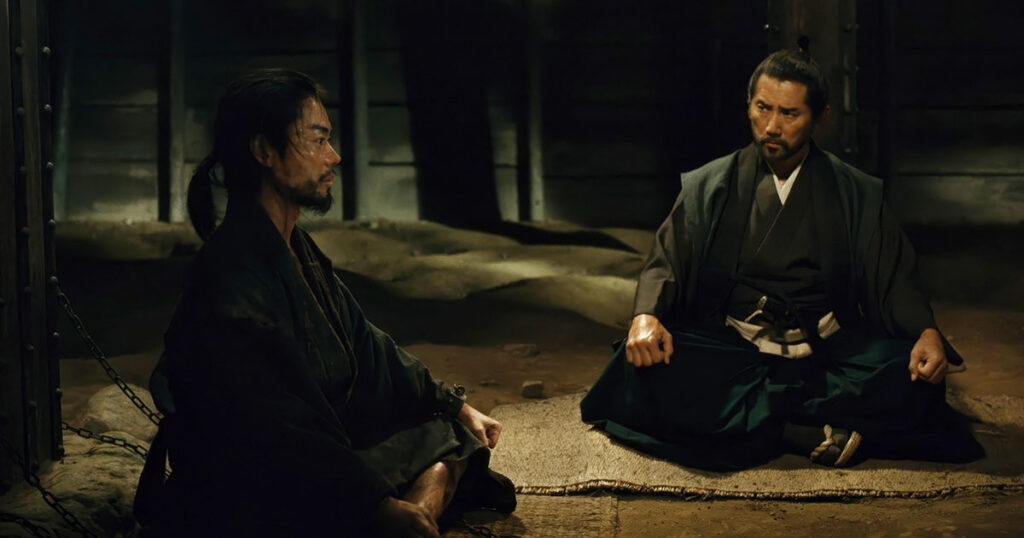
Kiyoshi Kurosawa’s The Samurai and the Prisoner is an attempt to fill in a historical blank. We open in 1578 during Oda Nobunaga’s campaign to unify Japan. Araki Murashige, one of Nobunaga’s former allies, refuses to join him. A messenger arrives at Murashige’s castle to warn him that he has chosen the wrong side: if he doesn’t join, his kingdom will be destroyed. Rather than send the messenger, Kuroda Kanbei, back to his leader with a response, or else make that response immediately clear by having the messenger executed (as custom would demand), Murashige orders Kanbei’s arrest and imprisonment. He thus sets off a series of events that will change the course of the war and lead to one man’s disappearance: his own.
The film is an adaptation of Honobu Yonezawa’s 2021 historical novel of the same name, which is based on a set of known facts. When Araki Murashige betrayed his former ally and his kingdom came under siege, he abdicated his position and disappeared. He left behind his wife and his people, and his kingdom was overrun. But Murashige’s reasons for disappearing—the feelings, thoughts, and processes that inspired a man to act in such a mysterious way—remain ultimately unknowable.
What makes a man relinquish power? What would make a man who has fought through great sacrifice and pain give up what he has accumulated? And if we don’t know his intentions, how are we to judge whether this was an act of great cowardice or bravery? If he had abandoned his kingdom to spare the lives of his men, who have sworn to die protecting their leader, couldn’t this act then be reframed as one of mercy? But how to know the difference if we can’t see inside the mind of the man? And, of course, why does that matter? These historical anomalies, when a person or a nation behaves in a way that is mysterious to us, invite speculation. The unsolved murder, the historical quandary—the gap is a place for the imagination to play, even if what we create there will say things only about us and never about the period itself. Murashige himself is an anomaly—even his wife comments that she “can’t see into [his] heart.”
In the Yonezawa/Kurosawa version of events, Murashige develops a distaste for power. Or, at least, a distaste for power as it is practiced at the time. He seems disgusted with certain demands for violence and retribution. Adhering to the samurai code of honor would require that both Kanbei and the young son of a man who betrayed Murashige are killed. He dismisses the advisors who remind him of his responsibility to take these lives. “If I only obeyed custom,” he reminds them, he wouldn’t have his position of power. His reluctance to commit these acts at first looks like mercy, grace extended by a benevolent leader. But mercy makes the world of the castle strange. No one knows how to act because the leader is suddenly unpredictable. Even his decision to betray Nobunaga starts to look less strategic and more the result of some private inner process that will have tragic consequences for everyone around him.
Murashige’s ultimate decision to abdicate the throne violates the traditions and codes of the era, but it also goes against what we think of as human nature. In classic stories of the powerful, those who have power cling to it, bringing on destruction as a result. (This is the story behind one of the most famous samurai films of all time, Throne of Blood by the other, unrelated Kurosawa, Akira.) Murashige attained his position of power through violence and force. But his unwillingness to continue to use force creates uncertainty around him. As Kanbei warns him from a prison cell, “If you do what is contrary to the customs of the world, there will be consequences.”
Reality within the castle starts to warp. During each season of the ensuing year something impossible seems to happen—a murder structured much like an Agatha Christie locked-room mystery, the seemingly supernatural mutilation of a corpse, the killing of a priest and disappearance of treasure, and the death of a traitor by a lightning strike—and Murashige must solve these incidents, lest his people succumb to superstition. He turns to his prisoner to help him solve the mysteries, but Kanbei gives enigmatic answers and it’s never quite clear if he’s assisting or undermining his captor.
We as viewers know the samurai is violating codes of conduct because that is precisely what the film is communicating. But those of us who have seen a lot of samurai films will also know that like the Western or the detective story, the samurai film is a genre with clearly delineated rules and processes. And their prolificacy—from classics like the other Kurosawa’s Seven Samurai and Takashi Miike’s 13 Assassins to FX’s surprise 2024 hit Shogun—has established a set of expectations for the viewer. We are entering a world of rules and traditions, there will be erotic restraint but grandiose bloodshed, and someone is probably going to commit seppuku.
When we think up some aspect of World War II, we are likely to picture something from a movie we saw (Saving Private Ryan, perhaps), rather than anything based in historical knowledge. But screen-based entertainment distorts reality, influencing how we interpret and remember historical events. As Elizabeth D. Samet documented in Looking for the Good War, Hollywood films about World War II had a profound, worldwide effect on how people understood the war itself. As the films continued to come out, certain ideas solidified in people’s minds: The United States was the ultimate victor, the Soviet Union’s contributions were sidelines, and the Nazis were the pinnacle of evil. The bad things the United States had done (firebombing Japanese and German cities, perpetrating mass rapes through France and Italy, welcoming Germans and Japanese scientists who had been accused of war crimes, for example) diminished in both people’s minds and in the historical record.
Kiyoshi Kurosawa’s only other dip into historical features was his 2020 film Wife of a Spy, fittingly enough set during World War II. The plot concerns an amateur actress, Satoko, who discovers that her husband is working with the British to smuggle out evidence of Japan’s war crimes and medical experimentation in Manchuria. She has seen and acted in spy movies before, and she thinks she can effortlessly step into the role created for her by genre entertainment to assist him in his treasonous activities.
It’s never clear if she is betraying her country because she believes, like her husband, that what Japan is doing makes it worthy of violent retribution. It could be that she is simply choosing one loyalty (to her husband) over another (to her homeland). But when the world doesn’t respond to the role she is playing in the way she has come to expect from films, she finds herself unable to adjust. By the end, she loses all sense of self, and she ends the film alone with the city behind her in flames, screaming in grief and madness.
There is the historical time of the samurai, and then there is the distorted entertainment of the samurai. For those of us in the audience who are not historians or experts on this period, it is distortion all the way down.
Kurosawa invites these genre expectations and then disrupts them by centering a samurai who refuses to behave like a samurai. He has an almost modern sensibility, with his sense of mercy and restraint, but also his longing for a different way to live. Given the opportunity, he would follow his heart and build his life around tea. He also has a more contemporary understanding of trauma and the aftermath of violence.
The film features two short anomalous sequences, which appear like intrusive thoughts. The first is a vision of Murashige’s wife Chiyoho, rocking back and forth on the floor, comforting a doll as if it were a child. When she was young, she witnessed a battle that turned into a massacre, and this vision, which will be repeated later in the film, is either a memory of her trauma or a fear of what Murashige is about to inflict on the ordinary people he is sworn to protect.
The second sequence is also either a vision of the future or a memory of the past. Murashige greets Nobunaga, his once ally and now enemy, and maidens are lined up as an offering or a sacrifice. Nobunaga beheads two of the women and demands that Murashige kill the others. These are not the stoic, voluntary deaths we associate with the samurai. They are horrifying acts, performed amid painful screams and sobs.
Murashige’s refusal or hesitation to act during the present opens up a space for divine intervention. If the leader can’t get things done, maybe God or Buddha will have to do it. (There is some wonderful dialogue after the first appearance of Christian missionaries about how believers of different faiths are interpreting the strange events around them.) The first murder, of the traitor’s son after Murashige refuses to order his death, seems to have been committed with an invisible arrow, shot at an impossible angle. Even if the murderer had been human, divine guidance had to have helped. Murashige’s people, unable to source logical reasons for these strange events and finding their leader unreliable, are quick to blame supernatural sources. They have been living under uncertain conditions, waiting to be subsumed by an invasion or perhaps saved by an ally, for months. His wife cautions him, that the thing “ordinary people” fear most “is what comes next.”
These sorts of anomalies are Kurosawa’s thing: In all of his films, something or someone behaves differently than you would expect and that reveals the weirdness of the world. It’s always been weird, you just haven’t had to notice.
In Tokyo Sonata (2008), a man named Ryuhei loses his job but tries to prevent his family from learning the truth, and as a result the whole household starts to break apart. His son suddenly enlists to fight in another country’s war, his wife is abducted during a home invasion, and a fellow unemployed man loses his mind and commits a horrific murder. Because of Ryuhei’s inability to fulfill the expected role of the patriarch and provider, all of the people around him lose their way as well. In Cure (1997), a strange patient asks his doctor about her history of being mistreated by the men she works with. She had repressed her suffering in order to keep functioning. But with a simple question, the repressed bursts through into her consciousness and all of a sudden she is in the men’s bathroom, peeling a man’s face off with a scalpel.
In order to survive our time on earth, we consciously sort out a lot of information that might disturb our ability to function, by which we mean go to a job, fulfill our boss’s demands, cook and eat dinner, get in a car and drive to Costco. If we paid attention—real attention—to any one of these acts, we might notice how strange they are, how devoid of meaning, how close everything is to coming entirely undone. Kurosawa presents moments of inescapable weirdness, disrupts the unconscious flow, and shows the world its uncanny reflection.
In most of his films, someone tries to put the weird world back into order through an investigation. Within The Samurai and the Prisoner there is a detective procedural, as Murashige and his men attempt to gather evidence to establish the facts of the seemingly supernatural events. But as soon as they solve one mystery, another emerges. In Cure, a detective tries to wrap up cases like that of the homicidal doctor, but hers is just one in a whole string of murders that all seem to have been committed by separate, unrelated people but in identical ways. In a Kurosawa film, it always looks like the mystery is going to be solved, the world is going to be put right again, but then the detective’s gaze strays back toward the mysterious and the more profound questions that lead to a dangerous psychic space. Once his characters notice the weirdness of the world, its fundamental uncanniness, they’ll never be able to unsee it.
Murashige’s problem is that once he gets a good look at the code of honor and the acts he is expected to commit in order to retain his position of power, he can’t unsee how much blood and suffering and terror such a code requires. Even as he re-establishes equilibrium after solving each mystery, he can’t unsee what he has seen. He is only able to see all this because his prisoner directs his gaze in a certain direction, but is it out of benevolence or revenge? The knowledge is a gift and a curse.
In the 1970s, American psychologist Edward Tronick conducted an experiment in which women with young children were directed to present their infants with a “still face.” They were asked to show no expression at all, not even when their babies exhibited distress. It turned out that babies could cope with expressions of disapproval or even anger from their caregivers, but being met with no expression at all, with a blank face, upset them greatly. They would cry or coo or fawn or reach out, desperately trying to get some sort of reaction. Only when the mother’s face returned to its responsive state could they settle down.
I often think that what Kiyoshi Kurosawa is depicting is the reaction to a kind of divine still face—not absence, but cosmic indifference. And how people, faced with that, will wriggle and scream and flirt in an attempt to provoke a reaction. Murashige’s characters seem to prefer to believe the fantasy that the mysterious acts they witness were the result of divine intervention. The heavens might be ruled with violence, but at least they are responsive. Murashige himself, having seen the world’s weirdness, knows that there is only blankness, and he cannot help but become a blank himself as a result. Thus he disappears from history.