
The possessive pronoun—of course it’s handy to know what it is and how to use it. Whether in English, Spanish, or Ossetian, every child soon learns to say, “It’s mine!” But possessive pronoun as a term? Do 10-year-olds learning a second language need to know it? Of course not, and if not, what good does it do a teacher to rattle out the phrase? So I don’t talk about the possessive pronoun; I just use it.
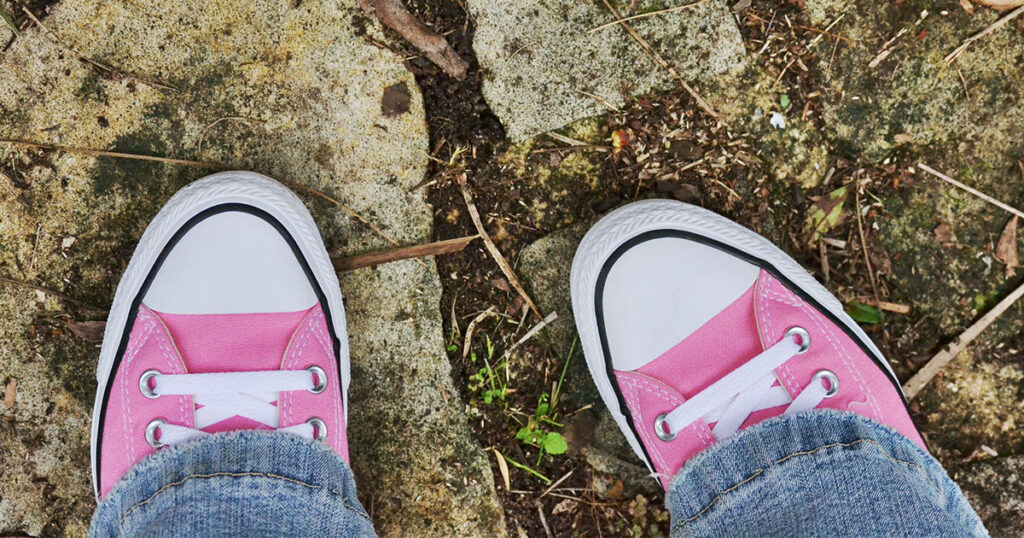
To practice, I point to a student’s new pink shoes. “Whose shoes,” I begin, but suddenly stop.
The textbook uses a slightly different form for a similar question: “Whose is this scarf?” It hurts my poetry-loving soul to follow suit and ask the question that way: “Whose are these shoes?” Robert Frost, who springs to mind at the word whose, surely would not. He would keep the noun at the front of the phrase, whether asking about scarves, shoes, or woods. But to avoid confusing my students, I bow to the authority of the lesson and shift my sentence structure. “Whose are these shoes?” I ask, my mind still on Frost.
The little girl looks down at her shoes, looks up at me standing two feet in front of her, my arm out, finger pointing at the pink trainers, and she smiles—not quite at me but toward me.
“They’re very pretty,” I add. Then I wait. We have time. Beside her, the other two students jiggle in their seats to get my attention, but I gaze steadily at the little girl. She’s a year younger than the other two, her memory is good, her pronunciation is beautiful, and her shyness is a fact of her life, harder to work on than her English.
Whose shoes these are I think I know.
She sits before me, in her row.
And does she mind that I stand here
To test and watch? I don’t think so.
This little girl must think it queer
To speak so loudly, without fear,
Of shoes, or book, or small keepsake,
As do the others, who sit near.
She gives her head a tiny shake
As if she dreads a small mistake.
The others blurt their guesses out;
She weighs the answer she will make.
It takes her a moment more to come up with her answer. She looks left, she looks right, then she looks up and her eyes are on me. Deep eyes.
Her eyes are lovely, spirit’s stout.
“Mine?” she says, her tiny voice barely audible yet brimming with doubt and timidity.
“Yes!” I sing out. It was more for her effort than for the right answer. Because that part I never doubted.
She will succeed—I cannot doubt.
I glance at the clock.
A minute now til class lets out.
The students pack up their things. They’re ready, standing at the door.
The minute gone. Now class is out.
And they leave, two chattering, the third going as quietly as she’d entered.