
Our Versatile, Durable Pickup
The story of a vehicle that is many things to many people but is, above all, an American icon
America may have been the home of that great innovator Henry Ford, but the inventor of the gas-powered automobile was Carl Benz, a German, and most early car technology originated in Europe. Cupholders aside, two innovations that are distinctly American stand out: the station wagon and the pickup truck. In the 1950s, suburban American families fell in love with the station wagon—until they didn’t. The last American-made full-size station wagon was manufactured in 1996, replaced by the minivan and the SUV. Meanwhile, every mainstream European car company still has a station wagon in its lineup. These vehicles are called estate cars in Britain, kombis in Germany and Sweden, and breaks in France. The obscure origin of the last term is the shooting break, or break de chasse, a horse-drawn wagon that carried dogs and gear for hunting parties. Thus, like the British estate car, the French break conjures an image that is sporty and upper-class rather than suburban. Ironically, the origin of the plebeian American wagon is likewise upper-class: The first Ford station wagons—the charming woodies—were expensive vehicles, marketed to country estate owners and resorts to ferry their guests from the railroad station.
Culture matters. Europeans like station wagons, but they are still lukewarm on pickup trucks. European-made pickups are rare. Volkswagen, Fiat, and Peugeot make pickups in South America exclusively for that market, and although a midsize VW pickup (built in South Africa) is available in Europe, it is not a big seller. Americans, meanwhile, may be over the station wagon, but their affair with the pickup continues. Indeed, the Ford F-150 pickup has been the best-selling automobile in the nation for the past four decades.
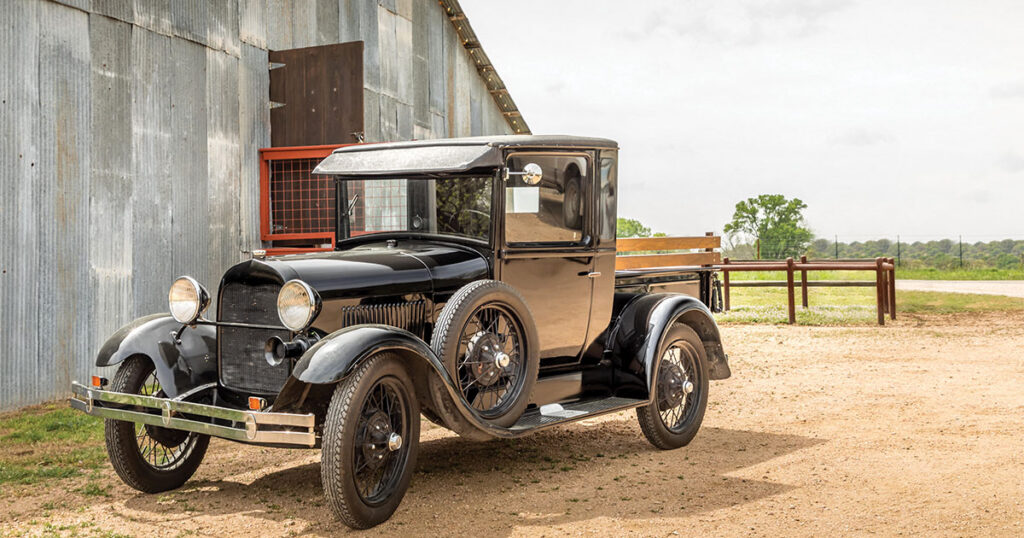
The pickup dates from the dawn of motoring. Immediately after the Model T appeared, private coach builders began adding a shallow box to the rear of a modified Ford chassis. The Galion Allsteel Body Company of Galion, Ohio, is sometimes credited with the idea. Seeing a business opportunity, car manufacturers followed suit, and in 1925, Ford modified its Model T Runabout, a two-seater roadster, by adding a cargo bed to the rear. A few years later, the Model T’s successor, the Model A, was unveiled. It was a closed-body car with roll-up side windows and a safety glass windshield. This was before General Motors popularized the practice of marketing different models, and the Ford was a Ford whether it was a coupe, sedan, roadster, station wagon … or pickup. At less than nine feet long, the wheelbase left room for a small cargo bed with a loading space of only 17 cubic feet, although it could carry heavy loads, thanks to an upgraded suspension. Vans and trucks remained the vehicles of choice for deliveries and hefty cargo, but the carlike truck, intended chiefly for farmers and ranchers, was useful for occasional “pick-ups.” Old photographs show the little truck loaded with milk cans or piled high with bales of hay.
Mechanical devices evolve sometimes slowly, sometimes quickly. It took 50 years for the passenger automobile to achieve its final shape. The first step was to enclose the passenger compartment with a solid roof and windows, then to add a trunk in the rear, and finally to replace the fenders and running boards with a smooth “pontoon” body. By contrast, the first Ford pickup—a two-door cab with a bench seat for the driver and a passenger, and a rear cargo bed with low sides and a hinged tailgate—emerged all of a piece. Over time, the basic configuration persisted while the bed grew larger. By 1948, when Ford introduced the F-1, it was no longer a modified car but a purpose-designed truck, and the length of the cargo bed had grown from four and a half to six and a half feet.
Login to view the full article
Need to register?
Already a subscriber through The American Scholar?
Are you a Phi Beta Kappa sustaining member?
Register here
Want to subscribe?
Print subscribers get access to our entire website Subscribe here
You can also just subscribe to our website for $9.99. Subscribe here

true