
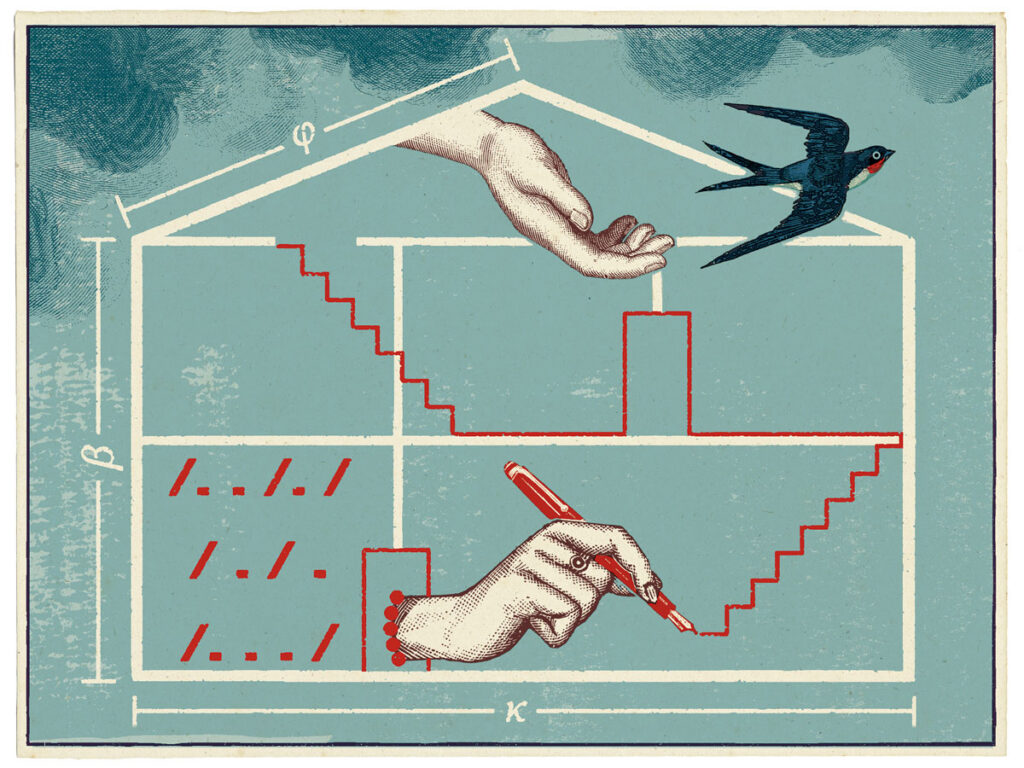
Stanza is the Italian word for a room in a house or building. This fact held little weight for me when I first learned it at 18 years old, slogging my way through an entry-level Italian class that met at nine a.m. every weekday at the University of Virginia.
The word acquired gravity only in the poetry workshops I took in later semesters. Stanzas, I was taught, were a principal organizing measure of poems. If I thought of a poem as a house, each stanza became a room; a poem’s formal thresholds, its movement from “room to room,” are what build tension and create propulsion.
UVA is where I began learning the craft of poetry. The Phi Beta Kappa Society is the house in which I became a poet, putting a roof over my head (sometimes literally) as I made my way through early adulthood. What follows is a roam through memory, from room to room.
I get my first job by oversleeping. I blame the “spring forward” of daylight saving time, but it wouldn’t have been a problem if I hadn’t slapped my alarm silent twice. As it is, I am not present when my name is called at the 2002 Phi Beta Kappa induction ceremony for the Beta chapter of Virginia.
After the ceremony wraps, I approach John Churchill, the ninth Secretary of the Society, who is new on the job and attending as many inductions as he can. I request my ceremonial handshake, stammer out, “Oh, your office is in D.C.; I’m going to grad school at American University,” and ask if he needs volunteers.
The national headquarters, as it turns out, has a newly budgeted $25,000 per year internship. He gives me a business card, and two interviews later, I am Phi Beta Kappa’s intern.
Our offices are on the fourth floor of 1785 Massachusetts Avenue NW, though everyone calls it the Mellon Building. The walls used to hold oil landscapes that have since been donated to the National Gallery of Art. The office I share has a fireplace and a John James Audubon bird print.
Sometimes it feels weird, working in a space that was so obviously a home. Our files fit awkwardly in deep cabinets built for linens, not legal-size paper. But who could complain about opening a forgotten safe and finding a letter from Robert Frost tucked inside, as happens to a colleague one day.
Presiding over it all is Secretary Churchill, who insists we call him John and speaks with a warm Arkansas accent. When my MFA program’s Literary Journalism class requires me to profile someone, John agrees to sit and talk for two hours over pints of Bass Pale Ale, which summon his memories of studying at the University of Oxford as a Rhodes Scholar.
Despite having just graduated from a university that relished Civil War history and mid-19th-century literature, I am not enamored of Ralph Waldo Emerson’s approach to the world. I want to be an artist, not an American scholar. But John is so pure in his enthusiasms—our conversation jumping from growing rosemary to Ludwig Wittgenstein’s time in a monastery garden to the Wittgensteins’ sponsoring paintings by Gustav Klimt. He effortlessly cross-fertilizes practical matters, academia, and art, and I am beginning to understand that my love of avant-garde art forms might be deeply incomplete if I cannot learn to appreciate what has come before them.
Because the Society’s annual award for a poetry book is relatively new, the volumes submitted for consideration are filed haphazardly on the tall shelf beside my desk. In fact, one is not a collection of poetry at all; I pull Susan Stewart’s Poetry and the Fate of the Senses from the pile. Although I’m told to discard it, I beg John Hollander, a judge for its intended award category, to take it on for review. Stewart will go on to win Phi Beta Kappa’s Christian Gauss Award for literary criticism. Luck, I learn, can never be discounted when it comes to book prizes.
The 2002 Phi Beta Kappa Poetry Award ceremony takes place at the Cosmos Club. Judge Yusef Komunyakaa, who won the 1994 Pulitzer Prize for Poetry, and all five finalists attend. I manage to put my foot in my mouth when I greet Nathaniel Tarn by complimenting his translations of Pablo Neruda, which I’ve just finished reading for my Poetry in Translation class. “People only ever mention the Neruda,” he says resignedly.
I don’t remember the remarks, only small moments. Finalist Jimmy Santiago Baca isn’t prepared for the Cosmos Club dress code, so he has to put on a borrowed tie and a jacket fished out of the lost-and-found closet. When Marie Ponsot is named the winner, finalist Grace Schulman, seated beside her, plucks a rose from the table arrangement and lays it on Ponsot’s plate.
I overhear T. R. Hummer mention to Komunyakaa that he has brought his horn, and the possibility of playing pickup at a local jazz bar arises. As I walk home to my apartment in the Adams Morgan neighborhood, I wonder if I will spot them through the window of Bossa or Columbia Station. But even if I do, I know to keep walking up 18th Street. I have not earned my place yet. I am not a published author—I’m still assembling my thesis, carrying around a binder-clipped stack of pages I shuffle daily.
Phi Beta Kappa’s 40th Triennial Council is held in Seattle, a city I have never before visited.
Former U.S. Poet Laureate Robert Pinsky is receiving the Award for Distinguished Service to the Humanities, and I have been assigned to be his handler on the night of the ceremony. I’m excited and nervous—he seems like a celebrity to me.
Everything goes wrong. Moments before I’m supposed to head down to the reception, I get a call that my father is in the hospital back on the East Coast with a collapsed lung (thankfully, he will make a full recovery). Instead of admitting that I’m too upset to fulfill my duties, I head down to the ballroom late and in a daze.
Absent his handler, Pinsky has gone wandering in search of a glass of red wine and a name tag. I have the name tag, but I’ve left the holder in my room. I attempt affixing it to his jacket pocket with a paper clip.
Later, when I present my copy of his translation of Dante’s Inferno to be signed, he asks, “Why do you have Henry’s copy of my book?” I’d forgotten that it had been a castoff my professor Henry Taylor—Pinsky’s peer—gave me on his retirement from teaching.
At the end of the dinner, exhausted, I make my way upstairs. Another award winner didn’t collect his check that night; I peek into the envelope and find, to my horror, I’ve switched Pinsky’s check with his. I call down to the front desk and connect to Pinsky’s room. It’s late, but he’s leaving early the next morning, and he gruffly says I should swing by now. He opens the door in a white undershirt and, I’m certain, can barely resist slamming it shut after me.
The Phi Beta Kappa team gathers for staff meetings around a conference room table. Lately, our meetings have been preoccupied with the impending move to new headquarters, just a few blocks away on New Hampshire Avenue. But we always have time for personal news of birthdays, weddings, vacations, and so on. Today, the news is mine to share.
“I published a poem!” I hold up the Fall/Winter 2003 issue of Rosebud to prove it. I’m thrilled—Rosebud has national distribution, and I’m in the same issue as Ray Bradbury. I am met with tilted heads and puzzled congratulations. John does not ask me to read the poem.
Later, staring a little dejectedly at the magazine, I register that its cover features an illustration of a suited man, his face partially obscured by a rodent mask, and a woman wearing a rabbit head and holding a mask of a woman’s face. Or is she a bunny-woman hybrid? Either way, and surely noticeable to my colleagues, part of her nipple is showing.
The poem begins in an office that mirrors my own—a new development, following a recent minor promotion—“from gray floor to gray wall.” I miss the cheery grandeur and easy chatter of the office I used to share. The reality of a full-time job plus full-time graduate school is also catching up with me. I often hide in my desk’s kneehole, curled on the floor, for quick naps.
When I get discouraged about the realities of the writing life, I like to sneak over to walk around the office of The American Scholar. To be a fledgling writer working under the same roof that houses an acclaimed magazine is both educational and agonizing. So close, yet so far. Submissions are ferried up in big mail bins, stacks of envelopes waiting to be sliced open. In every one of them, I see my dreams waiting.
I complete my MFA program in late 2004. My thoughts are increasingly about the practice of being a real live poet, and American University is no longer my sole reason to live in D.C. The city has around a dozen bookstores, literary series hosted at storied institutions like the Folger Shakespeare Library and the Library of Congress, plus a slew of independent readings, such as the Burlesque Poetry Hour, hosted monthly at the Bar Rouge on 16th Street.
I leave Phi Beta Kappa in 2005 to serve as an executive assistant to a husband and wife, both authors. It’s a great way to learn about maintaining a writing life. But after a few years of the highs (lecture prep) and lows (dry-cleaning runs), I’m thrilled when Bob Wilson, editor of The American Scholar, makes a space for me as an assistant editor at the magazine. By this time, Phi Beta Kappa has moved into its new home on New Hampshire Avenue. A month into the job, I learn that I’ve won a university press’s contest for publication of my first collection.
Both of my two main editorial duties, assembling the magazine’s Works in Progress department and coordinating its books section, require a kind of ferocious breadth of interest in the world around me. Architecture, particle physics, politics, economics, environmental conservation, music—I’m acutely aware that all fit under the umbrella of Phi Beta Kappa’s dedication to the arts and sciences, and all might be fodder for a 300-word reported snapshot or a book review.
What I lack in expertise I make up for in gonzo energy. I persuade the fundraising committee for the Martin Luther King Jr. Memorial to offer us a glimpse of the statue then being planned. I convince an opera composer to share a score before the piece is done. How would political philosopher Jean Bethke Elshtain contend with a new book by English historian Tony Judt? Only one way to find out: Make an assignment.
This constant rotation of subjects, and the curiosity it requires, is making my poems weirder and rangier. I’m writing less about my life and more about capybaras and chemistry.
My favorite publication phase is “pink book” proofing, just before the issue is shipped. It’s hard not to be in awe of Jeanie Stipicevic and Sandra Costich, editors on staff who have a combined 50 years of experience and spot things no one else can. But I’m the one who catches a tiny mechanical error in the image caption for “Nessus at Noon,” the last piece published by John Updike in his lifetime. Jeanie gives me a high-five.
I’d come back to Phi Beta Kappa for the Scholar, thinking I’d stay a while. But life has other plans. I win a poetry prize that opens doors to meeting agents, one of whom encourages me to propose a nonfiction book he can sell. The day I sign with him, a dishwasher breakdown in Phi Beta Kappa’s kitchen showers my desk, computer, and review galleys with soggy ceiling tile.
By 2013 I have published a memoir, a second poetry book, and a New York Times Book Review article on that strangest of backhanded compliments—plagiarism.
This last piece catches the attention of John F. Andrews, former executive director of the English-Speaking Union, an international education organization and Phi Beta Kappa’s original carriage house tenant at the New Hampshire Avenue office. John reconnects me via email to his buddy Donald Lamm, a former vice president of the Phi Beta Kappa Senate who had occupied esteemed positions in the literary world, having been an agent and the chairman and president of W. W. Norton.
John and Don invite me to dinner if ever I’m in Santa Fe, where they both now live. A year later, my husband and I take them up on that offer. Over chips and salsa at a converted gas station, I hang on their stories, which are anchored by references that I quietly scribble on a napkin to look up later. It’s occurring to me that I won’t be part of the historical record unless I contribute to the labor of recording history.
Come Celebrate Our 100th Anniversary, the invitation says, adorned with W. W. Norton’s seagull logo, reminding me with a jolt that I am a Norton poet. The formidable publishing house has released the last three of my four poetry collections, but I am two years out from watching the latest drop into the pandemic abyss, and I have not been writing, instead juggling multiple jobs to support my family in the wake of a medical crisis. Still, I am determined to go to this party, so I pack my cocktail attire and ride the Amtrak from D.C. to New York City, the sky outside my window growing increasingly orange from the haze of the Canadian wildfires.
There’s a moment at a New York literary party, or at least all those I have attended, where you lurk against a wall feeling small and lost, all the while pretending to inspect your drink. The planned remarks are over, the toasts toasted. You’ve said hello to those you know, made one or two game efforts to meet people you don’t. Your feet ache.
Maybe that’s when you spot a face you didn’t dare hope to see. Of course he has flown in from Santa Fe for this—he started off as a college sales rep for Norton in 1956, before retiring in 2000 as chairman and president. “Don,” I say. “Don Lamm.” He turns.
Within the Phi Beta Kappa Society, I have always found poetry. Wherever I go as a poet, Phi Beta Kappa appears. I began by calling the Society my house, but that isn’t quite right. Phi Beta Kappa is the key that unlocked my house’s door.