
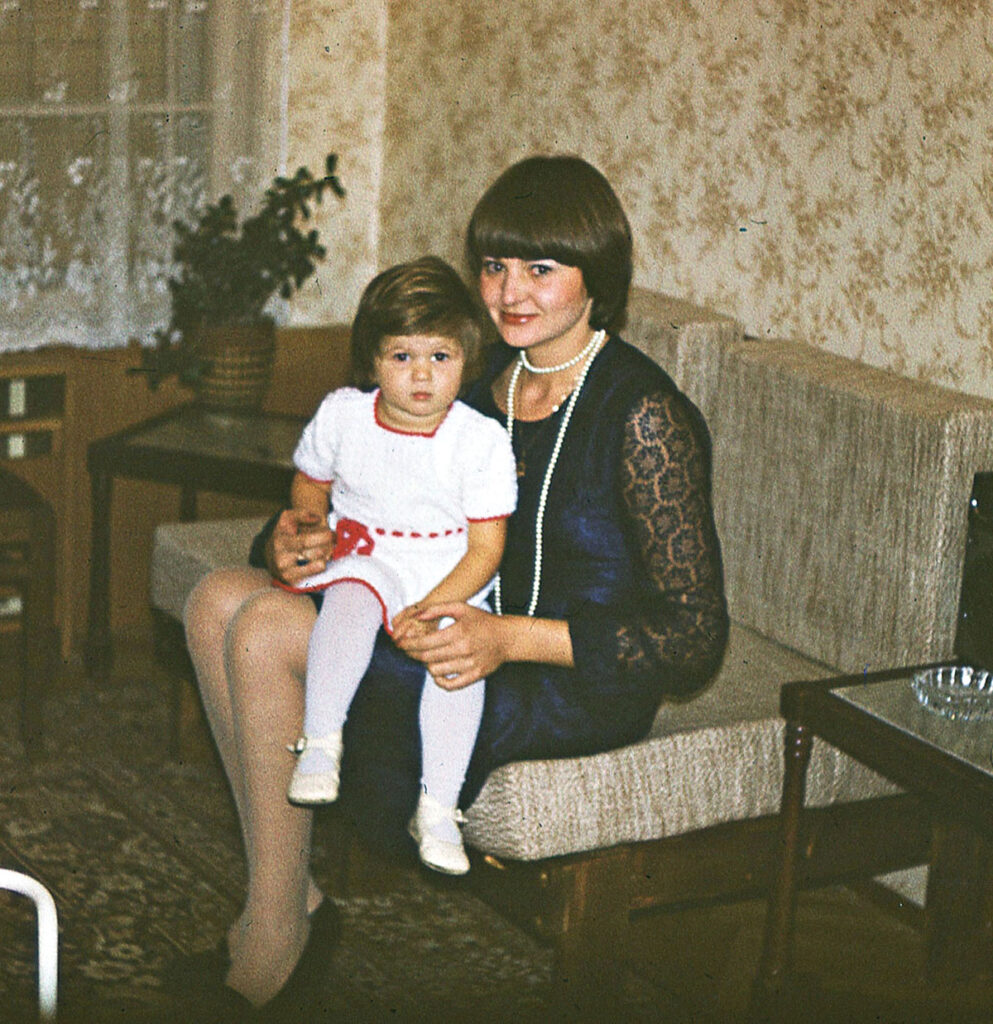
My father, Solomon—wild, ambitious, unruly—always joked that my mother, Nedialka—beautiful, brainy, reticent—had “caught the last train” in marrying him at the spinsterhood-circling age of 25. (It was 1979.) My great-aunt Stoyanka, who’d raised my mom after her parents died, was initially charmed by my father because he brought her flowers, which no one had ever done, but soon spotted the telltale crease in his left shoe and the limp that signaled his smaller left foot and shorter left leg, the result of having survived polio as a child. “Don’t marry him, Nellie,” she said to my mother. “He’s only marrying you for the apartment. Plus he’s got a bad leg. And he’s Jewish.”
But marry they did, in late December, eight months after they met, celebrating with 200 guests and dancing until the wee hours of the new morning. My mother, whose locks had once reached the backs of her knees, wore her golden-brown hair short, in large curls held up by a white flower crown that also held the veil. Her floor-length white dress was belted at the waist, with three-quarter-length sleeves and a high lace collar, see-through at the décolleté. Her hands were sheathed in short lace gloves, a gold ring over her gloved index finger. In the wedding photographs she is stylish, dignified, perhaps contemplative, but fond of the attention. In Bulgaria and, I suspect, elsewhere in the Balkans, the groom shows up at his bride’s house on their wedding day with his entire family, “breaks down” the front door, and “pays cash” for his new bride. I’m sure my father enacted an elegant version of this. Outside her apartment, my mother was greeted with a kiss on the lips by her tall, handsome father-in-law-to-be, my grandfather Israel. My father, in a photo capturing the moment, looks on with an undisguised, petulant jealousy—he knew just what a catch my mother was. (The men were only 20 years apart, and the relationship could be explosive.) At the ceremony and reception Solomon looks delirious with anticipation, ravenous for his new life, for his new bride, the most beautiful mechanical engineer in all of Sofia. The newlyweds signed at city hall—as one did back then because in communism there is but one God and that God is the state—under the Bulgarian coat of arms: a reared-up silver lion. (The lion, a symbol of Bulgarian strength and courage since the 12th century, was here edited for communism, with the cat flanked by ears of wheat.) My father was decked out in a black tux and bow tie, midnight hair in a ’70s bowl cut that glistened like a raven, low sideburns and oversize glasses with tinted lenses. A savvy handlebar mustache rounded his upper lip and curved down over his tiny mouth ever so slightly.
A few days later my father ran, limp and all, up the seven steps of his new home, the first-floor corner apartment at 6 Latinka Street in Sofia. He had nothing but his books, the shirt on his back and a burning, if undefined, ambition. He moved into a building occupied for generations by the same families, all with vastly different backgrounds and dispositions: affluent editors and party secretaries, factory workers, doctors, deadbeats whose parents were given an apartment because they happened to own part of the land the building was built on, and Sofia’s only TV weatherman—the perpetually tipsy Kanchev, up on the fourth floor above us. Every evening at
7:45 p.m., Kanchev held our entire apartment building—and all of Bulgaria, for that matter—as his captive TV audience, gently swaying, wooden pointer in hand, in front of a paper map of our tiny country propped up on an easel. The whole of eternity passed before he finally, absurdly, declared: “The weather will be … predominant.” The neighbors became family or mortal enemies (there was no middle ground), and you lived with them until the bitter end. People only ever moved in, or were born in, and no one ever moved out. They were carried out feet first.
I arrived nine months and 19 days after my parents’ wedding, in October 1980, the first of two daughters born to Moni and Nellie. My middle name was to be Solomon, after my father, per the patronymic naming system of Bulgaria then, now, forever. But when a city clerk came into the recovery room to fill out my birth certificate and heard my first name come out of my mother’s mouth, she hesitated, pen in hand.
“Izi … dora … What sort of name is that?”
“It’s the name we’ve chosen.”
“Well, unfortunately, that name isn’t on the list.”
“What list?”
“The list of permitted baby names, of course.”
The name Izidora isn’t Jewish, but it evidently still threatened the delicate fabric of Ivankas, Anis, and Marias, and my middle and last names—definitely Jewish—protruded with their ostentatious lack of conjugation amid a sea of Ivan-ovas and Andre-evas and Stoyan-ovas. Together, my three names formed an unholy trinity that Bulgarian bureaucrats were apparently unequipped to handle. I went home from the hospital nameless and stayed that way for three months. Eventually the bureaucrats threatened to name me by committee: “But doesn’t Isabella sound more … euphonic?”
My great-aunt Flor, the Jewish matriarch of the family, had had enough and marched down to the municipality, reminding them that Hitler had once changed her name, too. Bulgaria had saved nearly 50,000 Jews during the Holocaust when, in response to protests arising in parliament, the Orthodox Church, and elsewhere, King Boris III halted the trains headed to the concentration camps. But the Jewish population was still put through hell. More than 11,000 Jews in occupied territories were deported and murdered. Those who were not immediately killed were forced to work in labor brigades, to observe curfews, and to live with anti-Semitic legislation and discriminatory taxation. Plastic yellow Stars of David were sewn onto jackets like buttons, personal property was stolen, and names were changed so that your Jewishness could be telegraphed for all. Flor’s intervention startled the bureaucrats, and by the early afternoon, my birth certificate was typed up, all three very non-Bulgarian names on it.
As much as it stifled individual ambition and initiative, communism still-birthed imagination. My father was well-read and bookish but prone to verbal spats that always threatened to turn physical (he once nearly pushed our deadbeat third-floor neighbor, Vlado the Prick, off the roof of our building over an argument about a television antenna). He was allergic to authority down to the marrow of his bones and thus perennially falling out with his bosses. He had even managed to get himself fired from his accounting job three days before I was born. But Solomon had, nevertheless, a sharp entrepreneurial eye, a brilliant imagination, and a penchant for risk taking that was outside most people’s comfort zones. One fall, when I was about three, he partnered with Vassil, a guy he and my mom had met randomly at a Black Sea resort earlier that summer, because Vassil told my father the two of them could make 10,000 leva in three months—unheard-of money. They’d take part in a state-incentivized scheme to raise baby chicks for 12 weeks, then sell them to farmers and co-ops. Apparently, animal farming qualifications were not a prerequisite. “I’ve never known a Jewish chicken farmer!” my grandfather Israel, a respected civil designer and construction auditor, remarked with no small amount of dismay. He was always attempting to guide Solomon’s career, but suggesting that my father do anything was akin to waving down a hurricane.
Raising chickens was indeed a curious choice for an educated city boy, Jewish or not, especially one who read the collected works of Dumas in Russian and translated long-form essays from the same language into Bulgarian. But Solomon was set on the 10,000 leva, and so he bought several hundred baby chickens, rented a large barn outside town, transported a small bed from our kitchen to sleep in, and purchased special quartz lamps with mirror reflectors to mimic sunlight, because it was late November. One of my earliest memories is of visiting that cold, dark barn and cradling a fluffy yellow chick in my tiny hands. When I accidentally let it go from knee height instead of placing it down on the ground, my father gently told me, “Be careful, you can hurt it.” (At the same time Vassil, whose drinking was revealed only after Solomon partnered with him, would get wrecked and fall on the chicks, each time causing a small-scale massacre.)
At some point, my father got tired of Vassil’s drunken falls and fired him. He asked Rumba, his best friend from the trade school for precision mechanics and optics, to become his partner. The two 28-year-olds borrowed a boxy Moskvitch sedan from Rumba’s father, took out the back seat, filled the car with crates of clucking chickens, and drove around the villages on the outskirts of Sofia to sell the birds. After they’d offloaded their pungent inventory, Solomon took the wad of cash, not nearly 10,000 leva, but enough to more or less break even, and he and Rumba went to what was at the time the best restaurant in Sofia, Shtastlivetsa—“Lucky Guy”—built at the foot of the Vitosha Mountains, the lights of the capital twinkling below. Solomon and Rumba started to drink and continued to drink. They finally got around to ordering steak, and when it arrived, my father pressed one and then several more 10-leva bills into the waiter’s pocket so the latter would cut and keep cutting his meat for him.
We had a joke in Bulgaria in the mid-’80s. Hot Water and Electricity bump into each other outside the main entryway to an apartment block. “After you. I’m only here for two hours,” says Electricity. “No, no, after you, I insist,” says Hot Water, “I’m only going up to the first floor.”
The electricity “regime” was two hours on, two hours off, to conserve energy because Bulgaria was bankrupt. People joked that from the air, Sofia looked like a discotheque: lights on, lights off. The timing in your particular neighborhood was based on its location, and I was upset that our off-time always coincided with prime TV time. I didn’t even consider what this did to the food in our fridge. Once the power went out, we lit candles, convoluted our fingers into shadow puppets, and sat around while my parents chain-smoked. Finally, my father summoned the power with his deep vociferous baritone, tokaaaaa, tokaaaaaaa, and it did, magically, come back on mid-yell.
The electricity regime was inconvenient, but the hot water shortages were demeaning—and they lasted for months. To wash, we boiled giant vats of water using a combination of samovars or deep pots on the stove, transferred the hot water into a big green plastic basin and then diluted it. For some reason, the basin of scalding water was always perched precariously on the edge of our bathtub—a brutalist concrete box, tiled in pastel green, that rose straight from the floor.
Back then, we weren’t only short on hot water and electricity and tampons and toilet paper and bread and baby formula: with small but inexplicable exceptions, like Twin Peaks, we were also largely deprived of worthwhile television. As a result, we’d go wild for low-grade entertainment like the ridiculous Brazilian telenovela Isaura: Slave Girl, already a decade old by the time it was shown to us in a histrionic dubbing. Izidora and Isaura were far too close for the boys in my class to overlook, and I was addressed as “Isaura, slave girl!” for months. Isaura was beautiful and mistreated, but it was Januária, the large Black cook, who truly captivated me. Januária whispered dark spells into her deep simmering pots as she stirred them and was generally pulling the strings of everyone’s doomed fates.
And there I was, mumbling unintelligible incantations as I circled my palms over the steam emanating from the giant green basin on the edge of the brutalist bathtub, as my mother, her back to me, stood over the sink washing something. What happened next is perhaps not surprising. I don’t remember touching it, but the basin slid off the edge and fell not back into the bathtub but forward, splashing scalding water on me and gluing my pajama bottoms and my socks and my pull-on slippers to my legs and feet. I howled in pain, my mother howled in horror, and in an instant, my grandmother Dochka, who’d been watching TV in the living room, lifted me from behind as my mother pulled down my pajamas and socks and slippers, simultaneously ungluing them and my hot pink skin from my body. Dochka, by then already significantly slowed by a botched surgery on her bad knee and supporting herself with a wooden cane, loved to retell the story in her raspy voice over one of her long, thin cigarettes. As the smoke curled around her short, permanently lacquered mahogany hair, she would say, “And then I leapt like a lion from the living room.”
The end of communism came in phases, like a cold sweat, and although we were approaching the precarious (though bloodless, at least for Bulgaria) switch to democracy and a free market, in 1988 there was still plenty of communism left to go. The country had borders such that you could enter but scarcely exit, three television channels (one of them in Russian; another didn’t even start programming until 5:30 in the evening), three types of (very good) unsliced bread at the store, and cars made by Lada and Trabant and Moskvitch for which you had to wait years. It was a time of chronically petty financial stakes and soul-crushing bureaucracy—not misery, exactly, because the ideological bubble of the pyramid scheme that is communism hadn’t yet totally burst and most people owned their homes. Yet life felt permanently, irrevocably small. One could get a little taste of what the outside world was like from relatives sent abroad for work who brought back good whiskey and Toblerones and a little foreign currency to tuck away.
But no one was more worldly or had better travel opportunities than our sports stars. Rhythmic gymnastics was what all little girls aspired to. The gymnasts were our golden girls, Bulgaria’s pride—they traveled abroad, they made our little country famous, and we hungrily gathered around our small black-and-white televisions to watch their young lipsticked faces. We yelled, “Brava! Brava!” and cursed our rivals, the Russians, to the death, so that they’d drop their balls and ropes and clubs. Neshka Robeva, Bulgaria’s notorious national-team coach, a single stark blond streak slashing her black hair, was idolized and feared and despised for her tyrannical methods, for making the girls cry, for making them world champions, for starving them. “They’re only allowed to eat one banana a day!” was something I often heard. Its intended shock value was lost on me, as we had no bananas in Bulgaria.
Bananas were an exotic, tropical luxury from another world. When we somehow ended up with a box of them one New Year’s Eve—unimaginable riches, courtesy of Solomon—I watched with incredulity as my great-aunt Stoyanka, the one who’d been against my parents’ marrying, ate the soft, bitter inside of a peel. “Why are you eating the peel?” I asked her, disdainful, condescending, all of eight. “You don’t know what it is to be poor,” she said. And I really didn’t. Her mother had been pregnant with her when her father, my great-grandfather, was declared an enemy of the state because he’d taken part in an antifascist uprising in the 1920s. He ran, escaping to Ukraine by boat via the Black Sea. Once in Ukraine, he established a commune and worked as a tailor. For 12 years he lived in exile, sending money only on occasion. My great-grandmother raised her three children by herself, tended to the modest land adjacent to their small house, and lived off that land, partly by making and selling wine. I didn’t yet recognize the makings of a pattern that would come to define the lives of so many of the women in my family: paying their men’s debts, raising their men’s children.
My own foray into the golden dream of rhythmic gymnastics began when I was eight—already too old. But I was tall and thin and passably pretty and, I thought, rather flexible. I had done ballet, could do handstands and one-handed cartwheels, the splits, and even half a toe loop on ice. My mother arranged for me to be taken to the big gymnasts’ hall by our neighbor, Mimi, the 20-something daughter of Kanchev, the tipsy weatherman from the fourth floor. Kanchev’s daughter was attractive and slender and had at one time done rhythmic gymnastics, and since under communism everything depended on connections, it was decided that Mimi was the only one who could take me to the great hall where the golden girls practiced. Off we went on the trolley bus to try my luck.
We arrived, and I’d never seen ceilings so tall, a room so brightly lit, so lavish for the sheer amount of space it offered. Young girls with eyes pulled up by tight buns danced and jumped in stretchy leotards, bounced red and pink balls so glossy that they looked to be made of glass, twisted jump ropes around their bendy bodies, chucked too-large clubs for their teammates to catch, drew into the air with their red and white ribbons. Mimi walked me to the office of someone important. She may have been a coach. She was definitely smoking. Short introductions followed. “Lay on the ground, face down,” the dark-haired woman instructed me, and I did, and she leaned over and used her nonsmoking hand to grab my right ankle and bend my leg toward my head, followed by my left ankle, until both were around my ears, and she kept turning me until I’d been rolled over my chin and still she rolled me until an involuntary, unladylike grunt escaped from deep within my gut. She let go of my ankles, took a drag on her cigarette, and as I unwound myself, exhaled the fatal verdict: Malko e tromava. This can be translated as, “She’s a bit clumsy” or “she’s a bit lumpish” or “she’s a bit clunky, ungainly, bottom-heavy, a bit elephantine, gawkish, ham-fisted, a bit ungraceful, sluggish.” Such is the vast richness of the Bulgarian tongue.
Indoors, like good little Bulgarian girls, we were seen and never heard, but the playground was a screaming battlefield and the battle was always us against the boys in whatever we were doing: hide-and-seek, scheming for money, kicking a football, hunting and rescuing kittens, slamming balls into one another’s faces while playing narodna topka, our weirdly nationalistic name for dodgeball. Our playground, surrounded by six or seven apartment buildings, was peak communism: there was an empty, large patch of green on one end, and the other had two orange plastic seesaws, both cracked, and two corpulent iron swings, one of which was perennially unhinged or missing altogether because we’d swung it so high that metal had pounded metal until it had bent and snapped. Into the swing’s empty A-frame we’d shove an entire wooden bench and dangle our feet while peeling the hulls off roasted sunflower seeds with our teeth. Across from the empty swing frame was an orange plastic slide with a permanent crack that deposited you straight into a small, filthy sandbox. To its left was the metal skeleton of a blue ship, and the picture was completed by a sideways rocket fused to the cement. It was ugly, and it was all we had. We had no idea other worlds existed, and we didn’t care.
We were always interested in what the boys were doing, but they were never interested in what we were doing. We were jenki, dumb little females. The playground boys were different from the boys at school, not that those boys didn’t get away with a certain amount of violence in between classes. But absent the order of the classroom and teachers there to pull their ears, grab them by the collar, or slap them with a ruler, the playground boys taunted us, spat on us, chased us down to lash poison ivy across our cheeks, threw dead cats at us. They were empowered by some unknown law, some tacit universal understanding that males were superior and we were there to be demeaned and to seek their approval. On more than one occasion we summoned older relatives to rescue us in the hope they’d also beat up the boys on our behalf, which they sometimes did.
In the summer, I was out all day, my hands dirty, my knees perpetually flaunting thick maroon scabs, playing until I heard my father’s powerful whistle from the dining room window. Fu-feee-fuu. Pause. Then harder, with an exclamation. Fu-feeee-FUUUU. My chosen partner in crime was always Tsvetanka, who’d recently moved to the neighborhood with her family. She was eight, I was nine, and I picked her to be my everyday accomplice because she’d shown athletic skill and because she was second tallest (I was the tallest girl and therefore the ringleader). We were reedy tomboys, always in shorts, always running and jumping and climbing trees, picking rock-hard green plums and eating them as if they were free dessert, or squatting and pounding apricot pits with broken concrete tiles for their sweet, almond-like seed, or swinging on the metal carpet beaters until the mazoli—calluses—on the inside of our palms thickened and yellowed and some old guy in a trench coat randomly appeared from around the corner to shake his dick at us.
We gathered sticks and started small fires right in the middle of crosswalks, roasting potatoes under a pair of bricks. We scavenged for plywood for the playground boys because they were going to build a skateboarding ramp, and we dragged scraps of anything that resembled the material from blocks away for their approval. We picked thick bouquets of dandelions and wove them into python-size garlands that we’d attempt to drag home, only to get spotted by the boys, who would run over and gloatingly stomp on them, the flowers dying a second death. The evergreen scarcity under communism meant we sometimes had a football to kick around, but most of the time all we girls had was a ball of the cheap white elastic cord our grandmothers used to sew into our underwear to hold it up. We took that ball of elastic and cut four meters out, tied the ends, and used our fingers or the backs of our legs to stretch it out so Tsvetanka and I and another team of two girls could take turns jumping and crisscrossing the elastic with our feet for hours on end, performing intricate feats on the concrete, which eventually wore silver dollar–size holes into the soles of my only shoes during that particular time, a pair of red leather flats.
When, sometime in the mid-1980s, my grandfather crashed his pride and joy, his navy-blue Lada, with his mistress in the passenger seat, the only car he could afford was a banana-yellow Trabant. To say that the Trabant, made of Duroplast—a blend of recycled cotton waste and plastic—was the worst automobile manufactured in the entire history of automobiles would be hyperbolic, but only slightly. The car, outfitted with a two-stroke engine capable of generating more black smoke than a coal plant, was only slightly longer than a person and could go only up to 100 kilometers an hour, but it bravely ferried my grandparents and my parents and me, plus something inevitably strapped to the roof. For years, my parents would recall the one time my grandfather got the car up to its full capacity on the highway—an event.
My father borrowed the tiny Trabant whenever he could and inherited it after my grandfather died in 1987, but he—and we—dreamed of having our own car. Under communism, getting a car typically meant making a deposit into a slightly mysterious third-party account, having your name put down on a waiting list, and maybe at some undetermined time in the future, getting a phone call with the happy news. And yet, one day it appeared: a big, dark green Moskvitch, larger than a Trabant and not made of cardboard. It was used and clunky, but having it was a big deal.
One morning when I was seven, I woke up to my mother’s exclaiming in despair: “Oh God, Moni, look what they’ve done to the car!” I looked out our balcony and registered something quite off. The bulky hood of the dark green Moskvitch was pointing up, way up, at an unnatural angle. As my gaze panned to the rear end of the vehicle, I suddenly understood my mother’s horror. The two back tires had been stolen, and in their absence two small piles of red bricks barely kept the trunk off the asphalt.
Later that year, we drove the Moskvitch across the country to the seaside and got passed on the way by every single car. As a Mercedes flew by us, my father turned to my mother and said, using the sweet nickname they had for each other, “That’ll be us one day, Mutsik.” We sped back home only three days later, after my dad’s sister called to tell us someone had come in through the double-paned windows of our living room and robbed the apartment. Over the years, our apartment was robbed about nine times. We suspected our chronically unemployed neighbor Vlado the Prick in most of the robberies, and come to think of it, he was probably behind the Moskvitch tire trick, too.
But those robberies were not what finally persuaded my father to put wooden shutters on all the windows. It was something far more menacing. I was 10, and we had just gotten the Mercedes that Solomon had promised, in glittering gold. On a morning just like any other, I got up before my parents, got ready, and took myself across the street to school. When I came home early in the afternoon, my mother, typically still at work, stood at the entry to our living room, pale and wet-eyed.
“What happened, did someone steal the new car?” I asked.
“No. Someone threw a brick through our bedroom window last night.”
I’d heard nothing.
Some six years after the chicken farming fiasco, Solomon, an economist by education, had decided he was no longer going to work for someone else. He would be at the helm of something big. He would be the boss, the creative vision and force behind all his future endeavors: opening the hottest nightclub in the capital, running five restaurants, renovating city landmarks, building the first manufacturing plant in the country after communism, developing plans to build a whole city. But before all that—before he sent me, alone, on an airplane to Chicago, before he brought my mother to join me, before he flew with my little sister on the Concorde to New York and then on to Chicago to bring her to us, before a meteoric rise and a spectacular crash, before he signed his companies over at gunpoint and surrendered his passport, before a rigged, purposefully delayed 13-year trial and two imprisonments—before all that, he did something he had a bad habit of doing. He pissed off the wrong people.
A brick crashed through the double-paned window of my parents’ bedroom in the dark of night, flying over their heads before landing on the floor between their bed and the crib of my two-year-old sister, Theodora. She slept on unharmed, but my mother startled awake, her eyes slowly coming into focus on the rivulets of blood from the cuts the spray of glass had caused on her inner forearms. A handwritten threat was strapped to the brick by a rubber band. Whoever had thrown it was aiming for my father’s head and must have known which way the bed faced—had, most likely, seen the inside of our house. The next day was a Saturday, and I watched as my father had six-foot wooden shutters installed over every single window.
It was 1990: communism was officially over, and, I came to realize much later, so was my childhood.