
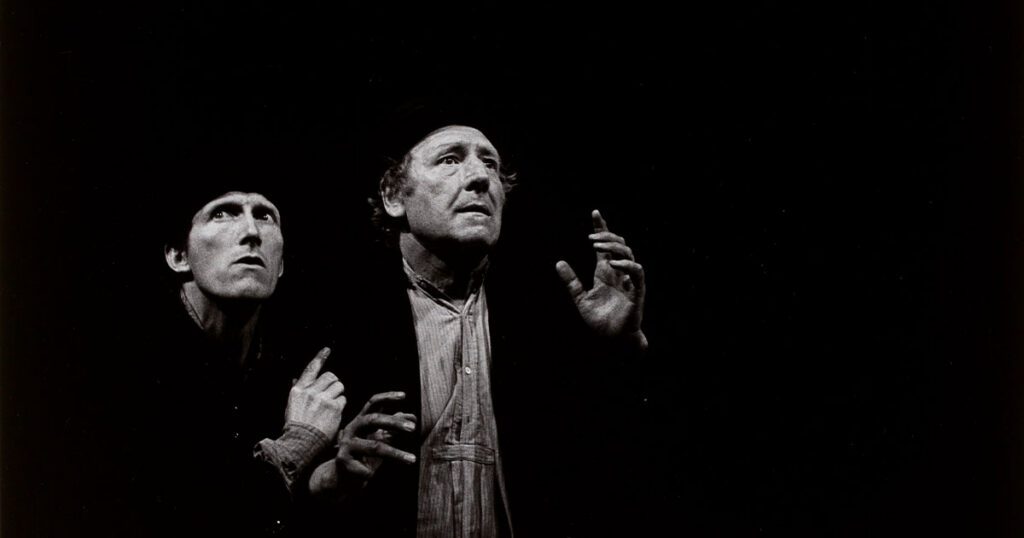
Every afternoon, I drive to my local YMCA and spend an hour jogging in place on an elliptical machine. At that time of day, I am not in the mood to chat with my neighbors, churning away at their own machines, or even to gaze at the images on the screen before me. I instead turbo-charge my elliptical run and open a book. I am all business.
But a couple of weeks ago, my eyes kept wandering from the book I had brought—a play that my students were reading in one of my classes—to a fellow Y regular. I had noticed her many times before but had not paid her much attention. Wearing the same garb every day—a white and blue sailor’s shirt and baggy, blue jeans—she always circled the gym with small weights in both hands, frequently halting her orbit to chat briefly with another gym member. It was always the same. The width of her gyre never changed.
Her routine, which I first found intriguing, began to make me uneasy. Why did I see her, as if for the first time, only now? It no doubt had something to do with the book I had brought with me that day. As I looked down at one of the dog-eared pages, I reread an exchange between the play’s two principal characters, Vladimir (Didi) and Estragon (Gogo):
ESTRAGON: Let’s go.
VLADIMIR: We can’t.
ESTRAGON: Why not?
VLADIMIR: We’re waiting for Godot.
[Pause]
Forgive this unsubtle nod to the 20th century’s most influential play, one produced and parodied countless times, commented on in countless books and recast in what seems like countless languages: Samuel Beckett’s Waiting for Godot. Though the play first opened in Paris in 1953, this year marks the 70th anniversary of its American premiere. On January 3, 1956, the curtain went up on the play’s dismal landscape, staged at the Coconut Grove Playhouse in Miami. In an unwitting touch Beckett might have appreciated, the theater had promoted the play as the “laugh sensation of two continents.” By the intermission, more than half the audience had walked out. My guess is that nobody was laughing.
My Beckett epiphany is emblematic of the play’s uncannily prophetic character. All too often, the hawk-nosed Irish writer seems to have scripted our lives and experiences. In the 70 years since the theatrical debacle in Coconut Grove, the world has not only come to terms with the play, it has seemingly become the play. We are all characters on Beckett’s stage. Of course, this happens on an individual scale, as with my afternoon at the Y. But, no less alarmingly, it unfolds on a global scale as well, one where much of the world seems to be waiting, with a mixture of dread and hope, for the arrival of, well … what?
Don’t ask Beckett. Although he wrote the play halfway through a century scored by world wars and cold wars, genocidal regimes and totalitarian ideologies, the poisoning of our natural resources and denaturing of our political discourse, he always insisted that he had nothing to say about contemporary events. This assertion seems reflected in a stage set as blasted and bleak as the dialogues—dialogues that, in subsequent plays, withered into monologues, then drifted into the mute gestures of mimes.
Yet even Beckett, try though he might, could not fully remove himself from the world. As one of his favorite thinkers, Arthur Schopenhauer, observed, Dante mined the material for his Hell from this world of ours. The world of Godot—a bare tree, an empty road, a rocky mound— resembles the world that, a few years earlier hosted concentration camps and incinerated cities, and in our own time has been home to yet more concentration camps and incinerated cities. This is the featureless, colorless vista, fixed by a single tree, that Gogo declares, perhaps ironically, a “charming spot” with “inspiring prospects.”
Didi observes that the tree might be a willow. If so, it is perhaps weeping. Like the tree, Gogo and Didi are rooted in this world, and it is from this tree that Gogo and Didi contemplate hanging themselves. It is near this tree that Gogo and Didi make conversation with one another and with another couple, Pozzo and Lucky, who wander in and out. And it is next to the tree that Gogo and Didi wait for Godot, a mysterious figure who perhaps has a white beard. In a flight of pseudo-philosophical lyricism, Didi asks, “What are we doing here, that is the question. And we are blessed in this, that we happen to know the answer. Yes, in this immense confusion one thing alone is clear. We are waiting for Godot to come—”
[Pause]
Of course, Godot never arrives. In a Sesame Street parody of the play, the tree, fed up with the melodramatic and nonsensical patter of two Muppets waiting for Elmo, uproots itself and walks off the stage. But we cannot uproot ourselves and walk off the stage; instead, stuck like Didi and Gogo in a state of non-arrival, we wait. For those who waited for an answer from Beckett, none ever came. He once snapped at the English actor Ralph Richardson, who asked if Godot stood for God. If he had meant God, Beckett said, he would have written God. The play, he insisted, strove to avoid definition. This strategy of avoidance leaves us to gaze at a landscape void of meaning, one that by turns is the source of our bemusement and amusement.
Ironically, this same denuded landscape has lent itself to dozens of dazzling productions driven by political and moral imperatives. Over the years, the play has been staged in places racked by violence, like South Africa, Bosnia, and Israel. Or places like New Orleans, where natural calamities are compounded by man-made inequalities. Or, for that matter, in places like the maximum-security prison at San Quentin. The inmates of such places can connect in ways I never can to Didi’s plaintive series of questions:
“Was I sleeping, while others suffered? Am I sleeping now? Tomorrow, when I wake, or think I do, what shall I say of today? That with Estragon my friend, at this place, until the fall of night, I waited for Godot?”
What shall we say of today? Better yet, what shall I say of today? That I will try to do better, perhaps. But Beckett hasn’t much patience for such resolutions. Self-help gurus and management consultants delight in quoting a famous line of Beckett’s, plucked from Westward Ho, a small book he published near the end of his life: “Ever tried. Ever failed. No matter. Try again. Fail again. Fail better.” Very neat, very smart.
And very misleading. None of these writers quoting these lines seem to have read the entire paragraph, for it continues:
First the body. No. First the place. No. First both. Now either. Now the other. Sick of the either try the other. Sick of it back sick of the either. So on. Somehow on. Till sick of both. Throw up and go. Where neither. Till sick of there. Throw up and back. The body again. Where none. The place again. Where none. Try again. Fail again. Better again. Or better worse. Fail worse again. Still worse again. Till sick for good. Throw up for good. Go for good. Where neither for good. Good and all.
Still, Didi and Gogo do offer something of immeasurable value—apart, that is, from uneasy laughter. They embody the kind of good we should go for—namely, the goodness of solidarity and compassion for one another in what Pozzo calls “this bitch of an Earth.” Friends marveled at Beckett’s hypersensitivity to the suffering of others. “He couldn’t help being affected by what was happening around him,” remarked his close friend and biographer Barbara Bray. “He had a finely tuned mind which got straight to the point of everything.”
Among the many things this remarkable mind got straight much earlier than many other minds was the threat posed by Adolph Hitler. Following Germany’s defeat and occupation of France in 1940, Beckett was among the earliest recruits to the French Resistance. His reason was simple: He was appalled by what the Nazi occupation meant for French Jews, including his friend Alfred Péron. (When Beckett’s resistance cell, “Gloria,” was uncovered by the SS, he just managed to escape south but dozens of fellow résistants, including Péron, were captured and imprisoned.)
In Beckett’s tragicomedy, acts of compassion and solidarity, no matter how small or slight, appear like lightning bugs against the black night sky. There is Didi’s burst of outrage—though it soon passes—over Pozzo’s brutal treatment of Lucky; more tellingly, Didi cares for Gogo, offering him carrots, calming him with a song, covering his shoulders with his own coat while Gogo sleeps.
Toward the very end of the play, while Gogo is once again sleeping, Didi gazes at him and utters, “Astride of a grave and a difficult birth. Down in the hole, lingeringly, the gravedigger puts on the forceps. We have time to grow old. The air is full of our cries. (He listens.) But habit is the great deadener.” Indeed. It’s well past time that I break my habit of watching the woman in blue circling the gym and trying to deduce meaning from her endless actions. It’s time instead to go up and greet her.
[Pause]