
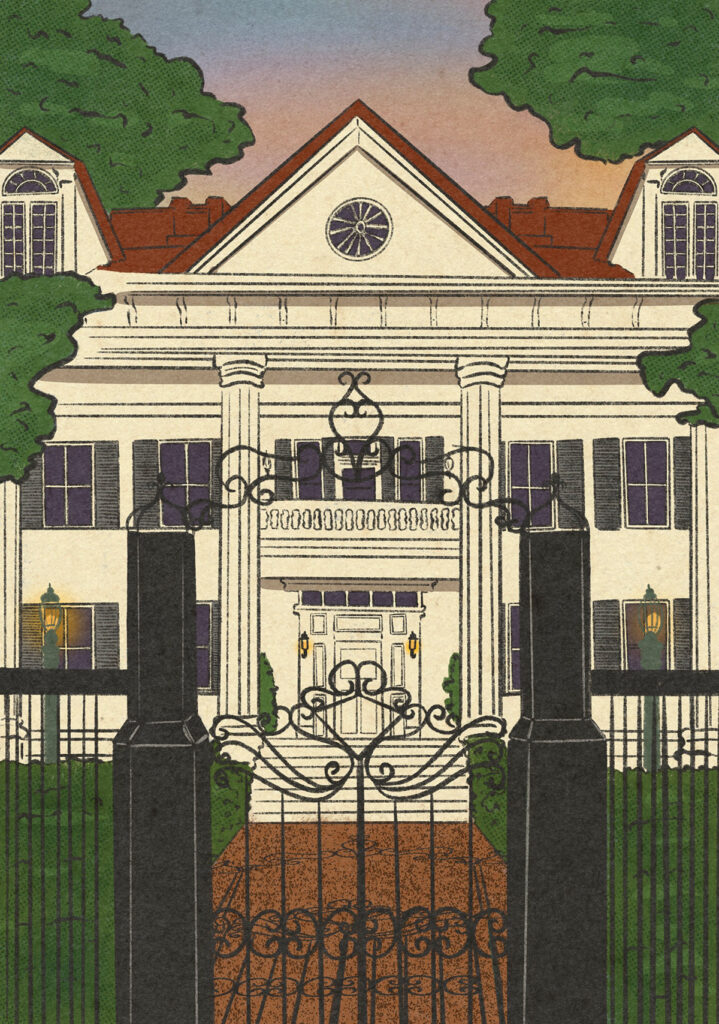
In 2015, I took a road trip with my family from Key West to Washington, D.C. The intention, we told friends at home in San Francisco, was to explore the South. My husband is from Kentucky, and I’d seen enough of the region to know that I wanted to see more. But as I described the things I planned to do on the trip—hike the Blue Ridge Mountains, look for alligators in the Everglades, eat a lot of barbecue—there was one thing I didn’t mention to my friends: I wanted to see a plantation.
Although plantations can be educational, they are often for-profit tourist traps. I didn’t want to contribute to the whitewashing of slavery that some institutions do, where the owners are positioned as philanthropists and the experiences of enslaved people are minimized or erased. However, I also knew that my view of plantations was skewed. The only exposure I’d had to them came from Margaret Mitchell’s 1936 novel, Gone with the Wind, which I read when I was 11, and the subsequent movie. I decided that I would revisit the book during the trip, reading it as we drove through the South.
GWTW was a hit when it was published, selling a million copies in six months and winning the 1937 Pulitzer Prize for fiction. Today, Americans regularly list it on surveys of their favorite books. It has been translated into dozens of languages, and more than 30 million copies have been sold. The movie has been even more successful. Adjusted for inflation, it remains the highest-grossing film ever. I knew, of course, that Gone with the Wind is racist. This has been pointed out ever since the NAACP objected to the movie in 1937. What I couldn’t have predicted before the road trip, however, was just how much this novel would shock me with its loathsomeness and dedication to white supremacy. On my travels through the South, I found that I wasn’t just interrogating a controversial book. I was interrogating its lasting hold on me.
It’s hard to overstate how much I loved Gone with the Wind as a child growing up in Humboldt County, on the northern coast of California. I was hooked from the first sentence: “Scarlett O’Hara was not beautiful, but men seldom realized it when caught by her charm.” Scarlett, with her 17-inch waist and green eyes, possesses a magnetic power that I coveted. She might not be beautiful, as the book unconvincingly states, yet when she attends a barbecue decked out in a hoop skirt, the men surround her like June bugs. I hoped one day to develop a similar irresistible charm that would allow me to control men. I’d already gotten the message that they were the ones to impress if I wanted to succeed in life. On top of that, Scarlett’s determination appealed to me. After the devastation of the Civil War, she vows to get back everything she has lost, even if she has to “steal or kill—as God is my witness, I’m never going to be hungry again.” Then she follows through on that promise, marrying a series of men, taking over multiple businesses, and running them successfully, all while driving around in a carriage unchaperoned.
I mistakenly took a feminist message from this, that a strong-willed, smart, painfully thin woman could change her circumstances, even if people were against her, or something along those lines. Scarlett is an unlikable female protagonist, and that meant a lot to me because I felt unlikable. By fifth grade, I was always picked last for partnerships or games. During recess, no one would play with me, so I hid in the hallway and read. Scarlett, I thought, was just like me. She’s passionate, and her desires are easy to understand. I was passionate, and I had strong desires. In fact, GWTW was the first book I encountered with anything approaching sex scenes: drunken foreplay in “swirling darkness,” embraces that evoke “feelings never felt before.” When you’re 11, this is potent stuff. And unlike the other women in the novel, Scarlett doesn’t care what people think. I desperately wanted not to care what people thought. “She wasn’t going to sit down and patiently wait for a miracle to help her. She was going to rush into life and wrest from it what she could.” Exactly. That was how I would be, starting next recess.
Reading GWTW led to watching the movie, which I adored. I owned a GWTW music box and two collector plates that my mom bought off TV. This led to a fascination with Vivien Leigh, who famously beat out hundreds of actors for the lead role, including heavy hitters like Bette Davis and Katharine Hepburn. I devoured biographies of Leigh and tried to see all her films. I even practiced the catlike smile she employs throughout GWTW and was flattered when another child told me I reminded her of Leigh.
So it was all mixed up in my mind: Scarlett O’Hara, elaborate dresses, Vivien Leigh, “swirling darkness,” white houses with columns, and eating rotten radishes while sobbing that you’ll never go hungry again. What strikes me now is how little thought I gave to the enslaved characters in the book. Today, this seems odd. It’s a story set on a slave plantation, so why didn’t I care about the central conflict of the story? Then again, I remember skipping over large portions of GWTW. The book is structured such that information dumps about the war are interspersed throughout the story, which means you can ignore the battles and politics and still understand what’s going on with Scarlett. On top of that, the enslaved characters speak in dialect: “Is y’all aimin’ ter go ter Mist’ Wynder’s?’ ’Cause ef you is, you ain’ gwine git much supper.” I puzzled over such lines, determined that I didn’t like them, and disregarded any dialect I encountered. Thus I read GWTW for the love scenes and drama and skimmed everything else.
My reaction may have been fairly typical. For many readers, slavery is merely a backdrop for the story. Scarlett’s racism is seen as part of her complexity, a mere foible in the fabric of her humanity. Or it’s written off as ancient history, as if white supremacy is long over, making it therefore harmless to root for an enslaver’s daughter.
The first leg of our 2015 road trip went from Key West to Savannah. Along the way, we stopped in St. Augustine and toured the Castillo de San Marcos, a 17th-century fort built to protect the settlement from pirates. Beside a rock tower, men in old-timey jackets set off a cannon with an impressive blast. My three-year-old son was delighted, shouting, “Bam bam!” and “Wow!” and asking how cannons work.
Unimpressed by the touristy shops surrounding the fort, we decided to go to the beach. Once there, I sat on the sand reading a battered, thrift-store copy of GWTW while my husband and son bobbed in the waves. The first scene revealed Scarlett where I’d left her 20 years earlier, flirting with the Tarleton twins while wearing a dress made from 12 yards of green-flowered muslin. But almost immediately, I was startled by the hatred filling the pages of the novel. GWTW is so overtly racist, it’s difficult to quote. On seeing a white person, a Black man is described rolling his eyes as his “watermelon-pink tongue lapped out” and his body “wiggled” in “joyful contortions … as ludicrous as the gamboling of a mastiff.” In another passage, old men sit by the road begging for someone to write to their “Marsters” to take them back “home”—that is, back to slavery. Black people are compared to devils, sexual deviants, animals, and children. The rape of Black women and the presence of mixed-race infants are blamed on Yankee soldiers, not slaveowners. The n-word is used more than 100 times.
Mitchell describes a nightmarish version of postwar Atlanta, full of violence, displacement, and theft. The Yankees are crass capitalists who want to destroy the rights of Southern men: “Here was the astonishing spectacle of half a nation attempting, at the point of bayonet, to force upon the other half the rule of negroes, many of them scarcely one generation out of the African jungles.” The sexual assault of white women like Scarlett is so frequent, it causes “the Ku Klux Klan to spring up overnight.” The KKK is painted as a necessary evil—the last resort of good people backed into a corner by harsh circumstances. Rhett Butler is thrown in jail because, he says, he killed a Black man who was “uppity to a lady, and what else could a Southern gentleman do?”
Scarlett is not, as I once supposed, a complex, passionate heroine whose trauma keeps her from recognizing true love. Scarlett is the new South that Mitchell decries throughout the book: “It was an era that suited her, crude, garish, showy … too many jewels, too many horses, too much food, too much whisky.” From the beginning, Mitchell is explicit about Scarlett’s greed, stupidity, and destructiveness. After the war destroys Scarlett’s way of life, she is determined to survive: “There’s still plenty of money to be made,” she thinks, “by anyone who isn’t afraid to work—or to grab.”
Now that she can no longer profit from enslaved people, Scarlett uses white criminals as unpaid labor in her sawmill, horrifying the genteel Atlantans. Mitchell suggests that Scarlett is forced to extremes to protect Tara—much is made about the $300 tax bill on the plantation—but really, Scarlett just wants to be rich. “I’ve found out that money is the most important thing in the world and, as God is my witness, I don’t ever intend to be without it again,” she announces. Only occasionally does she have flashes of conscience, always while thinking of her saintly mother, Ellen. Sometimes, when doing something heinous, Scarlett considers “with a sigh that she was not as Ellen would like her to be.” Yet she’s disdainful of her “mealy mouthed” sister-in-law Melanie, the embodiment of the proper southern lady—meek, quiet, kind, and noble.
As the novel continues, Scarlett grows increasingly shrill and cartoonish. At the end, she invites the “scallawag” governor to a party at her house, leading good society to snub her—a scenario meant to show how far she has fallen from the gentility Mitchell associated with the prewar South. Yes, Scarlett survives, but at what cost, Mitchell asks. Scarlett destroys her familial ties and alienates almost everyone in her life. The proper conduct for her is to be the lady Ellen taught her to be, which seems to entail, as Rhett says when he leaves her, yearning for “the calm dignity life can have when it’s lived by gentle folks, the genial grace of days that are gone.” That is, Scarlett, the daughter of enslavers, should be longing for the era of slavery and upholding its values as best she can.
It turns out that Mitchell thought Melanie was the star of the book. As she wrote to journalist Harry Stillwell Edwards, “[Melanie] is really my heroine, not ‘Scarlett.’ I wanted to picture in ‘Melanie’ … the true ladies of the old South, gentle and dear, frail of body perhaps, but never of courage, never swerving from what they believed the right path.” The reader of GWTW is supposed to weep when Melanie dies and dislike Scarlett for her ambition. Little girls are supposed to emulate Melanie, not Scarlett.
So much for feminism. So much for a strong female character.
All of this rereading brought up a question for me: Why did Margaret Mitchell only write one novel? Given the critical and commercial success of GWTW, she could have written anything she wanted. The novel’s final line, “After all, tomorrow is another day,” felt like a cliffhanger, and readers begged her for a sequel. Mitchell refused and spent her time answering fan mail instead.
Born in 1900, Mitchell was inundated as a child with Confederate propaganda about the Civil War. According to Anne Edwards’s 1983 biography The Road to Tara, Mitchell was “taught the names of battles along with the alphabet.” Her “lullabies were doleful Civil War songs,” which she listened to “as she stared up at her mother’s tear-stained face in the dimly lit room.” Her family had lived through the war and was still angry about the end of slavery. Like Scarlett’s father, Gerald O’Hara, Mitchell’s great-grandfather emigrated from Ireland. His 2,375-acre plantation enslaved 35 people.
Her grandmother Annie Fitzgerald was a teenager when the war started, just like Scarlett. At family gatherings, she and other relatives “spiritedly refought the Civil War,” talking about everything from the burning of Atlanta to the smell of gangrene. Mitchell especially enjoyed the stories about women who kept the home front, surviving famine and nursing the wounded. No doubt she imagined herself in their place.
Despite all this, no one told Mitchell about the outcome of the war. She was 10 before she discovered that the South had actually lost, and the way she found out was just weird. Prewar life was so romanticized in her mind that she wanted to try working on a cotton farm, according to Edwards’s biography. Someone must have arranged for her to spend time—it’s unclear how much—picking cotton. Mitchell quickly learned that it was difficult “laboring beneath a blistering sun, her back aching, her hands bleeding.” But she “refused to quit.” The Black people working beside her in the field, who probably didn’t have the option of giving up when their jobs got hard, were the ones who informed Mitchell how the war ended. She was shocked.
In 1926, after resigning as a newspaper reporter, Mitchell began writing GWTW. At that time, Atlanta was headquarters for some six million Klansmen. These violent terrorists set fire to Black-owned businesses and churches and were so dangerous that Mitchell’s domestic worker, Cammie, wouldn’t venture outside after seven p.m. The resurgence of the KKK in America was inspired by The Birth of a Nation, the 1915 blockbuster film based on Thomas Dixon’s white supremacist novel The Clansman. Mitchell was a huge fan of Dixon. “I was practically raised on your books, and love them very much,” she gushed to him after GWTW was published. She went on to “confess” that as a child, she dramatized another Dixon novel, The Traitor, and performed the play in the sitting room of her family home. Her father’s reaction was to spank her and lecture her about plagiarism. In describing the incident, Mitchell added, “For years afterward I expected Mr. Thomas Dixon to sue me for a million dollars.”
In many ways, Mitchell’s success mimics Dixon’s career. Both wrote best-selling novels about the Civil War that championed the Confederacy and romanticized slaveholders. Both books were followed up with even more popular movies. When I watched The Birth of a Nation, I was struck by how much GWTW imitates it. The stories present the same images of life before, during, and after the war. Black characters are viewed through the same racist lens. There’s a focus on making the most out of poverty—in GWTW, Scarlett sews a gown out of a velvet curtain, and in The Birth of a Nation, Flora decorates her dress with “Southern ermine,” raw cotton balls.
Mitchell also borrowed part of The Birth of a Nation’s plot: the attempted rape of Flora by a Black soldier. In the movie, Flora goes to the creek alone, even though she isn’t supposed to go anywhere as an unaccompanied woman. Once there, a soldier named Gus, played by a white man in blackface, attempts to sexually assault her. To escape, she jumps off a cliff to her death. This event prompts her brother to organize the KKK, which ushers in the third act of the movie, where white “order” is restored. In Mitchell’s version, it’s Scarlett who goes to the creek alone without a chaperone. Instead of one potential rapist, she encounters two—a white Yankee and a Black man. At the last minute, Tara’s foreman, Big Sam, shows up and rescues her. That a Black man saves Scarlett does not prevent her husband from joining the KKK. When he’s killed in a raid, everyone blames Scarlett for his death, believing that her actions brought on the assault.
It’s almost as if GWTW is retelling parts of The Birth of a Nation from a female point of view. It’s possible Mitchell never wrote again because so much of her message was misunderstood by the public, and she didn’t want people to notice. Despite the popular success of the novel, critics weren’t blind to its faults. In 1936, literary scholar F. W. Dupee complained in The Nation that the book was “heavily imbued with cliché, and the writing is correspondingly dull and grubby.” Mitchell may have been skilled at constructing sentences—a craft she honed as a journalist—but she couldn’t pull all the threads of her plot together without resorting to borrowing from other texts. She poured everything she had into GWTW: her personal and family histories, fantasies of the Civil War home front, false narratives from her Confederate relatives, and the political and cultural biases in which she was immersed. In the end, the novel’s moral lesson was lost on readers, who didn’t frown in disapproval of Scarlett in favor of perfect Melanie. They just wanted to know what would happen next to Scarlett. Perhaps the reason Mitchell didn’t write another book is because she thought it was better to go out on a high note than be revealed as inept.
While planning the road trip, I’d considered going to Atlanta specifically to see the Margaret Mitchell House, where she lived and wrote GWTW. By the time I got to Georgia, I’d read enough of the novel to be happy I didn’t make the detour. Instead, we chose the more historically preserved Savannah. I was taken by this charming city, which greeted us that morning with a rollicking parade. By contrast, Charleston seemed colder and more sedate. We took the ferry to Fort Sumter, where the first battle of the Civil War occurred. During the conflict, the Confederacy fired on Sumter for 34 hours until the Union surrendered. There were no casualties. After that, the fort remained in Confederate hands until Sherman marched through South Carolina in February 1865.
Visiting the fort felt like entering a mausoleum. A hush hung within the brick walls, and visitors gazed about with somber expressions. When my son saw the cannons, he started shouting, “Bam! Bam! Bam!” and I worried that he might disturb someone. Though to me the Civil War is history, many of these people were acting as if it were a recent tragedy. In the museum, there was a tattered American flag that flew during the attack. A patch in the blue is called the “face in the flag.” I leaned in to study this visage, which did indeed look like a film negative of a soldier with a bushy beard. Some people believe that a ghost is trapped in there, a peculiar kind of afterlife. As I moved away, I noticed that an old man next to me was blinking back tears. He held his hat against his chest.
GWTW is the last accepted cultural artifact that romanticizes antebellum southern life. It presents a fantasy that something charming and graceful was lost forever from America with the end of the Confederacy. The novel, the movie, the whole Margaret Mitchell machine covertly promote white supremacy while seeming to be about something else—history or romance or beautiful costumes, take your pick. The story seduces you so that it can get close to you and whisper hatred in your ear. This insidious, sly approach to racism is perhaps part of the reason why GWTW is still present in the culture while The Birth of the Nation is seen as a relic. As I got deeper into the novel, I realized how dangerous it is to like the fantasy it represents, or to see any of it as attractive or fun. I can say this because I now understand how GWTW affected me.
Growing up in Humboldt County, I was surrounded by the hippies who migrated north after flower-power times ended in San Francisco. Politically, these “back to the landers” were pro–civil rights, anti-consumerism, and busily cultivating illegal weed in patches between redwood trees. At the time, nearly 90 percent of the population was white. People often mentioned this fact as an embarrassed joke, like, “Ha, ha, Humboldt is so white, what are you going do?” I felt removed from the racial unrest that occurred during my childhood, including the Rodney King beating and the LA riots. No one I knew spoke rudely about people of color or used slurs, not while I was around, anyway. I encountered the n-word for the first time when I was eight while reading Tom Sawyer, and I didn’t hear anyone actually use the word until I was in college.
But Humboldt was founded on a heritage as ugly and violent as any in America. The same 19th-century loggers who cleared the old-growth redwood forests also rid the area of other people. They slaughtered the Indigenous tribes and purged the Chinese populations, forcing them onto boats to San Francisco and stealing their belongings in the process. A business directory from 1890 bragged that the area was “the only county in the state containing no Chinamen.” Humboldt, it turned out, was white by design. The freedom to enmesh ourselves in an environment where racial problems seemed separated from us was, of course, privilege. It was also counterfeit.
Still, GWTW presented images that seemed exotic to my redwood-bordered childhood. The picture of Scarlett in a billowing dress, surrounded by beaus at the barbecue, went into my mind and stayed there. I fell for this ideal of white beauty so thoroughly that I measured myself against it—quite literally, in the sense that I would measure my waist. (It was nowhere near 17 inches. This bothered me a great deal.) Scarlett’s position as a petite, feminine, well-dressed white woman protects her from scrutiny. For many readers, these physical attributes are enough to counteract her bad characteristics, making her seem complex instead of just a terrible person. The root of Scarlett’s appeal lies in the fact that rich men want her, not just sexually but romantically, which gives her choices other women don’t have. I understood none of this while growing up, but I wanted the power her appearance promised, and I was aware that I had some of it already in my skin color. If you give a child racist material, she’ll absorb it even if she doesn’t understand it. Even today, I can’t completely reject the aspects of GWTW that resonated with me in the past. I still think the dress at the barbecue is pretty. I may hate the novel for its ugliness, but my love for the images of lovely Vivien Leigh came first.
In truth, the images I was responding to weren’t from the South. They’re from Hollywood. GWTW is California’s idea of the Confederacy, with bigger rooms, taller ceilings, and longer staircases. Many of the sets, including the long view of the driveway and front of the Twelve Oaks plantation house, were matte paintings blended on film with action shots. The façade of Tara was built on a back lot in Culver City. And the “Atlanta” that burns around Scarlett and Rhett as they flee the city incorporated a set used in King Kong.
The movie perpetuates Mitchell’s fantasy more effectively than the book. It’s also less racist than the novel because producer David O. Selznick, caving to pressure from cast members and the NAACP, stripped away mention of the KKK and overtly racist language. Even though the enslaved characters are limited and stereotypical, GWTW was the first movie for which a Black actor won an Academy Award. Hattie McDaniel may have been portraying a Mammy, but she endowed a thinly written role with humor and complexity. Responding to criticism for her part in the film, McDaniel reportedly said, “Why should I complain about making $700 a week playing a maid? If I didn’t, I’d be making $7 a week being one.”
It must have seemed progressive in 1940 Hollywood for a Black person to win an Oscar, especially over her co-star, Olivia de Havilland, who played Melanie. However, at the ceremony, which was held at the Cocoanut Grove nightclub in the Ambassador Hotel, McDaniel wasn’t allowed to sit with her fellow actors because of a “no blacks” policy. She was “escorted to … a small table set against a far wall,” according to an article in The Hollywood Reporter. She sat there, away from her co-stars, throughout the ceremony. It would be 24 years before another Black actor would win an Academy Award—Sidney Poitier for Lilies of the Field.
I decided Middleton Place—a rice farm founded in 1741 near Charleston—would be the plantation we would visit on our trip. Arthur Middleton signed the Declaration of Independence. His grandson Williams Middleton signed South Carolina’s Ordinance of Secession from the Union, making the state the first to secede. The Middletons acquired some 50,000 acres of land and enslaved around 800 people. They weren’t content with one mansion, so they built three. During the war, Sherman’s army burned down two and camped in the third, just as Tara in GWTW was occupied by soldiers. Today, you can visit the remaining house, the slave quarters, and the grounds and elaborate gardens.
By the time we went to the plantation, I’d finished rereading GWTW and was relieved to be done with it. Still, when we pulled up to Middleton Place, I was nonplussed. GWTW had conditioned me to think plantations were beautiful, but no pleasing sights met my eye. In the middle of a flat lawn sat a dour brick building. Humidity pressed on me like a cloche as I got out of the car. Spanish moss dripped from the trees. This plant had seemed charming in Savannah, but now it reminded me of the mistletoe that invades the oaks in California, a romantic symbol choking a tree.
I walked around the grounds first, starting at the cabins where the enslaved people lived. These small buildings sat on post-and-pier foundations and made me think of chicken coops. On one wall, a display of a page from the Middletons’ bookkeeping ledger recorded the names of the workers and their individual worth in British pounds. “Ben, a hairdresser” was valued at £50. “Judy, House Wench and Seamstress” was £70. “Old Jonney Superannuated” (his age perhaps remarkable because most enslaved people didn’t make it to middle age) was worth £100. “Maria & Child” were a combined £200. “Quam, cooper” was £300.
Middleton Place was the kind of plantation where, at some point, the property owners built a chapel so the enslaved population could attend Sunday services. Beside the chapel was a pond bordered by green grass. As I approached the edge, my foot sank into something slimy. When I lifted it out, algae slid off my shoe like oil and trickled onto the water. What I’d thought was grass was swamp.
Inside the house, the rooms were smaller and more cramped than anyone who has seen the movie version of GWTW might believe. There were no columns or sweeping staircases, just dark chambers crowded with furniture. Usually a historic home reveals the owner’s personality, but the Middletons seemed strangely blank. There was little creativity or intellectual interest evident in their belongings, just displays of wealth—silverware, oil paintings, gilt busts, a fancy Bible. Instead of the landed gentry Mitchell describes, I found myself thinking of her gaudily dressed carpetbaggers, who try to cover their lack of class with tacky, expensive things. (This, I have since learned, is a stereotype—carpetbagger was a slur for any northerner who came to the South during Reconstruction. Again, Mitchell’s stereotypes played in my mind, uncriticized.)
Outside, I took in the view from the front steps. Ahead was a lawn, and to the left were the slave quarters. Beside the main house were the remains of the two buildings Sherman destroyed. Piles of bricks leaned against a retaining wall like a grave. I imagined the family traipsing from one stuffed house to another. I didn’t think of Scarlett O’Hara. I thought of Kara Walker’s silhouettes, grotesque caricatures revealing the depravity of slavery.
Since most of the plantation was destroyed in the war, the remaining vestige of its heyday are the French-inspired gardens that Henry Middleton established in 1741.The goal was symmetry and order, which were achieved by hundreds of hedges planted by enslaved people. I wandered through, somewhat at a loss. It should have been delightful, but it wasn’t. I don’t remember seeing any insects or hearing any birds. Bushes gave way to secret nooks filled with Grecian statues, and I shrugged. I passed fountains, obelisks, and spiky palm bushes with barely a glance. Shrubs hunched around lawns in a grassy monotone. I sat on a bench. I tried to like it. I like gardens a lot.
Finally, I came upon a swamp. Behind a fence, trees grew out of algae-coated water. Branches slumped, dripping with spidery languor into the green surface. The algae was even and still, concealing the darkness underneath like a musty carpet, and there were suspicious lumps throughout, as if alligators might be lurking. A mosquito reared up and bit my arm.
As I took the path back to the parking lot, I understood what had bothered me about the garden. Here I was in the South, which I love for its friendly people, great music, and delicious food. It’s a place where purple banana flowers seem about to talk to you, where trumpet vine and hibiscus blossoms riot on the fences, where beautyberries group in lipstick-colored balls, and passion vines turn clocklike faces to the sun. Since reading GWTW for the first time, I’d heard that plantations were emblems of this beauty, worth visiting as long as you compartmentalized their splendor from their origins in slavery. I was prepared to compartmentalize for the length of time it would take to see the garden, as I had as a child when I first read GWTW and skipped the parts about the war so I could concentrate on the romance. At bottom, I wanted to witness the famed charm and grace I’d always heard about, the fragrant magnolia trees and serene passages of old and lush beauty. If any of this ever existed, surely I could have found it in this swampland turned, by enslaved lives, into an estate. And yet, this enormous garden did not contain even one blooming flower.