
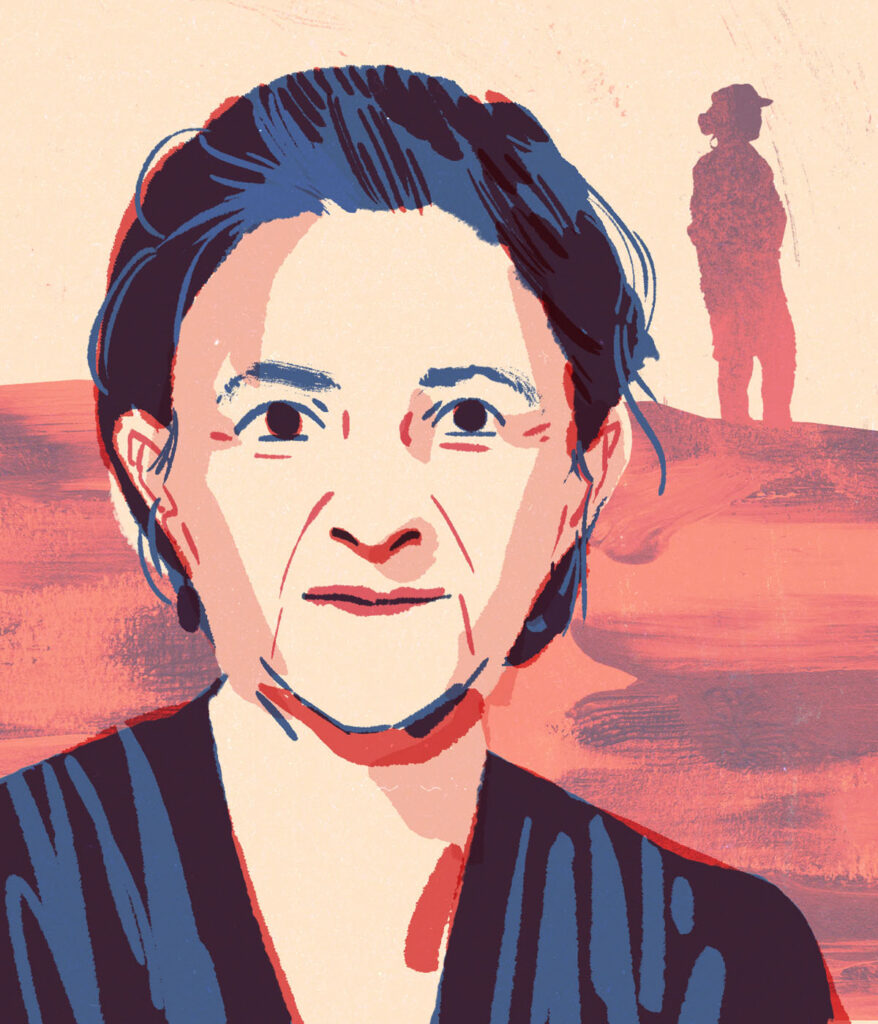
Helen Benedict’s mission in both her fiction and her journalism is to examine the personal consequences of social injustice, whether in the context of colonialism, violence against women, or modern warfare and the global refugee crises that result from it. She began her career writing articles and several books about rape, including Virgin or Vamp, a critical look at the press coverage of sex crimes. A professorship at Columbia University’s Graduate School of Journalism enabled her to give more time to fiction, her first love; her novels have spotlighted the experiences of the impoverished and dispossessed in situations ranging from British prisons (A World Like This) and American slums (Bad Angel ) to remote African islands (The Edge of Eden) and, most recently, a Greek refugee camp (The Good Deed ). Benedict continues to write nonfiction on matters she considers of pressing public import; in 2022, her collaboration with Syrian writer Eyad Awwadawnan, Map of Hope and Sorrow: Stories of Refugees Trapped in Greece, was published. Among the classes she teaches at Columbia is a course on journalism and social justice.
We meet in her sunny apartment on Manhattan’s Upper West Side to talk about her new novel, The Soldier’s House, which completes a trilogy about the Iraq war that makes palpable its human consequences for Americans and Iraqis. The first volume, Sand Queen, is set in the Iraq desert during the early days of the 2003 invasion; it contrasts Kate, a 19-year-old American dealing with the toxic sexism of her fellow soldiers, with Naema, a displaced Baghdadi whose father and brother are incarcerated in the makeshift prison Kate guards. Naema returns in Wolf Season as a doctor in a small upstate New York town that is also home to several Americans grappling with various kinds of war trauma. Wolf Season takes place in 2014, three years after the last American troops have left Iraq; The Soldier’s House rolls back to 2010, bringing Kate back into the story, along with Jimmy, a fellow military guard and one of the few decent male soldiers in Sand Queen. Naema is there, too, nursing bitter memories of her husband, Khalil, who was assassinated for working as Jimmy’s interpreter, a job she never wanted him to take. She is not at all grateful for the sponsorship and shelter provided by Jimmy, who is guilt ridden about his failure to protect Khalil and frustrated by Naema’s hostility. Benedict doesn’t paint her characters in black and white, nor does she offer easy resolutions to their stories. “War doesn’t make for happy endings for anybody, ever,” she comments. “Some people pull through and find a way; some are still struggling. I don’t think an honest war story can have a happy ending.”
Sand Queen was prompted by a lack Benedict felt after completing her 2009 nonfiction work, The Lonely Soldier: The Private War of Women Serving in Iraq. That blistering exposé of the rampant sexual abuse of female soldiers by men who were supposed to be their comrades inspired a Peabody Award–winning documentary—The Invisible War—and a lawsuit against the Pentagon, but Benedict wanted to go deeper.
“I spent three years listening to women soldiers talk about their experiences in the war and learned so much from it, but I kept coming up against that barrier that all nonfiction writers do: There’s only so far you can go inside a human experience when that human is real. They often have things they don’t want to tell you, especially if they’ve done something they’re ashamed of. Or they don’t know themselves well enough, or they can’t even articulate it. I wanted to get inside the heart of what it was like to be in a war from the inside. D. H. Lawrence once said something like, If you write about war as a novelist, you have to follow the soldier’s heart to its home; I wanted to do that.”
Benedict began to plumb the hearts of Kate and Jimmy. “But I thought, wait a minute, I’m doing what Westerners have always done; I’m writing only from the point of view of Americans. Who’s really getting hurt, much more than us? So around 2009–10, I began to seek out Iraqis to get their point of view. I found a blog, Baghdad Burning, by this young woman who was giving a blow-by-blow account of living every moment inside the bombardment and meanwhile dealing with everyday things like family dynamics and work. It was so different from what we were getting from American chroniclers of war. Then I learned that there were 400 Iraqis and their families settled around Albany, and I was able to talk to quite a lot of them about their side of the war. They had come on this special immigrant visa given to Iraqis who had worked for the Americans to save them from persecution at home—none of these people would even be allowed in now.”
Login to view the full article
Need to register?
Already a subscriber through The American Scholar?
Are you a Phi Beta Kappa sustaining member?
Register here
Want to subscribe?
Print subscribers get access to our entire website Subscribe here
You can also just subscribe to our website for $9.99. Subscribe here

true