
Hidden Truths
A new portrait of one of the 20th century’s most controversial philosophers
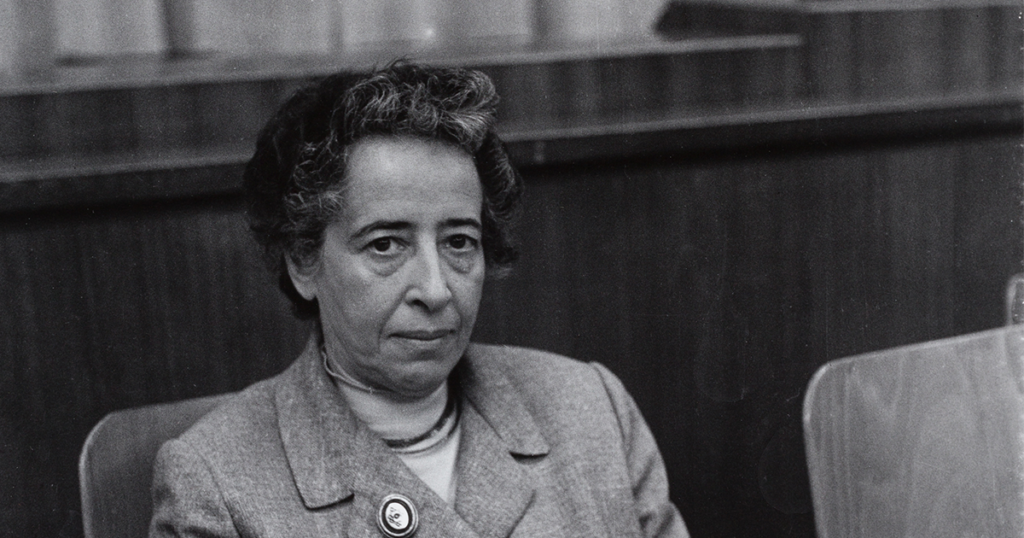
Hannah Arendt: A Life of the Mind by Thomas Meyer (tr. Shelley Frisch); Penguin Press, 560 pp., $35
Last year at the Vatican, Pope Leo XIV spoke to a gathering of journalists from across the globe. He reflected on a “crisis of communication” brought about by the blurring between information, disinformation, and misinformation. Turning to Hannah Arendt, Leo cited her warning that the “ideal subject of totalitarian rule is not the convinced Nazi or the convinced Communist, but people for whom the distinction between fact and fiction and the distinction between true and false no longer exist.” Nevertheless, the pope warned, “no one today can say ‘I did not know’” about the acts of inhumanity now unfolding.
A half-century after Arendt’s death, she has been canonized by political commentators who use—and frequently misuse—phrases and terms Arendt either coined (the banality of evil) or made current (totalitarianism). In the wake of the 2016 presidential election, sales of Arendt’s 1951 book, The Origins of Totalitarianism, were so sudden and explosive that Amazon briefly ran out of stock. Moreover, academic interest in Arendt shows no sign of flagging. The number of conferences and centers, monographs, articles, books, and documentaries devoted to Arendt’s life and work continue to proliferate. She was even the subject of an eponymous 2012 feature film by German director Margarethe von Trotta. And all of this while many of the philosopher’s previously undiscovered writings are emerging from various archives. As Thomas Meyer remarks in his own new biography, the 430 published works listed in a recent bibliography pale in comparison to the hundreds of manuscripts, correspondences, and transcripts that have yet to be published.
Meyer’s exploration of a daunting array of archival holdings help make Hannah Arendt: A Life of the Mind—the subtitle is a nod to Arendt’s last and unfinished book—an intriguing work. A professor of philosophy at Ludwig Maximilian University in Munich, Meyer is the editor of a just completed 12-volume series of Arendt’s writings. With these credentials, he announces that his aim is not to challenge existing interpretations of Arendt’s life and thought, but instead to offer a narrative based on what, in a way, did not exist before—namely, the reams of recently discovered documents. These papers, Meyer writes, allowed him to “highlight connections and bring in names that have not received substantial—or any—attention in earlier biographies of Arendt.”
This material is often revelatory. New details emerge about Arendt’s student days first in Marburg, Germany, for example, where she fell under the influence of—and in love with—Martin Heidegger. That she was smitten by the charismatic thinker who was nearly twice her age is well-known, but the depth of that attachment is revealed in a sketch she wrote in which she expressed her “unbending devotion to a single one.” There followed by her short stay at Freiburg to attend the classes of the phenomenologist Edmund Husserl, and finally on to Heidelberg where she studied under Karl Jaspers. The latter encounter led to a lasting and rich friendship. With difficulty, Arendt managed to overcome her “schoolgirl fear” of Jaspers’s towering intellectual presence, thus forging their bond, in Jaspers’s words, by “loving strife.” Arendt’s relationship with Heidegger, however, only veered toward strife after what Arendt described, perhaps too simply, as her former lover’s infamous Kehre, or “turn”—namely, Heidegger’s decision in 1933 to embrace Nazism. But Jaspers and Heidegger left indelible and at times oddly touching marks on Arendt’s writing. As Meyer points out, Arendt’s dissertation on Saint Augustine’s concept of love is riddled with terms like Dasein and Existenz, which, much to Jaspers’s displeasure, reflected Arendt’s debt to Heidegger’s thought.
Meyer also traces Arendt’s own Kehre, in which she turned from academic philosophy to politics. In the mid-1930s, she became preoccupied, Meyer writes, with “the investigation of phenomena concerning Jewish emancipation and modern antisemitism.” This preoccupation fired Arendt’s early fascination with Rahel Varnhagen, the early 19th-century German-Jewish writer and socialite; an intellectual who converted to Christianity yet never truly escaped her Jewish roots. It was in the writings of Varhagen that Arendt found her double, an “original, unspoiled, and unconventional intelligence, combined with an absorbing interest in people and a truly passionate nature.” (Although Arendt completed a biography on Varnhagen in the 1930s, an English version appeared only in 1957.)
As the Nazis seized power, Arendt’s most passionate interest was the predicament of German Jewry. With newly discovered or largely ignored archival sources, Meyer documents Arendt’s multiplying engagements with Jewish and Zionist organizations during the 1930s. Fleeing Germany in 1933—in her haste, she left behind her Varnhagen manuscript—Arendt eventually settled in Paris with her first husband, Günther Stern, a failed academic and struggling journalist. There the young philosopher found herself jobless and stateless—a Catch-22 in which the latter condition made it difficult to resolve the former and vice versa. Yet Arendt managed to secure a position—in part, by exaggerating nearly nonexistent clerical skills—with a French–Jewish humanitarian organization called Agriculture et Artisanat, where she taught agricultural and artisanal trades to Jewish refugees.
And here Meyer introduces us to a young woman, not yet the famed political theorist, who was a passionately engaged Zionist activist. Based on dozens of heretofore unexamined telegrams, memos, letters, and even postcards, Meyer reconstructs Arendt’s efforts to send young German Jews to Palestine. Given the many bureaucratic hurdles she faced, along with the increasing pressure exercised by Nazi Germany’s metastasizing anti-Semitic legislation, Arendt brought the same moxie to the life of action that she brought to the life of the mind.
In a 1935 report on her activities, she proved grimly prescient about the future—one in which the Nazis would act on the “perennial suggestion for solving the Jewish question by slaying all the Jews,” she wrote—and untiringly persistent in her efforts to respond to threat. “If we are not to witness the total destruction of important age groups of Jewish youth, active assistance must be implemented. … These youngsters have something extremely valuable to offer; their value has been overlooked and runs the risk of being destroyed if help does not arrive soon.” That same year, Arendt herself accompanied a dozen teenagers to Palestine, where she then spent two months organizing plans for the transfer of German–Jewish youths.
This largely unfamiliar portrait of Arendt as a young Zionist complicates the older and more familiar image of a woman who was unafraid to criticize Zionism as it came to be practiced in the state of Israel. Meyer reaches even further back in his subject’s life, recounting the many hours Arendt spent during her adolescent years reading and dreaming in Das Haus der Bücher (The House of Books), an iconic and rambling bookstore in Königsberg. Arendt remarked later, in her 1964 German television interview with Günter Gaus, that her younger self believed “she had two choices in life: to study philosophy or drown herself.”
By then, Arendt had become an unlikely media star in West Germany and the United States through her newspaper and journal writings, as well as her radio and television interviews. So much so that Meyer asserts, with a dash of bravado, that Arendt “was the very first media intellectual in a comprehensive sense.” Interestingly, Arendt’s best-known foray into this realm, her series of dispatches from the Adolf Eichmann trial for The New Yorker, was far less controversial in West Germany than in the United States—or, more accurately, Manhattan—where it was met by a hailstorm of outrage and incomprehension by fellow Jewish intellectuals.
Meyer offers an important insight on the American edition of Arendt’s Origins of Totalitarianism: “The book wound up with the wrong title, and it was written in an English that is not American, because it was essentially conceived in German and French. Its parts were jammed together and the resulting entity strained against the boundaries of any form.” The same might be said of Meyer’s book. His presentation of the material might pose a problem for readers unfamiliar with the outlines of Arendt’s life. He allows tranches of documents, many of narrow, scholarly interest, to speak for themselves, often at such length that they submerge the narrative. Thus, the first chapter—a dry, dense, and detailed account of the lives of Arendt’s parents and grandparents—will prove challenging for many readers. The same goes for his many lengthy digressions into the lives of people only loosely tied to Arendt.
Shelley Frisch’s English translation, though clear, retains the sometimes convoluted style of Meyer’s original German. Dense thickets of prose at times make the book a tough go, as do some of Meyer’s more confounding assertions. In his discussion of Albert Camus’s impact on Arendt, for example, Meyer refers to Camus’s public talk, “The Human Crisis,” given at Columbia University in 1946. He does not make clear if Arendt attended the talk and, oddly, describes it as an “unorthodox sampling of French existentialism,” failing to note that existentialism was a scandal because it was unorthodox, and that Camus himself always rejected the label “existentialist.”
Nevertheless, this book, for scholars and non-scholars alike, is impressive, important and, dare I say, relevant. In a recent interview, Meyer insisted he was not “someone who immediately resorts to a quote from Hannah Arendt as soon as they encounter a problem and thinks everything has then been said.” Instead, he rightly reminds us that, in the face of many of the same challenges that confronted Arendt, we should, well, think. The one cure to the plague of thoughtlessness in the world, Arendt wrote in The Human Condition, “is very simple: it is nothing more to think what we are doing.”
Granted, it is not that simple. But it is that vital.