
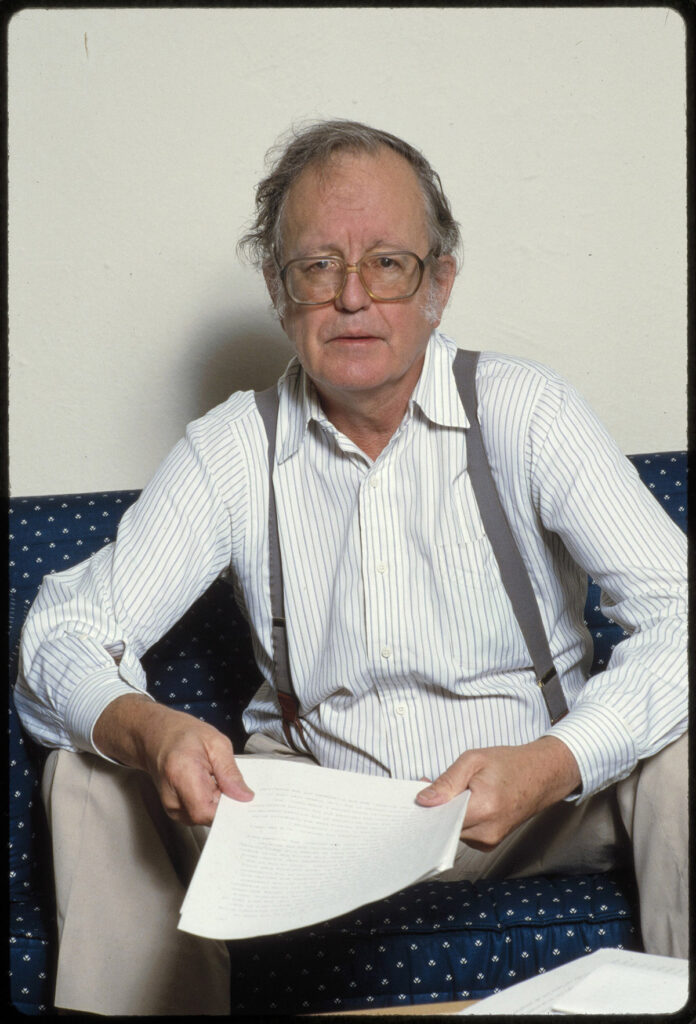
In the late 1970s, I was a teenager in Winona, Minnesota, a sleepy Mississippi River town defibrillated by three colleges and a few residual hippies. I aspired to be a writer.
The prevailing mood in Winona was, let’s just say, sincere. Besides Orwell, Kerouac, and school assignments, I was reading an anthology called 25 Minnesota Poets #2. The cover featured cream type against a brown background on sensible matte paper. It might as well have been printed directly on wheat. A few lines describing an oppressive shop teacher, excerpted from poet Stanley Kiesel’s contribution, give a sense of the tone: “Pop could see—plain as pliers— / poems swimming in my fingers.” The collection included some excellent poets, but it lived and died by the heartfelt declarative sentence. Even the local humor—think A Prairie Home Companion—was about as edgy as a quilt. Without knowing exactly why, I was unhappy with the literary culture that the anthology represented and yearned for something else.
Then, in 1978, I discovered Wilfrid Sheed. In an appreciative Rolling Stone review of the novel Transatlantic Blues, Greil Marcus wrote of Sheed that it must be frustrating to be the best book critic in America while having your novels dismissed as brilliant but minor. Wait, what? I’d never heard of Sheed before reading Marcus’s review. Now, in my adolescent way, I wanted to know everything about him.
Born in London in 1930, raised in England and the United States, and educated at Oxford, Sheed had published numerous works of fiction and criticism. I sensed that such a critic might point me toward what was lacking in my reading life, which had been limited to the American classics. Fortunately, Northern Lights Books, the new independent bookstore downtown, had a copy of The Good Word and Other Words, a recently published collection of Sheed’s essays. The title referred to the monthly column he wrote for The New York Times Book Review in the early ’70s. This was one of the most prestigious platforms ever offered to a Times critic.
The first thing I noticed was the sentences. I’m not sure that, for all my teenage literary enthusiasms, I had ever thought of the sentence as a separate thing, as something that could be crafted, with a value distinct from other narrative components, such as plot or argument. But Sheed’s sentences were engines of insight and something I didn’t recognize at first: joy.
A few examples. On Evelyn Waugh’s fascination with the landed gentry: “A writer who would rather be dined by Lord Chowderhead than praised by [Edmund] Wilson is a genius or he’s nothing.” On the disgruntled NFL star Dave Meggyesy’s evocation of fans watching football in a state approaching sexual frenzy: “At my place, aphasic torpor would be closer to it.” I had to look up both “aphasic” and “torpor,” and, when I did, I realized they were perfect. On the Watergate hearings, which everyone I knew had taken very seriously: “And so it went, each man a marvelous specimen of political comedy, which occurs whenever the need to show off is combined with the imperative of doing nothing; i.e., all the time.”
I had never encountered a writer so confident or a tone so elastic. So this is what happens when a Catholic, Oxford-trained mind intersects with a jaunty midcentury American voice. The elasticity didn’t simply apply to diction; Sheed’s syntax inspired envy. In an essay about the novel of manners, he speculates about one set in the counterculture: “And no dowager ever made one more conscious of saying the wrong thing or expressing the not-quite-right attitude as a hippie in full feather. ‘Oh, man, you just don’t know’—the strains of Emily Post still linger in that one.” But there was much more to his work than an agile, charismatic style. There was a brightness to this voice, and a crowded, convivial aspect to these collected columns that reminded me not of a lone poet on a matte prairie but of another touchstone of my childhood: the parties in my favorite sketch comedy TV show, Rowan and Martin’s Laugh-In. They were populated with jaunty celebrities grooving to ’60s cocktail music, then freeze-framing to exchange inane quips. It may seem an odd comparison and even a vulgar one. But Laugh-In was a memory of effervescence that I carried into the ’70s gloom. I was witnessing the last flashings of a midcentury energy that Sheed had glimpsed as a young man, coming to these shores during the Second World War.
The Good Word was a crucial part of my literary education. Sheed located his book reviewing in the personal, profound process of crafting a self, and it is precisely this grounding in the human journey that made the book so important to me. As he writes in his introduction:
This kind of reviewing is imprecise, speculative work like fiction, and its truths are the truths of fiction. The books are events that happened to me and are as open to misinterpretation as my neighbors or the Siege of Chicago in 1968. Along with one’s novels these pieces form a mosaic of someone coming of age at a certain time and place, and what he made of it.
I was someone coming of age in a certain time and place, and I wasn’t quite sure what to make of it. And increasingly, books were things that happened to me. The process of encountering the world one book at a time, and of using those books to enlarge the self, is a subjective process. But what does subjectivity mean? It is not a disavowal of standards—far from it—but an acknowledgment of fallibility. As Sheed concludes in “The Art of Reviewing”: “Omniscience is on the calling card, along with the tricks and novelties; but between trash and Shakespeare, there is much uncertainty.” This sentence has informed my understanding of humility—and my disdain for brittle, overconfident opining—ever since.
He begins an introduction to a Paris Review Writers at Work volume with a specific confession: “This is partly an act of reparation. A few years back, I wrote a somewhat lofty piece about the second collection of Paris Review interviews, suggesting that the information therein was neither better nor worse than Hollywood gossip.” He then admits that it was “a dishonest piece (I was too young to be honest) in that I artfully concealed how much I had enjoyed the volume—which meant it had some kind of value, if not the kind I was looking for.”
Honesty is the crucial idea in that sentence. In my childhood, honesty was the opposite of subtlety, and subtlety was a bad thing, a slippery slope that led to sophistry. Honesty was instrumental: It enabled confession. Either you hit your sister, ate meat on Friday, or smoked dope behind the garage, or you didn’t. In my teenage years, honesty became brutal honesty: the affected grit and seedy posing that I sought in writers like Charles Bukowski. He’s, like, really honest, man. It took me a while to figure out that Bukowski’s honesty was really weaponized self-pity and sideways romanticizing.
Reading Sheed, I began to realize that adult honesty was only occasionally brutal. More often it was subtle and required intellectual labor. This subtlety was the opposite of sophistry. It didn’t evade the truth, it sharpened it. The purpose of this honesty was not the admission of guilt or whatever Bukowski was trying to do but the achievement of precision. And that precision had a spiritual aspect. It valued the complexity of creation over the dunderheadedness of the individual human mind with its sloppy categories and half-baked perceptions.
Of course, humility is no excuse for being mealy mouthed. Sheed knew the value of clear statement, especially in criticism. Of the critic Cyril Connolly, he wrote, adding italics for emphasis, that “for all his surly independence, he could not make the assertions that criticism requires.” Sheed could. Also of Connolly: “He had never been a good critic, because among other things, he could never pan a friend.” Or of a Walter Kerr study of silent film that Sheed admired: “Such a critic may be fine at good vs. bad, but untrustworthy on important vs. trivial.” When revisionists imputed genius to old studio-extruded movies, he reported what he actually saw: “The thirties, forties were an era of mass-produced junk, and all the auteurs and editors with tongue in cheek cannot alter that much.”
Some sentences have stayed with me because they said something in a way that stays said. When Sheed observed that Edmund Wilson possessed “an extraordinary gift for friendship in all its degrees, from the exchange of funny postcards to the complete opening of his mind,” he defined friendship for me with a precision that, decades later, I still return to. The micro-epiphanies of that sentence illuminated what friendship might be and, thus, what life might be. He dropped other parenthetical realizations. Of the tendency of LSD to moot speech: “Writers afflicted with vocation would refuse to enter heaven itself if they couldn’t describe it afterwards.” Or of football players who became authors: “Like all of us, they were raised on at least two completely contradictory moral codes, and can preach from either one interchangeably.” Beneath the jaunty and the jovial lived truth.
For me, growing up in the provinces, writers were part consumer brand, part Greek god—at any rate, something more than human. But Sheed understood that we are all flawed, God-sensing, metabolic puddings, and that doesn’t change just because you happen to write a novel. His fellow authors were not the producers of a consumer product but characters in a story he was writing. They could be deluded, trapped within assumptions they couldn’t see—in the case of the Beats, their assumption that writing faster, without revision or premeditation, taps into the subconscious: “It now seems possible that Kerouac wanted to bypass the subconscious by outrunning it. … The words on the top of one’s head do not necessarily come from anywhere near the subconscious.” He suspected that speed writing was a psychological strategy, not a literary one: “Kerouac’s manicness was a necessary strategy for fighting off the forest-dark, French-American glooms.” Earlier in the same essay, he wrote, “I tend to believe he handled his tormented, overloaded temperament as well as it could be handled.” In the space of one essay, he moved between literary insight, psychological insight, and forgiveness.
Sheed was thinking as he was writing. I’d never seen that before. To the extent that I had any template for thinking, it was the high school debate model: You gather your arguments, which are a lot like everyone else’s arguments, on index cards and then repeat them with great pimply teenage confidence. In my experience, surprise, growth, qualification, and recalibration weren’t a part of the process.
Sheed ends an essay prompted by four new books about Ernest Hemingway with sentences that fold big-hearted praise over damning criticism. The result is a judgment that is not simply complex but also noble:
As early as The Sun Also Rises there are signs of potential freedom, of an exit into adulthood, that he never availed himself of. This was his last book before fame settled in to stay and clamped his style into place, where it grew warped and gnarled like a tree in a cave: but that it was a splendid style, and that his pursuit of it was honorable, if muddle-headed, to the end, I have no doubt.
When you view writers as humans, sentences distill into epitaphs. Elsewhere, Sheed heartbreakingly summarized Evelyn Waugh’s Catholicism: “He found God where he could, in the sum of what was left when you subtract the twentieth century; but he shouldn’t have tried to name Him.” There is something very humane in saying “they did the best they could.” The first responsibility of the humanist is to acknowledge that we’re human.
It is also one of the first worldly responsibilities of the Christian, and Sheed knew his Christianity—he was the son of Catholic publishers Frank Sheed and Maisie Ward. I also had been immersed in the church as a boy, spending my first decade in the Catholic town of Rollingstone, attending a Catholic grade school. But after the closure of our school, the death of my father, and our move into Winona, I drifted away. When, in an essay titled “Spock Mugged,” Sheed chastened the English writer Malcolm Muggeridge for mocking Doctor Spock’s protest of the Vietnam war as “something I would have expected a stand-up Christian like Muggeridge to appreciate,” he added this footnote:
William F. Buckley raised the Eyebrow high over this one. But the New Testament frequently emphasizes the simple moral test beside which all else shrivels. ‘Lord, when did we see thee hungry or thirsty … sick or in prison, and did not minister to thee?’ Then he will answer them, ‘Truly, I say to you, as you did it not to one of the least of these, you did it not to me.’ And they will go away into eternal punishment, but the righteous into eternal life.
A writer who was pointing me toward a greater literary sophistication sounded like my mother, who was a farm wife and nurse, and Sister Maureen, my favorite grade school nun. Sheed connected my emerging literary standards with my childhood values in a way that made both more vital.
The central character in the coming-of-age tale Sheed tells in The Good Word is the reviewer, and the reviewer’s central moral challenge is to treat books fairly. “The Art of Reviewing” provides a useful glimpse into Sheed’s mind at work. Book reviews in the United States are overstated, he contends, but there are good reasons for this: Reviewers need to get readers to pay attention. So they throw around sloppy opinions and take shortcuts by ranking authors and books within the author’s oeuvre. These compulsive rankings distract from any meaningful consideration of the book itself—its goals, triumphs, textures, and failures. Although we can, of course, learn about a book by looking at the books, authors, and culture that surround it, ultimately, our obsession with ranking authors diminishes our reading.
Any paraphrase of Sheed’s ideas, including the one I offer above, misses the indelible energy of his prose. To read him is to experience the power of idiom, its voltage and adhesiveness. I suspect his work would not translate well. Missing from my paraphrase, for example, is this: “What [the author] will not be called anywhere is probably what he is—‘our most middling author in his most middling achievement.’ … Excessive opinions excite the average reader to madness, or at least to attention. … Still, in the uproar certain decencies should be observed.” And this, which feels especially relevant to our age of listicles and tweets: “To read that Sven Angst may be the number-two Swedish novelist, surpassing even Igmar Klutz, may be O.K. It means we have five minutes to take in the Swedish scene before the guests arrive. But to find this applied to our own writers is to wonder where tourism ceases.” And most powerfully for me, this:
All this tends to confirm something cramped and anxious about our reading habits. … Eventually you have to tell your son that this is not the longest ball game ever played or maybe even the best. It is fatally flawed in the ninth inning. However, it’s the only game we happen to have right now, and it fills the moment just as full as a great game would, even sharing some of the same textures. If you don’t enjoy it, you wouldn’t enjoy a great game either, except for its damn greatness.
I cried when I reread “The Art of Reviewing.” Why would a nearly 50-year-old essay on book reviews make a 60-year-old man cry? Here’s the best I can do: I was an enthusiastic but clueless teenager who didn’t know how to read books, much less review them. And a stranger had just pointed me to a way of reading that would enrich my life from that moment on.
For me, The Good Word also served as a crash course in critical thinking. At Beloit College, the courses I took, while richer than my high school fare, failed to sharpen my critical faculties for a reason that seems obvious now: My professors had selected the best books in their field to teach in their introductory courses. What sane professor would say, “Tell me why the books I’ve shared with you are lazy, sloppy, confused, biased, incomplete, or blinkered”? Of course, Introduction to Economics and King Lear are as subject to critical thinking as anything, but if my 18-year-old self had taken them on, I would have been punching above my weight. College was about appreciation, comprehension, clarity, implication, and integration.
Sheed taught me how to read the books that weren’t classics, the vast middle ground between “trash and Shakespeare,” the great tide of uncanonized culture that constitutes my reading life and probably yours. He was especially good at the kind of books that claim to address serious subjects but deliver only platitudes and muddle.
The best example of this is “The Subject of Ethnics,” an evisceration of Michael Novak’s The Rise of the Unmeltable Ethnics and Peter Schrag’s The Decline of the WASP. Both books, which aim to celebrate ethnic cultures, are guilty of “flattening out our largest and most varied group, all the white Protestants from W. C. Fields to Huey Long.” The unfortunate consequence of this is that the ethnic groups that the authors celebrate “begin to look ominously alike. They are all simply un-Wasp—earthy, passionate, spontaneous, all that great stuff.” He suggested that instead of being simple fountains of joie de vivre, people who crossed the ocean in steerage to escape crushing poverty “did not need lessons in discipline and perseverance from the Whiffenpoofs.” As a Catholic, Sheed recognized a sin winking under the sloppiness: Novak and Schrag diminished complex human beings.
Sheed treated authors as human beings, with the limits of human beings, and it’s only fair he be treated similarly. In 2026, I can see how his subjects tend to be “male, pale, and Yale.” His essays on women’s liberation, as it was called then, haven’t aged well, and his review of a James Baldwin book ages much worse. Consider this wince-inducing throwaway: “I assume he is still a black spokesman in good standing.” Besides the snotty tone, there is the failure to think about how being a “spokesman” is a version of something Black people deal with every day—the corrosive pressure of being not simply themselves, but representatives of their race. His list of the great midcentury prose stylists doesn’t mention Baldwin, the most urgent and nuanced essayist since Orwell, or Pauline Kael, the most original and charismatic voice of her time.
The Good Word is Sheed at the height of his powers. As the midcentury energy that he loved peaked in the early ’70s, so did he. Transatlantic Blues (the novel that Greil Marcus had reviewed in Rolling Stone) showed the limits of the ironic style. When I tried to reread it, I found the first few pages so cloyingly urbane that I couldn’t go on. Reading In Love with Daylight, his often insightful but sadly defensive 1995 account of his afflictions (including an addiction to pills), showed the limits of the man. Given that my relationship with Sheed partook of mentoring—even though I never met him, he helped me find better ways of doing something very important to me—the book shocked me. The writer who taught me what grown-up honesty looked like was dishonest when it mattered most. But that is the essence of addiction.
Sheed’s accomplishment is his voice, which raises the question: What is voice? If my experience is representative, voice is something that writers think about far too much when they are young, and then, embarrassed by their own enthusiasm, don’t think about at all. I believe I actually told one of my creative writing professors that I was working on finding my voice. I’m also pretty sure he winced. As you learn to write, as you break through the received, the affected, and the incompetent, your voice finds you.
Voice is the deepest and most unconscious part of style, spiritual in that it reflects whatever makes the self unique. Yet voice is also steeped in one’s culture. It is more closely related to character than my college self ever suspected, which is why you can’t build one in a semester. The characteristics of Sheed that I celebrate—honesty, mercy—are moral qualities. But voice is what I sought, especially as a young man, in authors such as Sheed, Marcus, Kael, and John Updike: the self behind the sentences. The teenage me was not reading to find stories. Stories made me nervous. The teenage me was reading to find friends—fellow travelers making sense of the world. I gravitated to criticism because it is the literary form closest to conversation.
A fellow Sheed enthusiast pointed out that his voice is, among other things, breezy—and the canonical Elements of Style specifically proscribes breeziness. But it’s one of those violations that help sharpen what the rule really means. Strunk and White were railing against an affected breeziness—a put-on jauntiness in an alumni magazine that resembled no actual human voice. When rereading the relevant passage in The Elements of Style, I also sensed something else in Strunk and White’s advice: a certain pale preppie classicism. Adjectives aren’t really our kind of people, dear.
Sheed’s voice wasn’t fully unconscious, of course. He clearly worried about style. He wanted a prose as big as America or at least as big as American culture. Arriving from England—and wartime England, which is England squared—Sheed encountered the energy of jazz and pop, of wise guys and baseball, and it is this joyful, ironic miasma that influenced his prose more than anything else. Every Sheed sentence is a kind of love song to a version of America. That the English are better than us at irony simply heightened the effects.
The painful irony of Sheed’s career is that he is often categorized as brilliant but minor. Sheed himself wrote, “This country is merciless to good small talents.” When he made similarly wistful observations about V. S. Pritchett, he might have been appraising his own career. One of his most trenchant essays, in his first book of criticism, is “The Minor Novelist.” You bleed a little after reading that one.
Personally, I’d suggest most so-called big talents are smaller than we think, and they often confuse public relations with subject matter. Faulkner knew Mississippi. Bellow knew Chicago and managed to trick us into thinking he knew America. Twain wrote well of one river, Melville of one ship. Fitzgerald wrote a great American epiphany. But when the subject grows larger, it often overwhelms the writer. Updike’s best writing was in his Talk of the Town pieces, short stories, and reviews. His explicitly ambitious Rabbit novels were so many pounds of anthropological sadness. Norman Mailer increasingly looks like a toxic clown.
Sheed’s subjects in The Good Word and Other Words—the voices and concerns of midcentury America, from F. Scott Fitzgerald to Watergate, from Cole Porter to Mary Gordon—are plenty big. His consideration of the Beats, extending over two essays, and his brilliant first-person account of the 1968 Democratic National Convention are as vivid a portrait of a time and place as you will ever read. Add to that books about baseball and pop music, his affecting witness to Bobby Kennedy’s assassination, his devastating takedown of Norman Podhoretz’s Making It, and well-regarded novels about a presidential candidate and magazine publishing, and there’s a good case for his significance.
Sheed changed my life at a time it badly needed changing, when I was an earnest kid in an earnest place in an earnest time. And if changing someone’s life isn’t the definition of a big talent, there’s something wrong with our definition.