
Thanatos Rising
A 1930s correspondence between Albert Einstein and Sigmund Freud laid out each man’s views on war and peace
In the 1980s, my college rock band closed each show with a furious rendition of “(What’s So Funny ’Bout) Peace, Love and Understanding?” Written in 1974 by Nick Lowe and performed by the jangly British country-rockers Brinsley Schwarz, the song originally included a bridge in which the vocalist pleaded: “We must have peace, more peace and love, if just for the children of the new generation.” Unfortunately, by the mid-’70s, the season of flower power had passed. The song bombed.
Then, around four years later, another rocker heard the song and thought: Peace? Love? Was this for real or a put-on? In 1978, he recorded a cover that cut the bridge and otherwise left little room for doubt about how he felt. Produced by Lowe himself and released on the Armed Forces album, Elvis Costello’s snarling tale of disillusionment became a New Wave anthem.
Lately, I’ve been playing those two versions of the song in my head, wondering how, during a period of only a few years, a sincere call for peace became ripe for rage and sarcasm. With jingoism and belligerence all around us today, Brinsley Schwarz’s entreaty seems even quainter. But why? What is so funny about peace?
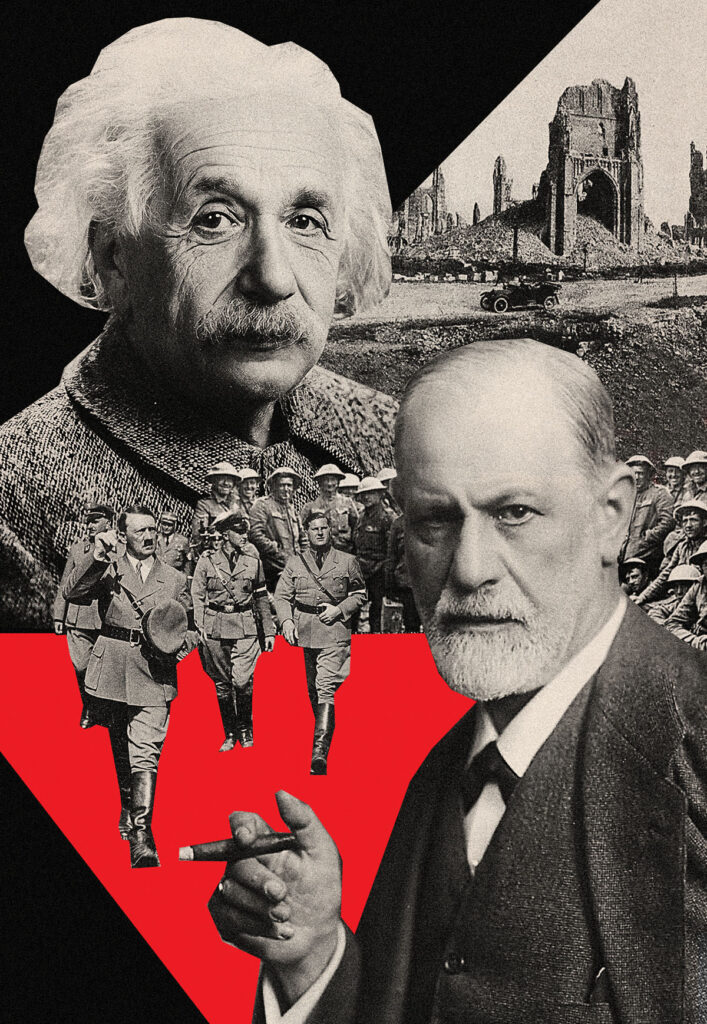
In 1931, the International Institute of Intellectual Cooperation, a branch of the League of Nations, solicited exchanges on the world’s pressing problems from a variety of thinkers. Albert Einstein was enlisted, and in July 1932, he contacted Sigmund Freud and proposed that the two tackle the question, “Why War?”
The two men had met once before. During the winter of 1926, the Viennese psychoanalyst traveled to Berlin to visit his son, Ernst. Einstein and his wife, Elsa Löwenthal, paid them a visit. Freud later quipped that their two-hour discussion was excellent, since he knew no physics and Einstein knew no psychology.
Six years later, both faced a darkening horizon. As they contemplated the causes of war, they had to wonder whether they would become its prey. Despite his Swiss citizenship, Einstein possessed no illusions. With the Nazi takeover of Germany a year later, he sailed across the Atlantic. Meanwhile, an ill, 76-year-old Freud clung to what he admitted might be “rationalizations.” He assured one ally that despite the rise of Hitler, Vienna’s Jews were safe, thanks to a negotiated treaty on minority rights that, if breached, required the League of Nations to intervene. As for Austria’s being swallowed whole by the Nazis, the French would “never allow” it. Such were the illusions that sustained the psychoanalyst when he received Einstein’s request to take up the riddle, “Why War?”
Einstein’s question was a bit ridiculous. Explain “war” in a short letter? Did the physicist expect the psychoanalyst to have a rule, an equation, some one-stop answer on the subject? Freud was not thrilled by the request. The often-marginalized founder of psychoanalysis enjoyed his association with the wild-haired theorizer of special and general relativity, but the vastness of the question and the epistolary format seemed like a recipe for disaster. Still, he didn’t want to turn Einstein down. A year later, their letters appeared in German, French, and English (translated by Stuart Gilbert), though tellingly, the pamphlet was barred from distribution in Germany.
In many ways, the dialogue between the two men highlighted their differences. Not particularly interested in depth psychology, Einstein was a moralist, a democratic socialist, and a dedicated pacifist. He had come to this last position after being disgusted by the whipped-up martial fervor in Germany prior to World War I. At that time, the 35-year-old physicist tried to rally opposition to the Kriegmenschen, who confidently touted the use of brute power as necessary and virtuous. In the 1930s, as the trumpets of war blared again, Einstein took up his pen for the cause of disarmament and building an antiwar coalition.
In his letter to Freud, Einstein focused on the troubles of nationalism. During the 19th century, modern, secular European states—shorn of the bonds once solidified by Crown or Church—struggled to maintain social cohesion. Universal ethical principles did not help to create national bonds. Instead, nations were inclined to define themselves by the shared heritage of their residents and the historical grievances they held toward their neighbors. Highlighting the irrationality of this attitude, the 19th-century press dubbed such bigotry Anglophobia, Francophobia, Germanophobia, or worst of all, xenophobia. The problem got bad enough for fin-de-siècle thinkers such as the Nobel Peace Prize winner Bertha von Suttner, Bertrand Russell, and H. G. Wells to suggest that the sole remedy was some form of supranational governance.
Einstein followed in that tradition. In his letter to Freud, he proposed that each country relinquish some autonomy to a neutral international body that would ensure law-based, collective justice and offer nonviolent conflict resolution. The toothless League of Nations could not yet provide this service, but it was a start. As for the enigma of why humans became possessed by a “wild enthusiasm” to kill and die for la patria, Einstein threw up his hands. Recently, he had penned a preface for a German pediatrician’s book called War as Illness. Was war, he asked, a “collective psychosis”? With that, he passed the baton to Freud.
As Freud put pen to paper, he relied on a range of Socratic skills honed over three decades. During those years, he was in near-constant dispute with an array of adversaries. He loved debate and admitted that he was most creative when thinking against others. These intellectual battles drew out his razor-sharp powers of analysis. Insoluble questions and imprecise terms would be dug up, then transplanted to more hospitable terrain. In addition, since shifting his studies from microscopy to the inner life, Freud had pioneered methods that allowed him to feel his way forward in darkness. Failures and impasses resulted in what would prove to be Freud’s most lasting achievement: a powerful, if easily misused, form of inquiry, with novel kinds of indirect evidence, and a specialized logic regarding deeper motivations that were not already known to the thinker.
Still, what an oddly phrased question. “Why War?” suggested that for his interlocuter, intergroup violence was an anomaly. Einstein believed that humans, as social animals, were naturally cooperative, and that organized violence was our greatest aberration. As such, he wondered if it might be driven by madness. Were there epidemics of insanity that explained everything from the battles of antiquity to the revolutions in France, Haiti, and Russia? As a proposition for historians, political thinkers, or military strategists, the notion was absurd. If war was an illness, they might have retorted, the cause was being human.
Freud’s early views on aggression and war had encountered much disbelief. By 1905, he had concluded that behavior was solely driven by the search for pleasure and the avoidance of pain. A modern Epicurean, he synthesized his theoretical excursions and clinical findings into an overarching concept: “psychosexuality,” which linked mind with body, reason with passion, and humans with their animal ancestors. Psychosexuality also made aggression neither intrinsic nor inevitable. Lift the repressive barriers imposed by family, church, and state, early Freudians contended, and civilized men and women would dispense with their frustrated fury. Otherwise, half-alive, pent-up beings would seek out violent, cathartic release.
This Rousseauian critique won adherents in urbane café culture and radical political circles, but it was opposed by a more prevalent view. During the decades that followed the Napoleonic Wars, Europeans conceived of themselves as custodians of the world’s most peaceful civilization. Technologically and scientifically, the continent had leapt ahead of the rest of the planet. Innovations in medicine, manufacturing, mechanized transport, electrical power, long-distance communication, basic science, trade, and military weaponry led to health, wealth, and power. Enhancing these advancements was the fact that after 1814, this once conflict-ridden region enjoyed relatively long periods of tranquility, attributed in part to advances like the Concert of Europe. After the Congress of Vienna ended in 1815, diplomats periodically congregated at this forum to calmly work out their differences. What better sign of a peace-loving culture?
In line with this self-perception, military theorists believed that in Europe, only “rational” wars would be fought. After the death of the Prussian general Carl von Clausewitz in 1831, his writings were widely admired. He had presented war as a logical instrument of national policy. Although conflicts took place in an emotional maelstrom—the “fog of war”—they were governed by cold reason; war was politics by other means. Some went further and declared that war in Europe was on its way out. A Russo-Polish banker and financier, Ivan Bloch, published a six-volume study in 1899 called The Future of War. Bloch concluded that as an act of rational, Clausewitzian politics, war on the continent had become pointless. Fifteen years before World War I, Bloch predicted that future large-scale conflicts would be based on trench warfare, in which both sides took great losses and achieved little. War between nations had become “impracticable” and “impossible.” While busy wiping out the other side, one could easily be wiped out oneself.
There was, however, one sizable caveat: The great European powers may have considered themselves to be peaceful by nature, but the feeling did not apply to much of Asia, Africa, Australia, and the Americas—parts of the world they had colonized through violent means in the 19th century. As telegraphic communications brought dispatches home to London, Brussels, Vienna, Berlin, and Paris, riots and unexplained deaths were reported in China, Java, the Congo, Ethiopia, Morocco, and Tasmania. These encounters were wrapped in euphemism and racism; the “primitives,” like prehistoric “savages,” were viewed as inherently warlike. And so, the settlers periodically needed to carry out corrective operations, events described more like exercises in school discipline than the massacres that they often were.
This split vision of peace here and unacknowledged war there crashed during the summer of 1914. With the assassination of Archduke Franz Ferdinand, the Concert of Europe split in half, halted negotiations, and descended into total warfare. Old rules that spared women and children—rules long abandoned in the colonies—no longer applied in the cities, towns, and countryside of Europe. The French psychologist Gustave Le Bon, though a fervent supporter of “actions” taken in the colonies, could not believe what was happening. “The war, which has brought so many nations into conflict,” he wrote (in E. Andrews’s translation), “burst like a clap of thunder upon a Europe which was pacifist [my italics] in its tendencies.”
Hardly. The brutality exercised in the colonies had come home. The birthplace of Bach and Chopin filled with the snap of repeating rifles and the screams of ambulances. Villagers stood wide-eyed as the earth was strewn with torsos. As the battles of Verdun and the Somme depressingly demonstrated, the “civilized” were slaughtering the “civilized” with “primitive” abandon.
The Great War was a disaster for many, including the Freudians. It compounded trouble that had started in 1910, when Freud, along with Carl Jung and Sándor Ferenczi, formed the International Psychoanalytical Association to weed out halfhearted adherents and make psychosexuality a shibboleth. That strategy backfired spectacularly, in part because of debates over the nature of aggression. Alfred Adler, one of Freud’s most prominent disciples, had rejected libido theory. Then president of the Vienna Society, Adler had insisted that the core driving force in humans was not sex but aggression, which, when repressed, led to feelings of inferiority and neurosis. “He has created for himself a world system without love,” Freud wrote to a friend, “and I am in the process of carrying out on him the revenge of the offended goddess Libido.” Just before war broke out, the loyal followers of that goddess had expelled doubters like Adler and Jung.
After the assassination in Sarajevo ignited war, Freud’s Pyrrhic victory became even more apparent. If it was ever wise to make a dogma out of psychosexuality, it didn’t look so smart after the Great War led to the worst mass killings in world history. Could this monstrous violence really have been caused by frustrated sexuality? The scale and scope of the cataclysm mocked that interpretation. Meanwhile, the International Psychoanalytical Association suspended all activities, journals ceased publication, and analysts were conscripted. For Freud, the conflagration did not just break up his fledgling community, it also shattered a lattice of conjectures. Some German neuropsychiatrists gleefully announced that the war falsified Freudian theory. Sexual repression could not do this.
In 1915, Freud began his own reappraisal. In an essay called “Thoughts for the Times on War and Death” (translated into English by James Strachey), he struggled to maintain some neutrality. “In the confusion of wartime in which we are caught up,” he began, “relying as we must on one-sided information …” Provisos piled up as Freud tried to stake out a position as a nonpartisan, a restraint that distinguished him from many colleagues. For unlike Einstein, many scientists had entered the fray. In 1914, 93 German intellectuals, including the biologist Ernst Haeckel, released a proclamation supporting their side. The founder of experimental psychology, Wilhelm Wundt, churned out a 1915 work, The Nations and Their Philosophy, that made the case for German superiority. Not to be outdone, the French Le Bon pumped out The Psychology of the Great War, which focused on the “aggressive attitude” of Germans. Meanwhile, professors on both sides, having embraced social Darwinism, egged the fight on, seeing it as a battle royale for the future. The only question was which race would go the way of the mastodon.
Freud’s attempt to avoid partisanship may have been motivated by his perception of the conflict as more of a civil war. A nonpracticing Jew and outsider in the polyglot capital of a sinking, Catholic, monarchical empire, Freud was a secular liberal and man of science who embraced Enlightenment culture, whether it came from England, France, Prussia, or elsewhere. In that sense, his people were at war with one another.
In “Thoughts for the Times on War and Death,” Freud had little to say about what destroyed peace on the continent, but he predicted its effect. Our “high norms of moral conduct” had utterly failed to resolve differences peacefully. Mass “disillusionment,” he wrote, would now afflict men and women on both sides of the fight. That prognosis proved correct. If in August 1914, H. G. Wells enthusiastically declared that this was the “war to end wars,” not many people held that hope a few years later. After the Paris Peace Conference, when the punitive terms were confirmed, the British viceroy of India, Archibald Wavell, bitterly remarked that this was the “Peace to end Peace.” Some 20 million Europeans—nearly half of them civilians—had died. And for what?
After the collapse of the Austro-Hungarian Empire, Freud’s Weltanschauung also tottered but seemed to hold. However, a clue in “Thoughts for the Times” pointed to a radical change that was coming. Freud had attempted to console his European readers. Their diminished sense of themselves, he insisted in that essay, was overstated, for “in reality our fellow-citizens have not sunk so low as we feared, because they had never risen so high as we believed.” In the unconscious, he continued, “we are ourselves, like primaeval man, a gang of murderers.”
Murderers? In the unconscious? Adler had been exiled from the Freudian community for asserting that violence lurked inside us. Did Professor Freud now agree? Later, Freud would admit how difficult it was for him to make sense of a primary form of aggression. However, the war experience and strange clinical matters like masochism forced him to try. In 1920, when the psychoanalytic journals came back to life, Freud stunned his adherents by announcing a U-turn. “Beyond the Pleasure Principle” was a messy, digressive hunt through speculative physiology and psychology for a new drive, a source of aggression not accounted for by the search for pleasure and the avoidance of pain.
In this reappraisal, one might have expected a discussion of Freud’s quarrels with Adler, not to mention another disciple-turned-rebel, Wilhelm Stekel, who had proposed that neurosis resulted from a battle between life and death forces. Instead, Freud referenced the work of a Russian analyst named Sabina Spielrein, who had put forward a theory in which destruction was inherent in creative actions of the psyche. Spurred by that, Freud wrote, he came up with a similar idea. In the unconscious, he maintained, libido coexisted with a death drive. If the life instinct Eros desired and created, then the death instinct, later called Thanatos, broke and destroyed. This death drive was an anti-desire; it expressed a yearning to be released from the constant anxiety and pressure of wanting. Thanatos sought out an unbothered state, a nirvana. It compelled us to relinquish hope, rather than nervously await what might be frustration or failure. Thanatos was a built-in remedy for the risk of disillusionment.
Though obscured by political rationalizations, wars—Freud wrote—were often driven by Thanatos. They were burn-it-down wildings, joint murder-suicide missions. Legions eagerly marched off, shadowed by their own doom, and when their enemies appeared, that shadow was cast outward. Thanatos controlled life’s risks by giving them up. It destroyed love with hate, the ambiguities of peace with eager warfare, and the anxieties of mutual understanding with dominant mastery. Hate and the urge to harm now had a primary source. Peace, Freud was forced to conclude, could no longer be achieved by lifting social and religious repression alone, for the death drive, too, would be untethered. It seemed Freud had grown closer to the Roman playwright Plautus, whom a few years later the psychoanalyst would quote: Homo homini lupus. Man is a wolf to man.
In September 1932, Freud sent his reply. He groused to a colleague that the result was tedious and sterile, his lack of enthusiasm likely stemming from having cribbed from a prior work, Civilization and Its Discontents. “Life, as we find it,” Freud had declared in that melancholy masterpiece, “is too hard for us; it brings too many pains, disappointments and impossible tasks.” We must take refuge in illusions, deflections, substitute satisfactions, or intoxications. Even then, suffering will arrive through the superior power of nature, our fallible bodies, and lastly, the “inadequacy of the regulations which adjust the mutual relationships of human beings in the family, the state and society” (translation by James Strachey).
In “Why War?” Freud explored that last cause of suffering—our social world. If Einstein believed in social democracy, Freud asked why it had failed, why humans refused to be more cooperative. “We believe,” he answered, “in the existence of an instinct” for hatred and destruction. “We” was a stretch here, for the theory of Thanatos had been rejected by most leftist psychoanalysts, such as Wilhelm Reich, Otto Fenichel, and Erich Fromm, as well as child analysts who followed Freud’s psychoanalyst daughter, Anna. They insisted on a larger role for social causes. But time had only hardened Freud’s view. Emotionally crushed by the death of his daughter Sophie and in constant pain from intractable mouth cancer, he could see the end hovering before him. Often sleepless, he would write into the night to tire himself and perhaps, through his pen, briefly taste the creative pleasures of Eros.
Freud did not fully elaborate, for Thanatos was no easy sell. And as an explanation for large-scale human violence, it was just a start. For if we all possessed a universal, aggressive drive, why did wars occur here not there, now not then? In 1931, the psychoanalyst Edward Glover, at the time influenced by Melanie Klein, delivered a lecture to a forum of the League of Nations, in which he discounted political and economic forces and tried to convince his audience that war was due to unconscious sadism. It didn’t go well. In “Why War?” Freud made no such error: For him, the aggressive drive in humans was but a prerequisite for group violence. He then tried to provide a succinct account of how social collectives formed, cohered, managed divisive forces, and fell apart. He began circuitously, asking Einstein why pacifists like ourselves recoil from violent conflict. Aren’t we the odd ones? Animals fight for resources and dominance. Isn’t such aggression natural? Though we are shocked by war, isn’t the real question, How do we avoid it? After seeming to head toward the war-is-inevitable logic of militarists like the Nazi Carl Schmitt, Freud then spun around. Everyone should know how horrifying and detestable war was. Pacifists may be unusual, but they constituted a vanguard, a group that via the “evolution of culture” had redirected its violent tendencies toward a higher end.
The question had flipped. Why Peace? was now the mystery. If the secret was “cultural evolution,” what kind of social structure evolved to rein in and redirect our destructive drives? Modern liberal thinkers thought they had the answer. Early bands of humans, once they settled into agrarian life, no longer were self-sufficient. They required goods from others and depended on those others to buy their surpluses. Immanuel Kant, the Baron de Montesquieu, and Adam Smith all believed such interdependence would diminish and maybe even end warfare. The Mediterranean offered a rich example of how trade gradually wove foreigners into mutually beneficial relationships. The problem was that war was not unknown among those trading seafarers. In fact, it was frequent. If mutual exchange helped to support peace, what else was required to make peace last?
Freud headed into this murky terrain, again by picking at Einstein’s assumptions. The physicist had expressed frustration that any international tribunal for peace eventually would be corrupted. “Law,” he wrote, eventually would be opposed by “Might.” Freud responded by asking, in an almost exasperated way, why they couldn’t call things by their real names. “Might,” Freud wrote, was actually “violence.” Furthermore, violence could not be neatly opposed to the law, since the latter sprang from the former, like Athena from Zeus’s head.
To explain, Freud imagined the origins of our social order. The earliest humans, he surmised, resolved conflicts with brute force. Domination by the most powerful created fear among the rest. Eventually, weaker parties banded together. Any time a new bully arose, new groups coalesced in self-defense. And so, the raison d’être of a cohesive society was not trade but fear-driven cooperation.
That also meant divisiveness within the group needed to be contained. How? Long fascinated by anthropology and archaeology, Freud once immersed himself in James Frazer’s four-volume Totemism and Exogamy, which examined social cohesion in tribal life. Tribal groups, Frazer concluded, moved past the parochialism of their sacred totem by insisting that women marry outside the group. Intertwined bloodlines limited the demonization of rivals and stabilized larger alliances. The royals of Europe had long used such a strategy, but was there a modern equivalent? For Freud, it was egalitarianism and a just, rules-based order. Within a nation, necessarily full of diverse identities and affiliations, those commitments created stability. What you were doing to others could be done to you.
However, problems were certain to develop. As societies stratified, the powerful inevitably tried to exempt themselves from the law, while the weak sought to alter it to their advantage. These centrifugal forces could tear the body politic apart. Unlike free-market believers such as Adam Smith with his “invisible hand” or Bernard de Mandeville in his Fable of the Bees, Freud’s community could not “self-regulate.” Adjustments and reforms were required. Shared histories, myths, religions, rituals, and traditions still created commonality, but for Freud, the failure to secure equality before the law was badly corrosive.
Peace between nations was similarly predicated on equality; a just, rules-based order; and the need for constant reformations that protected against corruption. The breakdown of these psychic stabilizers led to paranoid us-versus-them conflicts. One violent solution was to turn back to that original communal rationale and find a common enemy. Even ridiculous reasons to hate could suffice. In Civilization and Its Discontents, Freud referred to the “narcissism of minor differences” to explain how, for example, North Germans and South Germans, though indistinguishable to outsiders, furiously villainized one another.
Before these destructive forces, Freud offered up the bravery and resolve of men like Einstein. Cultural evolution led to those who were able to value the whole, a “vanguard” of pacifists, egalitarians, and moralists. They advocated for equality even when it was not in their own interest. They agitated for peace while others fomented violence. They dared to question grievances against an ancient foe and the ideological usage to which such stoked anger was put. Diehard believers in justice, tolerance, and cooperation, they had successfully neutralized and redirected their aggression, not into suicidal submission but rather into a righteous opposition to warmongers.
In 1938, five years after “Why War?” appeared, Freud fled his home in Vienna for London, thanks to the urging of Princess Marie Bonaparte. Four of his sisters remained and would be murdered in concentration camps. The exile was spared this knowledge, for tortured by pain, he finally asked his doctor, Max Schur, to fulfill a pact agreed to years before. Dr. Schur put his patient out of his misery. Sigmund Freud died without fully witnessing how Thanatos strode across the earth, taking 100 million men and women and children with it. Elias Canetti wrote that during this time even the smallest hope needed to be banished in order to survive: “You no longer say to yourself, ‘The curse of destruction! If it would only stop! Stop!’ You say instead, ‘It shall be! Night after night, destruction, destruction!’ ” (translation by Peter Filkins).
From the safety of his study in Princeton, New Jersey, Albert Einstein took in the horror. His pacifism had been brought to its knees; in fact, six years after his letter to Freud, Einstein wrote another famous letter, this one to President Franklin Delano Roosevelt, in which he urged the United States to quickly develop an atomic bomb before the Germans did. After the war ended, Einstein published an essay in The Atlantic, “Atomic War or Peace,” in which he defended pacifism as a principle, not an absolute commitment. The bombing of Germany and Japan, he concluded, had been justified. However, the commitment to global justice and pacifism now should be renewed. Atomic weapons should be unilaterally outlawed, and a world government must step in, enforce this ban, and provide international security.
Some of Einstein’s proposals materialized. The United Nations was founded. Its charter outlawed wars of aggression and created a body dedicated to the peaceful resolution of conflicts. A taboo on the use of nuclear arms also held. And the Cold War between the United States and the Soviet Union was restrained by the recognition, as Ivan Bloch anticipated, that direct hostilities meant mutually assured destruction. However, in the same way that Bloch bracketed out wars in the colonies, the postwar period was not peaceful.
Recently, I saw Elvis Costello perform and, sure enough, he closed with an acoustic rendition of “(What’s So Funny ’Bout) Peace, Love and Understanding?” Costello, now 71, was coming off a long tour, and his voice quavered and cracked. The tone was no longer anger directed at cynics, but more melancholic. Still, the song swept the crowd up and gave me chills, since ultimately, in its clear-eyed survey of decadence and immorality, it offered not easily vaporized fantasies but something steadier. Call it hope.
Like Europe in 1918, like America after Vietnam, we again seem to be experiencing mass disillusionment. After the duplicitous invasion of Iraq, the falsity and theft that led to the financial crash of 2008, and the catastrophic Covid-19 pandemic, the promises of globalism have come undone. Worse, suspicions around international cooperation imperil the postwar order. Nationalism has come roaring back and with it, militarism.
In the face of all this, to sustain real hope, disillusionment first may be required. My homeland, I always believed, though fallible, acted on fundamentally good intentions. Our exceptionalism as a nation was forever enshrined in those glorious founding words that we hold “to be self-evident,” the statue that welcomes persecuted masses to my city’s harbor, and the innumerable achievements that expanded individual rights, prosperity, and human knowledge. That America is exceptional; every citizen should be deeply proud of it. But there is another America. A number of years ago, I visited the Pentagon and stood before an exhibit that chronicled our military’s overt engagements. I was shocked. Today, the best estimate from the Tufts Military Intervention Project is that since 1945, excluding covert operations, the United States has participated in more than 200 military conflicts.
How are we to understand the fact that since the end of World War II, we have essentially always been at war? Why has our nation so often turned to armed conflict? Yes, Vietnam and the domino theory were mistakes. Of course, Iraq was a horrendous blunder—but 200? Like those pre-1914 Europeans who flattered themselves as “peaceful” by turning a blind eye to their own violence abroad, we might ask, What has been done in our names?
Wars, of course, differ. Some possess a casus belli; they are not just well-intentioned but also virtuous and noble, and in the end, they can save lives. However, among our nation’s 200 conflicts, how many were, at best, optional acts of militarism by a superpower that could do what it liked? How often have we been pushed into battle by leaders like Henry Kissinger, who believed pacifism, much less moral accountability in geopolitics, was ridiculous blather that signified pathetic weakness? What about the issue that both Einstein and President Eisenhower worried about—the way the military-industrial complex eagerly attends and pushes for war? Finally, Freud would have us wonder: How many of our violent missions indirectly stemmed from the difficulties we have squaring our “Wilsonian goodness” with our shortcomings? How often have we latched onto foreign demons to rid us of our own?
Wars and wars and wars. In all that fighting, were we at times busy restoring our own innocence by unifying against a new little Hitler? And as we did so, what cracks in our own society were papered over? By allowing internal fractures to go unattended over the decades, did we ensure that the solution provided by violent catharsis would also become an unwitting act of self-destruction, a gradual suicide? The “madman” abroad unifies us for a while, but the ills within our body politic do not heal. As the troops return from their missions, we blink and our homegrown problems burst back into sight. For an instant, their reappearance might occasion surprise, even seem odd, all these painful divisions over identity, power, and justice, in such a peaceable land.