
The Bottom of the Ninth
In baseball and in life, there is a cost to our pursuit of an error-free existence
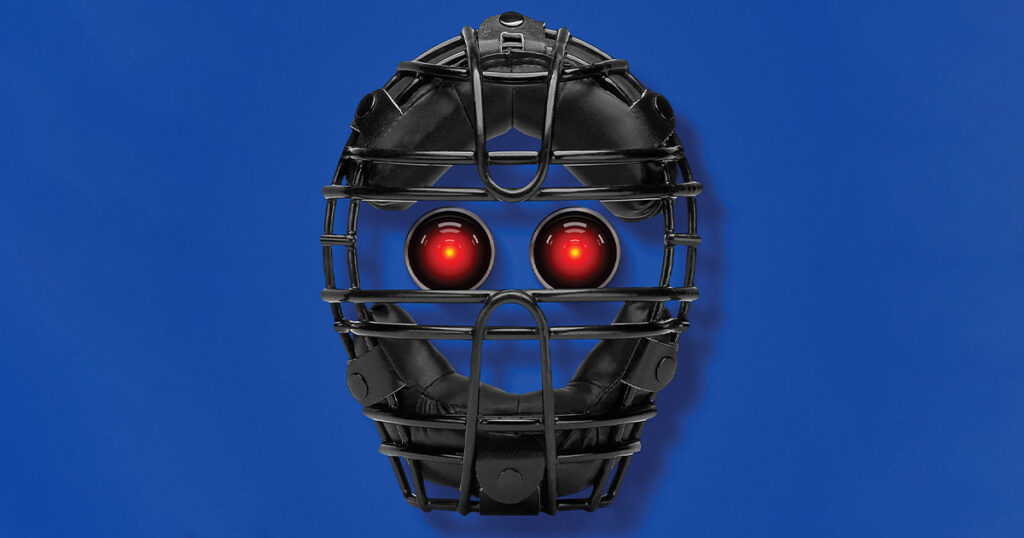
October 26, 1985. It’s the bottom of the ninth—isn’t it always?—and the visiting St. Louis Cardinals are up 1–0 on the Kansas City Royals. It’s Game 6 of the World Series, which the Cardinals lead three games to two. Jorge Orta, leading off the bottom half of the inning for the Royals, hits a ground ball on an 0–2 pitch that’s scooped up by St. Louis first baseman Jack Clark, who tosses the ball to Todd Worrell, the pitcher covering the bag. Worrell steps on the base before Orta reaches. The runner is out. Yet first-base umpire Don Denkinger doesn’t see it that way and signals Orta safe. Denkinger’s call is so notorious that it is often referred to, simply, as The Call. Some readers will remember watching it live. Others will have seen the replay. Everyone else should find the footage online before reading another word.
Jack Buck, the fabled Voice of the Cardinals for almost half a century, described what he saw for the radio audience: “Orta, leading off, swings and hits it to the right side, and the pitcher has to cover.” A disbelieving Buck repeated the umpire’s call to his broadcast partner, Sparky Anderson: “He is safe, safe, safe, and we’ll have an argument. Sparky, I think he was out … He had the base and he had the ball, man, what else—that’s the rule, isn’t it?”
The Cardinals, seemingly unnerved by the injustice, blew the game. St. Louis second baseman Tom Herr remembered, “You’re already under enough stress and tension. Now you have this happen. It kind of blows the lid off your emotional stability.” But a whole series of events had to unfold for Kansas City to win. With Orta on first, Royals power hitter Steve Balboni singled to left, making the most of a second chance at the plate after his pop-up in foul territory was misread and dropped by Clark (only recently converted from outfielder to first baseman). The Royals now had runners on first and second, but their momentum briefly stalled when Worrell fielded Jim Sundberg’s bunt and cut down the lead runner at third. Then everything started to fall apart again. Catcher Darrell Porter, appearing to get crossed up with Worrell on a slider, allowed a passed ball, and the runners advanced to second and third. With first base now open, the Cardinals intentionally walked Hal McCrae, Kansas City’s designated hitter. The next batter, Dane Iorg, singled to right, knocking in the tying and go-ahead runs, the latter scored by Sundberg, who beat a good throw from the right fielder and slid deftly into home beneath Porter’s tag. The Royals won 2–1 and went on to trounce the Cardinals 11–0 in Game 7 to win the series.
The 1985 Fall Classic, pitting cross-state rivals against each other, was billed as the I–70 or the Show-Me Series, and it really mattered in Missouri. In the wake of The Call, Denkinger received hundreds of ominous messages and letters. Someone even phoned his house in neighboring Iowa threatening to burn it down. Whether his mistake ultimately affected the outcome of the series became a matter of debate for the participants, too: “If that doesn’t happen,” McRae told reporters, “we probably don’t win.” Jamie Quirk, the Royals’ backup catcher, had a different reaction: “Other things happened, too. … Does a bad call mean you have to lose 11–0 in the next game?” Quirk’s rhetorical question implied that he didn’t want to be remembered as an accidental winner. Although they may readily acknowledge an instance of good fortune, most winners like to believe that they had something to do with their victory. If Orta is out, do the Cardinals win? Who can say? The correct call would have removed only the most egregious mistake from an equation full of mostly hidden variables. Quirk preferred to believe in his own agency rather than imagine himself dependent on what Leo Tolstoy called the unseen “laws of space, time, and cause.” Tolstoy proposed that for winners and losers, belief in autonomy is equally illusory. War and Peace advances a theory of historical causation in which even emperors are powerless: “Napoleon, who seems to us to have been the leader of all these movements … acted like a child who, holding a couple of strings inside a carriage, thinks he is driving it” (tr. by Louise and Aylmer Maude).
Following Denkinger’s mistake, Cardinals skipper Whitey Herzog charged out of the dugout to argue. These days, however, in the event of a bad call, a manager doesn’t have to get in the umpire’s face or kick dirt around or throw his cap. He doesn’t even have to leave the dugout. Instead, he puts his hands up to his ears signaling that he wants to challenge the play. Even though the manager has gotten the go-ahead from people in the clubhouse who have already reviewed the footage, challenges are still a bit of a gamble because “clear and convincing evidence” is needed to overturn a disputed call. Officials back at Replay Command Center in New York review the call from multiple angles, at regular speed and in slow motion, forward and back, over and over, until they are satisfied. Today, any call as unambiguously bad as The Call would quickly be corrected.
A manager gets a limited number of challenges per game; if a challenge is successful, he retains it for use later in the game. The list of situations subject to a manager’s challenge has been steadily expanding since 2008. In the 2026 season, with the introduction of an artificial-intelligence technology called the Automated Ball-Strike Challenge System (ABS), players will be able to request a limited number of pitch reviews, too. “Considered a middle ground between so-called ‘robot umps’ that could call every ball and strike and the long-standing tradition of the natural human error that comes with human umps,” MLB.com’s Anthony Castrovince reported, ABS “gives teams the opportunity to request a quick review of some of the most important ball-strike calls in a given game.” How long will this “middle ground” between erring human and robot umpires last? It is not impossible to imagine a league that gradually cedes all umpiring to technology in a drive toward adjudicatory perfection.
Baseball fans are intolerant of certain kinds of imperfection, especially when their team loses. Umpires are hardly the only source of uncertainty in the game: broken bats, bad hops, and caught spikes can all disrupt design. Then there’s the weather, the lights, the nonstandard configuration and dimensions of a park itself. The odds were mighty slim, for example, in the bottom of the ninth in Game 6 of the 2025 World Series between the Toronto Blue Jays and the Los Angeles Dodgers, that a line drive hit by Toronto’s Addison Barger would become wedged at the base of the centerfield wall in the Rogers Centre, resulting in a dead ball. The runner who thought he’d scored on the play had to return to third base.
Baseball has a rule for this eventuality. Rule 5.05(a)(7) accounts for any “fair ball which, either before or after touching the ground, passes through or under a fence, or through or under a scoreboard, or through any opening in the fence or scoreboard, or through or under shrubbery, or vines on the fence, or which sticks in a fence or scoreboard, in which case the batter and the runners shall be entitled to two bases.” Rule 5.05(a)(7) enumerates some of the strange hazards and permutations that might interfere with everyone’s expectations about how a play ought to turn out. The rule also announces an enduring pastoral quality to a game that has at times been as far removed from idyllic rusticity as are the urban sandlot and artificial turf. The critic Samuel Johnson once contrasted the styles of two great English poets, John Dryden and Alexander Pope, this way: “Dryden’s page is a natural field, rising into inequalities, and diversified by the varied exuberance of abundant vegetation; Pope’s is a velvet lawn, shaven by the scythe, and levelled by the roller.” Major League Baseball used to be a lot like Dryden’s page; now it seems to want to be more like Pope’s.
Rule 5.05(a)(7) provides for a freakish yet clearly not unprecedented type of intervention. The rulebook as a whole anticipates, and provides resolution for, as many causes of potential disorder as have been witnessed or imagined. Whenever confusion breaks out, the umpires must use their judgment to apply a rule or, should they be confronted by an unforeseen circumstance—pitcher Randy Johnson killing a dove with a fastball, say, during a spring training game in 2001—to invent one. The call in that case was “no pitch.” Rule 8.01(c) decrees, “Each umpire has authority to rule on any point not specifically covered in these rules.” But the rulebook can only mitigate the effects of chance, not eliminate it altogether. The rules can do nothing to legislate the flight of birds or human inconsistency and unpredictability: players who make errors, managers who make countless decisions over the course of a game, and on occasion, paying customers who interfere with a ball in play.
We live in an age highly skeptical of human judgment. Sometimes that skepticism expresses itself as contempt for expertise and a corresponding celebration of feeling, gut, or instinct. At other times, the ambient mistrust manifests itself as a surrender to various technologies that promise totality and perfection. One can hear both contradictory strains expressed in college classrooms, political arenas, ballparks, and barrooms everywhere.
Major League Baseball, perhaps self-conscious about its reputation for being slow and for the old-fashioned Casey-at-the-Bat wistfulness that clings to the game—blind or perhaps indifferent, with so much money at stake, to the idea that its idiosyncrasies are the very source of its poetic beauty—zealously embraces the realm of technology and statistics. Over the past two decades or so, teams throughout the league have relied increasingly on data analytics. Sabermetrics, an approach pioneered by Bill James in the 1970s, was put into action in the early 2000s by Oakland A’s general manager Billy Beane, who was searching for a way to compete on a limited budget.
As Michael Lewis recounts in his 2003 book Moneyball: The Art of Winning an Unfair Game, Beane used statistical analysis to justify replacing the team’s marquee players with a combination of less expensive ones. Beane’s approach was remarkably successful, and the use of data analytics quickly proliferated, especially among small-market teams. Rich teams don’t want to waste their money, either. Baseball’s use of data science constitutes, among other things, an attempt to exert a measure of control over all aspects of the game: scouting, drafting, compensation, trading, training, hitting, pitch selection, defensive positioning.
Several scenes in the 2011 film made from Lewis’s book emphasize the battle between statistical analysis and traditional approaches. In one, Beane confronts his team’s scouts across a conference table. The scouts’ expertise, developed over years of watching young talent, is pitted against a spreadsheet. “You’ve got a lot of wisdom and experience in this room,” the frustrated head scout boasts to Beane, but the more we listen to their inane conversation about prospects who have “square jaws” and “look like” ballplayers—it reaches a low point when one proposes that a player’s “ugly girlfriend” is proof that he lacks confidence—the more the scouts come to seem like a bunch of geezers who operate on hunch and prejudice alone.
The scene suggests that all the “wisdom and experience” the head scout claims is at best quirky, at worst downright silly and offensive. The scouts, whom Lewis calls a “Greek chorus” in his book, are caricatured in the film as useless antiques, whereas Beane, who relies strictly on numbers (chiefly on-base percentage and salary), comes across as shrewd, resourceful, and adaptable. He is a man built for the future. Even though the A’s don’t win it all, the film works to vindicate his philosophy. It doesn’t hurt the cause of sabermetrics that Beane is played by Brad Pitt.
Remake such a scene today, and the discussion would center on the golden promise of AI algorithms in a more comprehensive indictment of whatever has passed for human intelligence over the benighted centuries. Human intelligence is the past; artificial intelligence is the future. Today’s widespread fervor for AI is further abetted by a presentist mindset that conceives of the past as something to be gotten over, something to be pitied, something filled mostly with human error. As a colleague who works on the philosophy of artificial intelligence pointed out to me, AI in some form or other has been with us for some time; it’s the definition that changes. Although there are different AI functionalities, the one that has garnered the most popular attention and that is flogged most insistently to the public is generative AI, which predicts the next linguistic or visual element in whatever string it is asked to produce. Large-language models such as ChatGPT aggregate information and discern patterns at speeds impossible for human brains. These platforms are becoming increasingly invasive, more and more difficult for those who don’t want to use them to tune out or turn off.
Proponents of AI, who stand to make heaps of money from their platforms, tout it as the answer to all our inadequacies—physical, intellectual, and emotional. Sam Altman, the CEO of OpenAI, likes to share his grand ambitions for the technology. Unsurprisingly, curing cancer is a favorite example. It is convenient shorthand for any monumental achievement long regarded as impossible. Even in those areas, such as medical diagnostics, where the processing speed and analytic capabilities of AI appear to show great promise, there remains considerable uncertainty about the most accurate and effective way to integrate artificial intelligence with human decision-making. Nor is this collaboration free from potentially debilitating dangers such as “automation bias”: experts’ tendency to defer, even when they are correct, to machines. Furthermore, as the physician Dhruv Khullar pointed out in The New Yorker, “Many medical questions—perhaps most of them—do not have a right answer.”
Institutional and individual consumers of AI have quickly learned to parrot the same unquestioning enthusiasm with which the technologies are marketed to them. The language of the convert tends to be irrational, or antirational, in its intensity. Find a way to use AI, we are told almost daily, or risk getting left behind. Evangelists who attempt to bludgeon us into submission ignore practical as well as epistemological and ethical problems. The perfectibility of generative AI, for example, is not a forgone conclusion. The more powerful it becomes, the worse its hallucinations seem to get. And if only an expert has a shot at spotting hallucinations or discerning more subtle errors, where does that leave a generation of novices in a whole range of fields now being indoctrinated into AI’s mysteries? In corporate settings, such as law firms, AI can now do much of the routine work that new associates once did. But as a partner at one large international firm told me, it doesn’t obviate the need for third-, fourth-, and fifth-year associates. That’s a professional development problem he has yet to solve. Zealots likewise ignore AI’s irresponsible mining of intellectual property, violation of privacy, and deleterious effects on climate and the environment, as well as the various harms done to low-wage digital workers whose training of AI can involve labeling vast libraries of pornographic or violent images. Nor has the revelation that several vulnerable teens died by suicide after looking to AI chatbots (which combine generative AI and natural language processing to engage in “conversation”) done much to slow momentum.
We are told that we should not let anything stand in our way because AI’s promise is so great. But what, precisely, are we being promised? After all, most of us aren’t using AI to try to cure cancer or even to build self-driving trucks. And we don’t have bespoke platforms at our command. I have for several years now used a text-to-speech service to read drafts aloud. Hearing the prose in this way helps me revise, compare drafts, even spot typos. Once limited to the small library of voices available on my computer, some much better than others, I can now choose from a broad range of AI-generated voices offered by various providers. The quality of the voices is improving. Even actors, or deceased actors’ estates, have begun licensing their voices: Michael Caine, Judy Garland, Burt Reynolds, James Dean. My current favorite is Laurence Olivier. But listening to an artificial Olivier read my words isn’t remotely like hearing the real thing. The voice can’t reproduce the tone or emphasis I intend. It has no sense of timing or pace, and sometimes the very wrongness of its modulation proves distracting. It doesn’t understand what it is reading, and it doesn’t know that it is being criticized in this sentence. Even if, as some celebrants suggest, AI will continue to free me in other, similar ways from routine drudgery so that I can concentrate on meaningful, creative work, that would make it an asset, but one with all the romance of a dishwasher. One woman’s drudgery may be another’s vocation, but who is not glad for that particular labor-saving device? My dishwasher, which I just put on, allows me to spend more time working on this essay. I’m grateful, but I don’t confuse this appliance with a panacea or revere it as a god. Moreover, a study conducted by the MIT Media Lab found that AI is not enhancing productivity in many industries but is instead generating content that gives the illusion of finished work but in actuality lacks substance and is filled with meaningless diversions—what has come to be known as “workslop.” That sounds like something a malfunctioning dishwasher might produce.
There are people starting to write thoughtfully about aspects of AI and different kinds of labor, but they remain outliers. Ideally, the AI tsunami would provoke a serious public policy debate about work, autonomy, and human dignity in the 21st century as opposed to the mad scramble of adoption we are witnessing. Industrialization in the 19th and 20th centuries provoked more than that. Among other things, it catalyzed machine-smashing Luddites, unions, strikes, safety regulations, and worker protections. In some countries, of course, it sparked murderous political revolution. Today, a substantive discussion might produce a taxonomy that helps us differentiate between the kinds of labor that alienate us from our humanity and the kinds that could potentially fulfill it. The new technologies might inspire us to devise a new philosophy about which activities ought to be outsourced to machines and which reserved for us. That intellectual revolution hasn’t happened because our culture is focused almost exclusively on speed, profit, and efficiency.
The economist Kyla Scanlon notes the rapidity with which big AI “dreams” such as “curing cancer, personalizing vaccines and medical treatment optimization … have already devolved into next-generation social media apps, like OpenAI’s Sora and Meta’s Vibes.” If you can resist the seductively vague promises while ignoring the unsubtle threats about human obsolescence and pay close attention to the way AI is actually being marketed to the average consumer, you will discover the deeply and paradoxically anti-intellectual nature of the intelligence gathering it touts. A commercial currently airing on TV tells me that if I need “a recipe that says, ‘I like you but want to play it cool,’ ” ChatGPT can provide me with a dish (lemon-garlic pasta with cherry tomatoes) that will precisely signal a moderate level of romantic commitment. While watching the World Series, I was repeatedly told that AI from Google Cloud could tell me whether “a bat tap untaps good mojo.” It could also answer another burning question: “Can turning your hat inside out turn the game around?”
How quickly “intelligence” has degenerated into nonsense. These ads remind me of Dr. Faustus’s pact with the devil, not because AI is inherently evil but because its rewards seem so meager. Frustrated with the limits of human knowledge, Faustus turns to the practice of “dark arts.” He sells his soul ostensibly to break boundaries and thereby to increase his store of wisdom. In Christopher Marlowe’s version of the tragic legend, Mephistopheles, who sounds rather like an ingratiating chatbot prototype, asks him, “Now, Faustus, what wouldst thou have me do?” And Faustus, rather than penetrating the mysteries of the universe, ends up ordering Mephistopheles to play tricks on the pope, conjure illusions for the emperor, and terrify a man by making him think he has pulled off the doctor’s leg.
Anyone who collected baseball cards as a kid—or still consults the Baseball Almanac from time to time—understands the thrill of statistics. But back-of-the-card connoisseurs take a reflective, not a predictive, joy in poring over all those numbers. They might marvel at the offense generated by Nap Lajoie and Honus Wagner in the dead-ball era or wonder at the innings thrown by Cy Young, Warren Spahn, or Sandy Koufax in the days before modern coaching theories severely curtailed pitchers’ workloads and a pitch count of 100 became a magic maximum.
To watch a baseball game on television today, however, is to be plunged into a world of predictive metrics and likely outcomes made possible by Statcast, which MLB describes as “a state-of-the-art tracking technology that allows for the collection and analysis of a massive amount of baseball data, in ways that were never possible in the past. Statcast can be considered the next step in the evolution of how we consume and think about the sport of baseball, encompassing pitch tracking, hit tracking, player tracking and even bat tracking for all Major League games.” Announcers increasingly fill the space that the inimitable Vin Scully once used to let a game breathe by reciting statistics that begin to sound more and more trivial, conflating correlation with causation, and drifting into the realm of random coincidence.
Anyone who expresses suspicion about AI forecasting is immediately branded an ostrich, but the ironic thing about our manic indulgence is that it seems to be plunging us back into the past. The ancient biographer Plutarch didn’t know much about baseball, bat taps, or rally caps, but he was quick to discern the psychological appeal of tracking coincidence: “There are people who take a pleasure in making collections of … fortuitous occurrences that they have heard or read of, as look like works of a rational power and design” (tr. by John Dryden, revised by A. H. Clough). To illustrate his point, Plutarch presents his reader with an utterly meaningless series of parallels: two men who shared a name and were both torn limb from limb (one by dogs, the other by his lovers), three sacks of Troy, and four capable generals who had each lost one eye.
Of a piece with in-game forecasting, meanwhile, is the flood of online sports betting ads in between innings. Many announcers even give odds at the beginning of a broadcast. It has perhaps never been so easy to turn soothsayer. We can pick up our phones and attempt to monetize our powers of prognostication, even as the line between wild guess and shrewd analysis grows increasingly blurred. Moreover, the prop bet and the microbet allow customers to wager on individual events, not just the outcome of the game or the total number of runs or points scored. Clearly, the profiteers would love us to become so many Frau Hessenfelds. In Thomas Mann’s The Magic Mountain, Hessenfeld is the frivolous widow whose contagious “passion in life was betting on … anything and everything”: weather, dinner menus, the results of medical examinations, bobsledders, love affairs, and “a hundred other, often totally trivial and insignificant things” (tr. by John E. Woods).
A different class of company, the most prominent of which is Kalshi, trades “on the outcome of future events,” including sporting contests, while circumventing state gambling laws. The “prediction market” is regulated like a commodity futures exchange. Kalshi, which is facing a number of lawsuits from state gambling commissions and others, takes bets on everything from how many home runs Shohei Ohtani will hit to how many days a government shutdown will last. How quaint it now seems that Pete Rose had to call his bookie on a landline.
The mania for prediction expressed in betting, “statcasting,” and a superstitious reverence for AI’s pronouncements makes devotees seem less like futurists than revenants from some remote past. They are as uncritical of their tools and as dependent on the results as an ancient Babylonian guided by augury, a Greek reading the entrails of a sheep, or a Roman visiting the Sibyl at Cumae. The next time you ask AI for life guidance, you might think of the Lydian king Croesus, who tested the accuracy of oracles throughout Greece before asking the two he trusted most whether he should risk war against Persia. According to Herodotus, they predicted the same thing: “Croesus, if he did go to war with the Persians, would destroy a mighty empire.” Croesus digested this prophecy and went to war. What he couldn’t compass was that the empire he was about to destroy was his own. After Croesus’s defeat, when the Persian Emperor Cyrus asked him why he had undertaken such a foolish venture, Croesus told his captor that though he had launched the invasion, “the ultimate blame” belonged to the gods who had encouraged him to do it (tr. by Tom Holland).
Some months ago, I had an experience that suggested to me how far we have already traveled into a strange land. An acquaintance wrote me a very kind message of commiseration about something that he thought had happened to me. When I replied that I had no idea what he was talking about and wondered about the source of his information, he reported that he had asked about me. Whom had he asked? I persisted. He told me, in what struck me as a rather strange call and response, that when he had asked a question about me, AI had answered. I emerged from the exchange unsure whether I had convinced him that I, not AI, was the more reliable source for the facts of my own life.
Human beings are notoriously bad at predicting the future. No wonder we try to outsource the task. Forecasting, planning, and projection—these are the things that AI companies offer to corporate and individual consumers alike. Yet the more reflexively we give ourselves over to AI—the more we treat it like an oracle as opposed to a tool—the less likely we will be to harness whatever power it might have and the more rapidly our self-reliance, judgment, and ability to process the world’s ambiguous signals will deteriorate. Take the example of Albania, which is attempting to root out a history of corruption by turning itself into an “algocracy,” a country run by AI algorithms. “Algorithms can optimize efficiency, but they can’t decide between competing values—the very choices that lie at the heart of democratic politics,” Erick Schmidt and Andrew Sorota wrote in The New York Times. “When democracy struggles to deliver, people turn to strongmen, authoritarians and now algorithms, hoping for competence over chaos.”
As a few recent books have argued, grandiose claims about AI’s nature and capacities can sound like a long con. Americans aren’t the only ones susceptible to hucksters, but we do have a rich history of falling for swindles ranging from the mostly playful tricks of P. T. Barnum to the 19th-century Manhattan confidence man who made off with people’s watches, from the pyramid schemer to the patent-medicine salesmen promising life-giving elixirs to the sham preacher offering material and spiritual salvation exposed in Sinclair Lewis’s novel Elmer Gantry (1927).
The willing surrender to all such cons stems from discontent, insecurity, and fear. It owes to the belief that the system is rigged against us. Despite the obvious incongruity, this belief appears to be shared equally by the mother of three who has just lost her job and the billionaire who feels threatened by government regulation. “It’s an unfair game,” Billy Beane tells the scouts in Moneyball, pronouncing the subtitle of Michael Lewis’s book. The Oakland A’s have to compete with big-budget teams like the Yankees and therefore approach the problem, in Lewis’s words, like “card counters at a blackjack table” intent on beating the house. In an age of dislocation and resentment, many of us feel like the A’s. We’ve been dealt a bad hand, and we would love to turn the tables on an unjust world.
The aggrieved and confused are ready prey for what is being called the “casino economy.” Speculation has always been an integral part of the markets, but the wager is now ubiquitous. Scanlon, the economist, declared in a New York Times op-ed, “Look and you will see gambling throughout the economy—in markets, policy and how we talk about the future. … In a real casino, the math guarantees the house wins over time.” In other words, the average investor is now participating in an economy ordered by the same rules as a casino. We are no longer risk takers, Scanlon concludes, but “reckless” gamblers.
Whenever we feel out of control, it becomes harder, paradoxically, to resist the self-defeating urge to cede even more in a gesture that might look like heroic defiance but is in fact abject submission. We forget the essential process of parsing the tractable and the intractable expressed so eloquently by the philosophical former baseball player Mickey Rivers: “Ain’t no sense worrying: If you have no control over something, ain’t no sense worrying about it—you have no control over it anyway. If you do have control, why worry? So either way, there ain’t no sense worrying.”
Our casino life involves certain fundamental human fantasies: that we can beat the house, that we can avenge ourselves on a world filled with the unfair and the unpredictable, that we can abdicate the arduous and time-consuming exercise of judgment and personal responsibility by outsourcing it to a machine. Along the way, of course, we end up writing ourselves out of the equation. That’s a problem that transcends the baseball diamond but finds few better provinces for working itself out.
In his article on the advent of ABS, the MLB reporter Castrovince referred to “the long-standing tradition of the natural human error that comes with human umps.” If we can fix it, should we fix it? When it comes to umpires, MLB seems to be saying yes. But why is an umpire’s error less forgivable than a player’s or a manager’s? Where should we stop? To what extent should we reduce the influence of human judgment in an attempt to eliminate its inevitable companion, human error? Minimizing or eradicating errors in brain surgery strikes me as ideal, but there might be creative, experimental realms—classrooms, artists’ studios, ballparks—in which human error could be construed as a positive good. And if we have designed the algorithms on which AI works, can it ever really be free from our mistakes? When does technology make us better, and when does it simply make us less like ourselves? These aren’t questions the evangelists want us to ask. Such is an oracle’s theatrically intimidating power.
In baseball and in writing, the poet and Brooklyn Dodgers fan Marianne Moore once proposed that not knowing “how it will go / or what you will do” is the very thing that makes the game “exciting.” Even a spectator who finds fallibility in umpiring intolerable, and perhaps looks forward to the increasing reliance on technology toward which Major League Baseball is tending, would never trade Mookie Betts, even when he struggles, for a robot.
Betts makes, on average, an annual salary of $30 million, but he plays with the hustle and intensity of a rookie fighting for a spot on the roster. In 2024, at 32, he moved from the outfield to shortstop, the most demanding position on the field. In 2025, he saved more defensive runs than any other shortstop in the game. For much of the season, Betts was in a batting slump so miserable—one of those fathomless baseball sloughs of despond—that he ran out of ideas on how to fix his swing. But when the Dodgers returned to their home at Chavez Ravine on August 4, after a long and difficult road trip, thousands in attendance gave Betts a standing ovation when he came up to the plate in the first inning. Those fans recognized that they were watching a valiant struggle, and they responded to it with the same encouragement they would excellence.
The Dodgers are known for using state-of-the-art simulation and other technologies to support players, and you can be sure that Betts, in addition to spending countless hours in the batting cage, took advantage of every tool, metric, and measurement the team could provide. Eventually, he found what he was looking for in a human being, former teammate J. D. Martinez, who joined him on the road in August. Working with Martinez on some of the mental aspects of the game, Betts narrowed his focus and stopped trying to salvage his offensive season. “J. D. … just helped with grace and patience,” he said. “That’s what has kind of gotten me out of it.” This isn’t the movies. Betts improved considerably in August and September but continued to be inconsistent at the plate throughout the playoffs. He remained unrattled on defense, however, and also had a timely hit early in Game 6 of the World Series to drive in what ended up being the winning runs to force a Game 7, which the Dodgers won 5–4.
Baseball aficionados understand that the occasional error, the strikeout, even the prolonged slump are the inseparable complement to the clutch hit or the acrobatic jump throw that seals the double play. Betts’s magnificent athleticism, tenacity, and resilience are meaningful and exciting precisely because we know that he is also capable of a lapse at any time. He knows it, too, and his personal elegance and clear-eyed connection to his own human mutability only add to his appeal. Major League Baseball assures me that Statcast is “the next step in the evolution of how we consume and think about the sport of baseball.” But as far as I’m concerned, Statcast can do nothing to enhance the majesty of Mookie Betts or to increase the joy I take in watching him play.
Jim Palmer was the television analyst for Game 6 of the 1985 World Series. When Jim Sundberg squared to bunt and Todd Worrell couldn’t seem to get the ball over the plate, Palmer, a former pitcher himself now in the Hall of Fame, suggested that a pitcher “almost wants” the batter to lay down the bunt in such a situation. “Boy,” he said after Worrell threw another ball, “the human element now comes into the ballgame.” But the human element had been there all along.