
The Caravaggio Whisperer
On a Roman holiday, an unexpected friend took me deep into the artist’s world
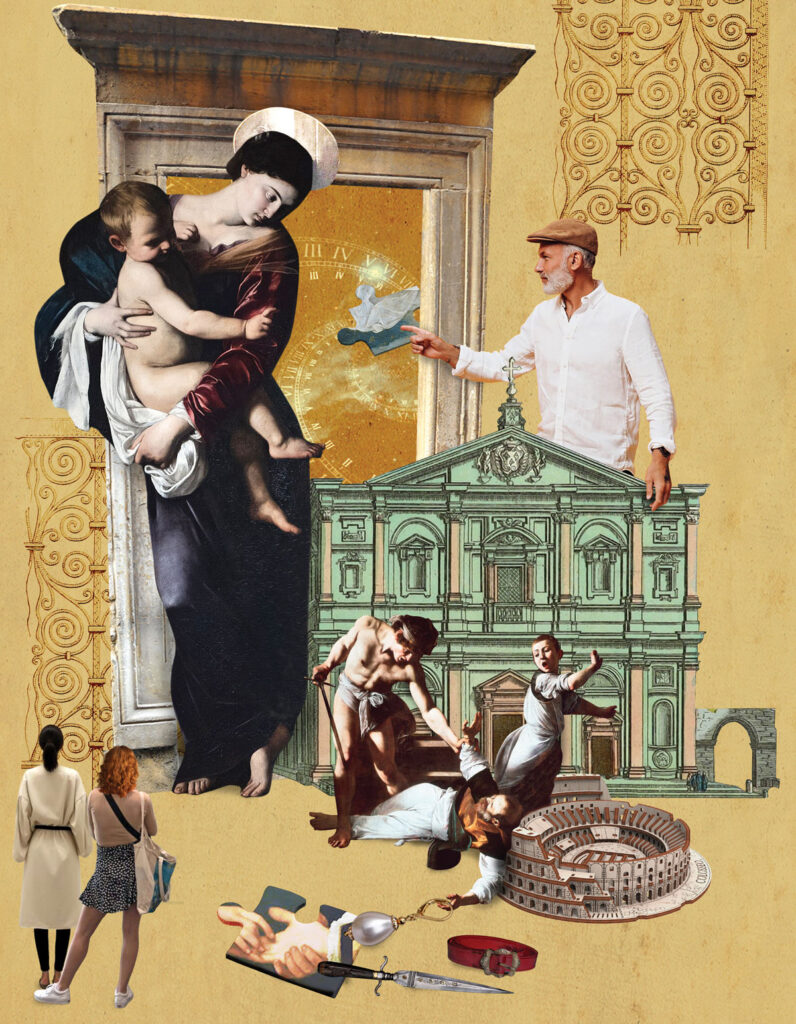
You’ll be smack in the middle of Caravaggio country,” my brother, an art historian, said after I told him where I’d be living during my month-long visit to Rome. I admired the artist, born Michelangelo Merisi in 1571, but knew almost nothing about his life. Thanks to that comment, though, he was on my mind from the moment I first stepped into the narrow, cobblestoned Via dei Coronari, a storied road in the neighborhood where Caravaggio lived during the Renaissance. He’d moved to Rome, as many young artists did, after an apprenticeship in Milan, just west of his birthplace, Il Caravaggio. At some point, the young Merisi adopted the name of his hometown as his own.
My building was a place of austere beauty reached via an ancient, crumbling outdoor staircase set in a row of three piazzas in the Ponte neighborhood. You could enter the apartment’s timeworn wooden double door in one of two ways: by disconnecting the two halves, then shimmying sideways through a narrow aperture, or by leaving both sides attached and, as with a modern door, just barreling through. As I learned through trial and error, there was no way to lock it unless both halves had been made whole.
My trip had come together at the last moment, so I was alone and knew no one in Rome. But soon the bustling city was all around me, with its warmth and ambient laughter. I inhaled the place, breathing in its beauty. I loved its ocher buildings with their stained, ancient walls and the bridges that crisscross the curving Tiber, one right after the next. Work thoughts slipped away. For a time my only aim was to float through the city, and to see.
So Caravaggio was on my mind, if subliminally. Then, suddenly, he was there before my eyes. I’d stepped into the Church of Sant’Agostino in Campo Marzio, just a short walk from my apartment, not knowing what I’d find inside. Some Roman churches announce the artist’s presence loudly—“This way to the Caravaggios!” reads a poster in front of the nearby Church of San Luigi dei Francesi—but not Sant’Agostino. I came across him there by accident, after joining a cluster of people standing before his Madonna of Loreto (1604–1606), an enormous altarpiece painting in the Cavalletti Chapel just to the left of the church’s entrance. As I would soon learn, works by Caravaggio often draw a crowd.
Login to view the full article
Need to register?
Already a subscriber through The American Scholar?
Are you a Phi Beta Kappa sustaining member?
Register here
Want to subscribe?
Print subscribers get access to our entire website Subscribe here
You can also just subscribe to our website for $9.99. Subscribe here

true