
The Spirit Seeker
Were it not for W. A. R. Goodwin, Williamsburg, Virginia, would look like a very different place today
For a small pocket of Tidewater Virginia, this is a year of significant anniversaries—not only the semiquincentennial of the United States but also the 100th anniversary of the founding of Colonial Williamsburg. Given that 18th-century Williamsburg was ground zero for fomenting local rebellion against the British Crown, this coincidence of dates seems fitting, if not charmed. After all, there is something about Colonial Williamsburg, like the American revolutionary cause, that has always seemed (in our collective mythology) inevitable. Providential.
What many people love about Colonial Williamsburg (CW) is also what critics have pilloried since its inception. Perhaps no public space in America is so clean (sanitized, according to detractors), no historic or replica buildings so pristine (again, sanitized), no home gardens so well manicured, and no visitors so restrained and civil. The Williamsburg aesthetic—perhaps even more than its equally celebrated historical programming—is a big part of the draw for the half million people who visit every year, for the 382,000 Colonial Williamsburg Facebook followers, and for the many YouTube historians who document their visits there.
Not far from CW’s main drag, Duke of Gloucester Street, stands a structure unknown to many visitors—unless they happen to be looking for ghosts. The George Wythe House, a small brick Georgian structure dating to around 1755, reposes virtually alone off the long Palace Green. If there were any building in CW where you might encounter the spirit of the Reverend Dr. W. A. R. Goodwin, this would be it.
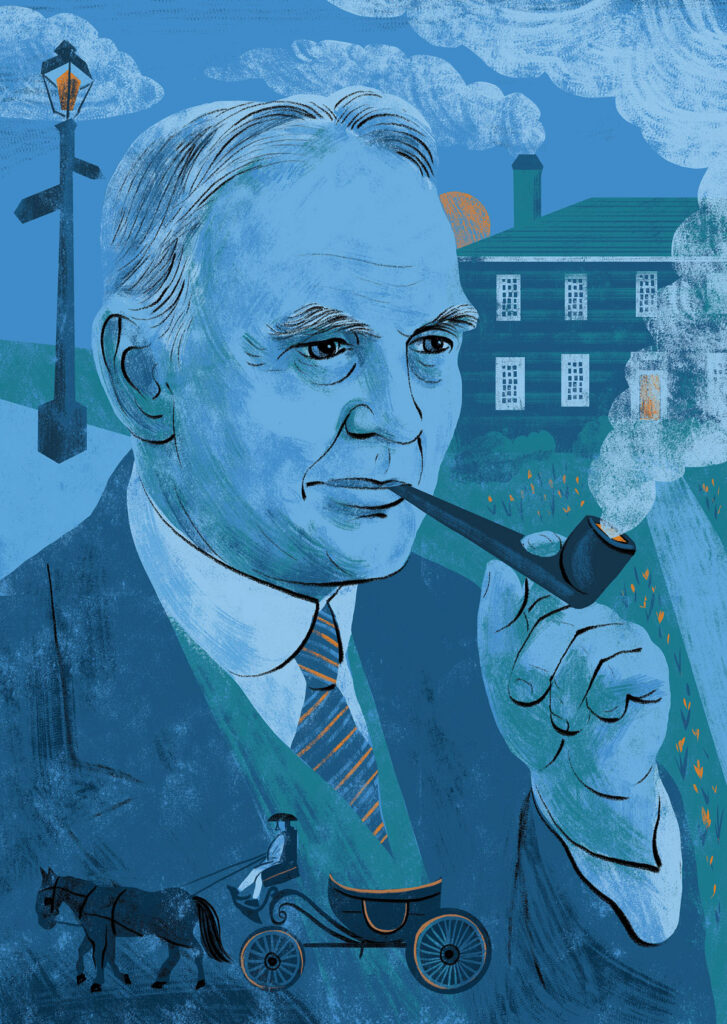
Kelly Brennan, a historian in the research department of the Colonial Williamsburg Foundation (CWF), has felt Goodwin’s presence here. She used to oversee the organization’s popular evening ghost tour program, which has a stop at the Wythe. In those days, Brennan was a doctoral student at the nearby College of William & Mary and would sometimes cram for exams in the Wythe’s downstairs parlor. “I could hear [Goodwin] walking around upstairs,” she wrote to me by email. “He must have come down the stairs, because I felt a presence in the doorway and the smell of pipe tobacco, as if he was checking in on my progress.” There have been instances, according to Brennan, when daytime visitors to the Wythe House encountered a “rude man” who was seen “staring out the window in a second-floor room. The visitors complained that the man wouldn’t turn around when they spoke to him.” The description of the figure was always consistent and “exactly matched photographs of Goodwin.”
That second-floor room was once Goodwin’s office. Staff and guests have also encountered his spectral presence behind the Wythe House, near a brick wall that abuts the Bruton Parish Church graveyard. This would make sense. Goodwin was twice rector of Bruton Parish. “The pipe tobacco,” Brennan wrote, “is Goodwin’s dead (pun intended) giveaway.” When Goodwin’s trusty briarwood pipe wasn’t clenched between his teeth, he used it to punctuate his thoughts, jabbing this sixth finger for rhetorical emphasis.
CW often refers to Goodwin as “The Father of the Restoration”—the project that involved the preservation or reconstruction of more than 300 buildings on 301 acres of Virginia’s former colonial capital. This appellation is no small honorific, considering that it was world-renowned philanthropist John D. Rockefeller Jr. who footed a bill worth well over a billion of today’s dollars to create the world’s largest, perhaps most eminent living-history museum. But it was Goodwin—embodying P. T. Barnum’s knack for showmanship, John Adams’s pit-bull tenacity and razor-edged powers of persuasion, and a history major’s wide-eyed passion—who willed this place into being. He wasn’t a historian or an architect but an excitable, loquacious, know-it-all Episcopalian clergyman whose vision led to the creation of a place that revolutionized preservation, interpretation, and living history.
Beyond a small group of history professionals, however, Goodwin is virtually unknown, a footnote. Perhaps this, too, was inevitable.
William Archer Rutherfoord Goodwin landed in Williamsburg in 1903, when he was hired as rector of the Bruton Parish Church. Built in 1715, Bruton in its heyday attracted such luminous congregants as George Washington, George Wythe, John Marshall, Peyton Randolph, and Patrick Henry.
Login to view the full article
Need to register?
Already a subscriber through The American Scholar?
Are you a Phi Beta Kappa sustaining member?
Register here
Want to subscribe?
Print subscribers get access to our entire website Subscribe here
You can also just subscribe to our website for $9.99. Subscribe here

true