
What He Stood For
How Angus Cameron, one of the most significant editors in the history of American publishing, responded to being targeted by the McCarthy blacklist
I
In December 1998, with talk of impeachment disrupting the apricity of a Sunday afternoon in Washington, D.C., there was (as the Irish like to say) a wonderful commotion taking place at the Cosmos Club near Dupont Circle. Publishers had shuttled in from New York or Boston or come down on the Metroliner. Democratic socialists from the 1940s and 1950s had come, too (along with a smattering of radicals and red-diaper babies), remarking that the witch-hunt atmosphere of Kenneth Starr’s Washington was not unlike that of the McCarthy period years earlier. Fly fishermen had put down their rods and taken off their waders and drifted in from Montana; salmon fishermen had parted company for the moment from the banks of the Restigouche and the Miramichi; hunters had emerged from the Adirondacks full of tall tales; birders temporarily abandoned their binoculars and migrated from near and far. All manner of chefs were there, gourmands, meat-and-potatoes guys, a few westerners with Stetsons, science buffs, historians of various stripes, writers with only one book in them, colorful con men a mere city block ahead of the law, a Scot with a kilt but, alas, without his bagpipes, and a former foreign correspondent who stepped right out of a Graham Greene novel. They, this whole rich stew of generations that formed pieces of a life, had all come to this august establishment on Massachusetts Avenue for Angus Cameron’s 90th birthday party, and they would hear, among other things, a letter from Gore Vidal, faxed from Italy.
“Although I cannot say much good about the century Angus Cameron has lived through,” Vidal wrote in his legendarily dyspeptic way, “I have regarded him as a singularly bright paladin, or dare I use the phrase, wise centurion.”
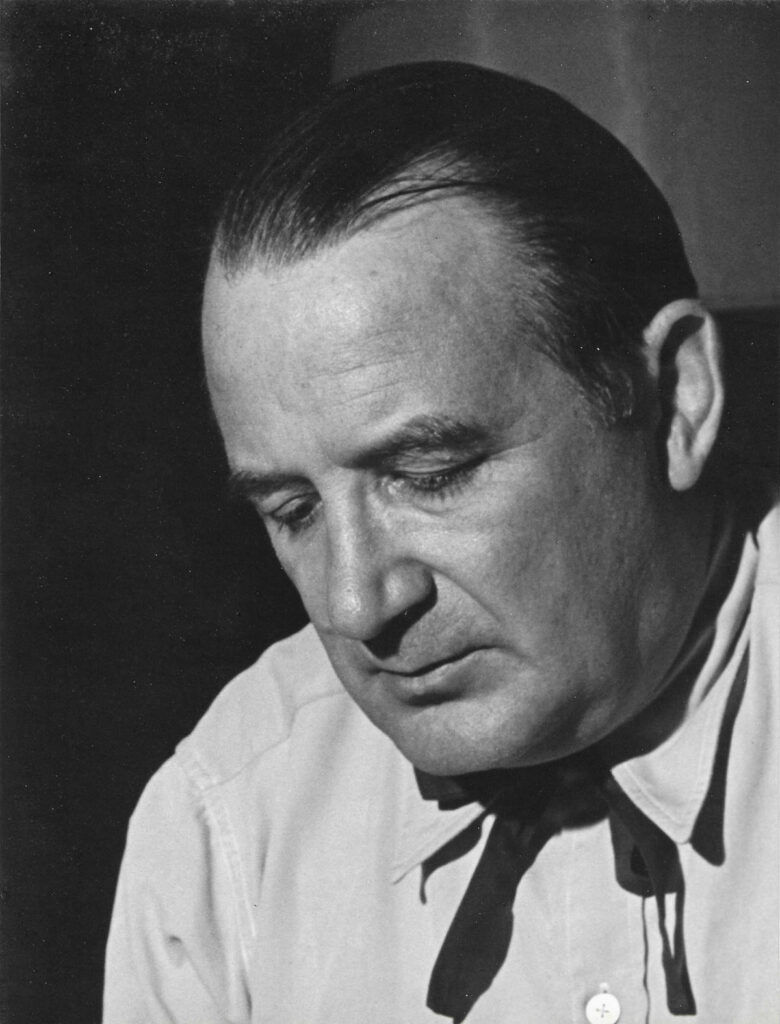
I had come to Washington that day, along with my five-year-old daughter, and as I sat there, staring across the room at Angus, at the father I might have chosen had I had a choice, it was not hard, even after all the years, to recall my first memories of him: the walrus mustache, the blue button-down Oxford shirt (or his Safari brown number), the briefcase that was more like a trunk (battered and brown and containing many things you would not expect), the pinkish Santa Claus face, the big Stetson and huge overcoat, the little Dutch cigars, those Schimmelpennincks he loved to draw on as he leaned back in the chair in his office, always keeping his sport coat on, his tie never undone, peering at you, taking your measure, taking an interest in you, and always, with a wry half-smile, dispensing a special form of wisdom, wisdom gleaned over time and through the way life cuts facets on you, as he loved to say.
He would often begin his sentences with “By the way” or “Of course,” and say those words in such a manner of folksy authority and Hoosier flatness, shaped in part by the fine loam of the Indiana prairie, that I would forever after associate those phrases with him and no one else. So, for instance, when talking about Arthur Schlesinger Jr.—perhaps the only person he felt any lasting animus toward—he would say, in speaking of his thin physique: “By the way, I don’t trust a man with no ass.” Or of the time he got so exasperated with the New Haven Railroad that he offered this choice piece of advice: “What you should really do, of course, is turn this whole operation over to the Lionel people.” Or on the amorphous subject of disillusionment: “Oh, by the way. You can’t be disillusioned, you know, without having an illusion in the first place.”
Nearly 24 years earlier, the invitation had come unexpectedly. I looked up from my desk in my small cubicle at Alfred A. Knopf one March day in 1975, and there he was, saying, “By the way, I was wondering if you were free for lunch on Thursday?”
I didn’t know very much about Angus Cameron at that point. I was 23 years old and had only been at Knopf for a month. His office was across the hall from where I sat. I may not have known very much about him, but I could hear him, could hear that resonant midwestern voice that captured and commanded your attention whether you wanted it to or not. He was 66 when we met, and I had heard (and later learned in much greater detail) that he was thought to be a communist sympathizer and had been the first editor in book publishing to be blacklisted in the 1950s, that the FBI had begun a file on him in 1945 (and maintained it until 1968, J. Edgar Hoover himself becoming directly involved at one point), that he had lost his livelihood, and that after nearly eight years of being in exile, Knopf had offered him a job, a way back into mainstream publishing. During that period of time away from what might be considered the prosaic routines of daily life, he never felt more free and unconstrained. He packed up his Buffalo Kaiser and took his whole family to the farthest reaches of Alaska in order to make money fishing for the Inuits. He also returned east to testify before Senate committees, displaying a knowledge of Robert’s Rules of Order and of the Constitution that far surpassed that of anyone questioning him. (It no doubt helped that he had initially thought of becoming a lawyer—as well as a lion tamer.) It was during this period that he and a man named Albert Kahn (and later, Carl Marzani) ran a publishing house that put out books (such as Harvey Matusow’s False Witness) that no one else would dare publish, all the while pushing back against subpoenas and feeling a twinge when many of his friends kept a safe political distance from him. When a reporter at The New York Times asked Mr. Knopf why he was hiring Cameron after this period of exile, his reply was characteristically gruff: “Because he’s the best damn editor around”—only underscoring what Time had written when Cameron resigned his editor-in-chief’s job at Little, Brown in September 1951: that in the aftermath of Maxwell Perkins’s death, Cameron was the “foremost book editor in the U.S.”
When Thursday arrived, we headed off to lunch at La Toque Blanche on East 50th Street, a few blocks east of Knopf’s offices, where Cameron had a table, the first one on the left, held for him every day until one p.m. Ordering for both of us, he wasted little time in finding out that I was an impostor, a guy who talked a good game but didn’t really have what it took to back it up.
Between bites of salmon, he pressed me, gently but firmly, like the best of prosecutors.
“Oh, by the way,” he said, leaning forward, “did you see that piece in Scientific American about …?”
No, I sheepishly admitted, I hadn’t.
“Why not?” he asked.
“I guess because I have very little interest in science,” I said.
He didn’t like that answer, I could tell, but he continued on, apparently unwilling to give up on me.
“Well, what about that article in Natural History that discussed …?”
“Same answer, I’m afraid.”
I was being tested, and I was failing, miserably. What, I sat there wondering, could have motivated him to ask me to lunch in the first place?
The short answer is that he genuinely believed everyone should possess the same relentless curiosity and appetite for knowledge—not just information, but knowledge—that he did. So when copies of Scientific American and Natural History—the first issues of yearlong subscriptions, I later learned—filled my tiny mailbox not long after that, the picture slowly came into focus.
The morning after I received them, I stood at the door to his office and waited for him to look up from his manual typewriter. When he did, I asked (even though I knew the answer) if he, by any chance, had anything to do with all this.
“Of course,” he said, face breaking into a grin, then becoming serious again. “If you’re going to get anywhere in this life, you must always be a contemporary of yourself.”
II
On the Saturday morning of September 8, 1951, Angus Cameron went to the post office in South Lincoln, Massachusetts, and received a letter in Box 105 that almost, but not quite, took him by surprise. The letter, from his employer, Arthur Thornhill of Little, Brown, informed him that he would need to let the firm know of any activities (i.e. political) he was engaging in when he wasn’t serving in his capacity as editor-in-chief. He was being asked to account for his time.
Angus had just gotten back from Maine the previous evening, having been delayed by weather and having missed a meeting on the Friday that was not supposed to have been held without him. But the notion of what is, or isn’t, supposed to occur is always tricky, and the tenor of the times only exacerbated all that. The minute you begin to say that certain things “should” or “shouldn’t” happen, you are alone out there in the blue, assuming a uniform logic and rationale that doesn’t exist and never has.
An August 31 article in the anti-communist newsletter Counterattack had brought the Little, Brown board of directors to a point of no return. Not only was Angus prominently mentioned in the piece, but the house itself was essentially being singled out as a place where all so-called communist authors could find a soft landing. Nuance was not of interest to Counterattack. Nor were any gray areas. If you were an author, you were your book, pure and simple. The unrelenting hysteria of the period made it even easier and far more conforming to paint everyone with the same brush. To honestly try and figure out the truth of what was actually going on—well, that required too much work. And besides, it didn’t fit with the prevailing wisdom, or more to the point, the lack of it.
For six years, Angus had been followed around by the FBI. Agents had insinuated themselves into every aspect of his life. They tapped his phone, tampered with his mail, went to meetings he had attended, and found people within Little, Brown and other places to report back on his movements and what he supposedly said and thought. Anne Ford, the firm’s publicity director, he would discover years later by his careful reading of his own file, had been one of the informants. John Woodburn, who owed his job at Little, Brown to Angus, had been one of them. Helen Jones, who Angus made sure became the juvenile editor, had been one of them. Even Martha, the woman who worked for the Camerons and whom Angus’s wife, Sheila, nursed back to health during an illness—she, too, had been one of them.
The irony is that Angus had always told his colleagues ahead of time if he was preparing to make a speech or sponsor a cause that might be potentially problematic to the firm. Always. But for Arthur Thornhill to ask what he was asking was, in Angus’s view, highly improper, the sort of request that “no free-thinking publisher would make and no self-respecting person would agree to.”
When Sheila read Thornhill’s letter, she did so without expression, and what she then said reflected perhaps the most important reason Angus had married her 15 years before:
“Oh well, Angus, next year at this time we’ll just be somewhere else, doing something else.”
This declaration of unconditional love is something one hopes for, but rarely finds. Any immediate worry about financial security was far less important to Angus and Sheila than their deeply shared belief that it was crucial to cling to one’s principles and reject conditions that would restrict their freedom. To do otherwise would have taken something vital from both of them.
In a letter to Jim Aldridge (one of his authors who lived in England) a year earlier, Angus had seen what was coming, displaying an uncanny ability he was blessed (some might say burdened) to possess. He could not only see to the end of the block but around the corner as well:
I have the feeling that time is running out for me at Little, Brown. The people there have been fine and courageous but the breaking point has to come sometime for men whose ideas are what theirs are basically. Little, Brown & Company is looked upon by all progressive people as the last standout of a free press here and Arthur Thornhill, the President, has been fine and we have some damned good books on the list. But the Westbrook Pegler smear of me [Pegler was a prominent red-baiting journalist] has let the devils loose and the talk is wild and general. Arthur had a bad time in New York last week and since he knows that I will not change my stand (I have come out as a member and officer of the Progressive Party against the [Korean] War), he is now searching for some beyond which nothing point. I feel sorry for him for he considers me his best friend and he also considers that I will someday soon become a luxury. The situation is tense for everyone but me for I have known for a long time that as good as LB & Co. has been, its chief people have a sticking point being good corporation men. The irony, of course, lies in the fact that business men like Arthur and the rest of them here are bringing about their own ruin by not taking a stand on events.
He then turned to a much more pleasant topic, all things being relative, of course:
I wish you were here to go deer hunting with me. I hope I will get to Colorado but that fell through so I am going to spend two weeks hunting in Nova Scotia and two more in New Brunswick. The limit in each province is two deer so I may get some winter’s meat. Hope I’ll be around to eat it.
But first he had some business to take care of, and he wasted little time in doing so. When he went to work that Monday morning, he told Thornhill how disappointed he was that the board had met without him the previous Friday, the implication being that Thornhill owed him more than that. He also could tell that the letter he had received had not been written by Thornhill but by Stanley Salmen, a man Angus considered bright but corrupt and a liar, a small figure (in the largest sense of the word) who worked behind the scenes, a man who was intent on seeing Angus go and had been scheming to bring about his departure. He knew it was Salmen because Salmen had tried to oust him before, back in 1948, while Alfred McIntyre (Thornhill’s predecessor) was still alive, drafting a similar letter for McIntyre to sign. McIntyre didn’t, just as he had never responded to Arthur Schlesinger Jr.’s Gunfight-at-the-O.K.-Corral letter of December 1947 in which he basically said that it was Angus or him (that Angus’s rejection of George Orwell’s anti-communist parable, Animal Farm—which was also rejected by T. S. Eliot in England—only confirmed his communist sympathies). As it happens, Schlesinger was the one who ended up leaving. (When I spent time with him one evening at his Sutton Place apartment in 2001, he remained adamant that “people like me were right and people like Cameron were wrong.”)
Angus not only told Thornhill that he could not accept what the letter asked of him, he also told him why, giving voice to the same thoughts he had two days earlier when he received it. (Thinking about this exchange between Angus and Thornhill brought to mind his exchange with J. D. Salinger not long before that, when he assured Salinger that Little, Brown would not do anything shameful or untoward in the promotion and publication of The Catcher in the Rye. He knew that Salinger had walked out the door of Harcourt, Brace upon seeing a reader’s report that referred to Holden Caulfield as “a neurotic little boy,” and the intensely private Salinger had made it clear he did not want his photograph to appear on anything. The agreement he and Angus reached, though, was that Salinger would, painfully and reluctantly, allow his photograph to be on the jacket for the first printing, but that it would be removed for any printings after that—of which there would be many, Angus confidently predicted. Angus called Salinger’s bluff essentially, by saying he didn’t know of an author alive who didn’t want his book to be read by the public as opposed to winding up in some dark and musty space in a drawer somewhere. The refreshingly direct, unvarnished, look-you-straight-in-the-eye way he had of talking with people—the deep trust he was able to engender, the uncanny way he had of sensing, even knowing, your ineffable desire—was only one of the many things that set him apart.) What made this exchange between him and Thornhill both sad and difficult was that Thornhill, on some level, didn’t fully understand why Angus was taking the stand that he was, unable somehow to grasp and accept that the things that mattered to Angus—his bedrock principles, for one—mattered to him a great deal more than continuing to make a relative fortune ($40,000 a year in 1951!) with stock options and having his own restaurant table held for him until one p.m. As Angus had indicated in his letter to Aldridge, it was easier for him to understand Thornhill’s predicament than it was for Thornhill to empathize with Angus’s position. The Depression was—and yet was not—a distant memory. You either were used to having certain things and a certain way of life and were determined to hold onto all that no matter what secret doubts might gnaw at you (if they gnawed at you at all)—or you were prepared to walk away, regardless of the climate. You were either consumed with how you were going to make the next payment on the Buick or you couldn’t care less, secure in the knowledge that you wouldn’t allow yourself to be tyrannized in that fashion.
I have never met anyone who convincingly possessed that degree of self-confidence. Still haven’t.
III
I have had three mentors in my life, and Angus Cameron has been one of them. His was a life steeped in an intimate and overarching knowledge of history and an unwavering belief in freedom of speech and freedom of the press—a staggeringly rich existence lived with moral integrity and dignity, forever guided by flinty principle and, as Jim Aldridge said, “a cheerful fearlessness.” He was a man who never backed down and never backed up. He was equally at home discussing philosophy with Edmund Wilson as he was cooking up squirrel and venison stew with a couple of fur trappers named Didge and Bromey in the Canadian bush. He distrusted godheads, Henry II and Ted Williams chief among them. “A rational person loses interest in the godhead,” he said with conviction, “because they are usually bores.” And he despised bullies, all of whom, he became convinced after much time spent with the famed boxing figure Cus D’Amato, were both scared and worryingly insecure. He had an enduring belief in the importance of the campfire—and a dread of its ever disappearing.
Without his wholly intending it to be, given that he could be a terrible procrastinator, the life Angus Cameron lived serves as both a social, cultural, and political companion through the 20th century and as a recurring, emblematic thread through many people’s lives—from Thomas Mann and Albert Einstein to Paul Robeson and W. E. B. Du Bois. Woody Guthrie, it is fair to say, would never have written the autobiographical novel Bound for Glory in 1943 had Cameron not come across a short story Guthrie had published the year before in Common Ground and convinced him of the importance of doing so. The Joy of Cooking might never have become the country’s culinary bible had it not been for the trust and belief in him that Irma S. Rombauer developed. Angus, who worked for Bobbs-Merrill at the time the book was published in 1936, knew she didn’t want to do very much to promote it, if anything. But when he wrote to say he was “counting on your continued cooperation,” she went wherever the publisher asked her to. He would not take no for an answer when a Princeton historian named Martin J. Sherwin did not want to do a biography of J. Robert Oppenheimer. That book, which eventually needed the help of Kai Bird, became American Prometheus and won the Pulitzer Prize. He waited 20 years for John K. Terres to complete The Audubon Society Encyclopedia of North American Birds, which would sell, as Angus often predicted to the sales force, “more in its second year than it will in its first, and more in the third year than it will in the second.” Were he still alive, it would give him immense pleasure to know that the book he cowrote with his colleague Judith Jones, The L. L. Bean Game and Fish Cookbook, remains in print today, 43 years since it was first published.
When Angus walked away from Little, Brown in 1951, refusing the request of company executives to keep them apprised of how he spent his time outside the office, he met great resistance—one of those “breaking points” he referred to in his letter to Aldridge—to his belief in and desire to publish Spartacus by Howard Fast. Not only was Fast a target of McCarthy’s blacklist, J. Edgar Hoover also warned Little, Brown that it would be “unwise” to publish the novel. Not long after Angus left, he helped Fast self-publish Spartacus, which became, despite or perhaps because of the controversy, a success, and an even more successful movie.
Fifty years later, on an autumn day in 2002 not long before both of them died less than four months apart, Fast insisted on the notion that “Angus was a hero, almost a legendary figure. We both gave up a great deal, but his was a far greater sacrifice. He was faced with never being able to work again in anything but a menial job, but he was willing to set everything else aside for what he believed in.
“Courage is a rare ingredient,” Fast said emphatically on the phone. “The only virtue that mattered was courage. And Angus Cameron was stuffed full of it.”
He was who he was, and he knew who he was, and the person that he was and knew was afraid of no one.