
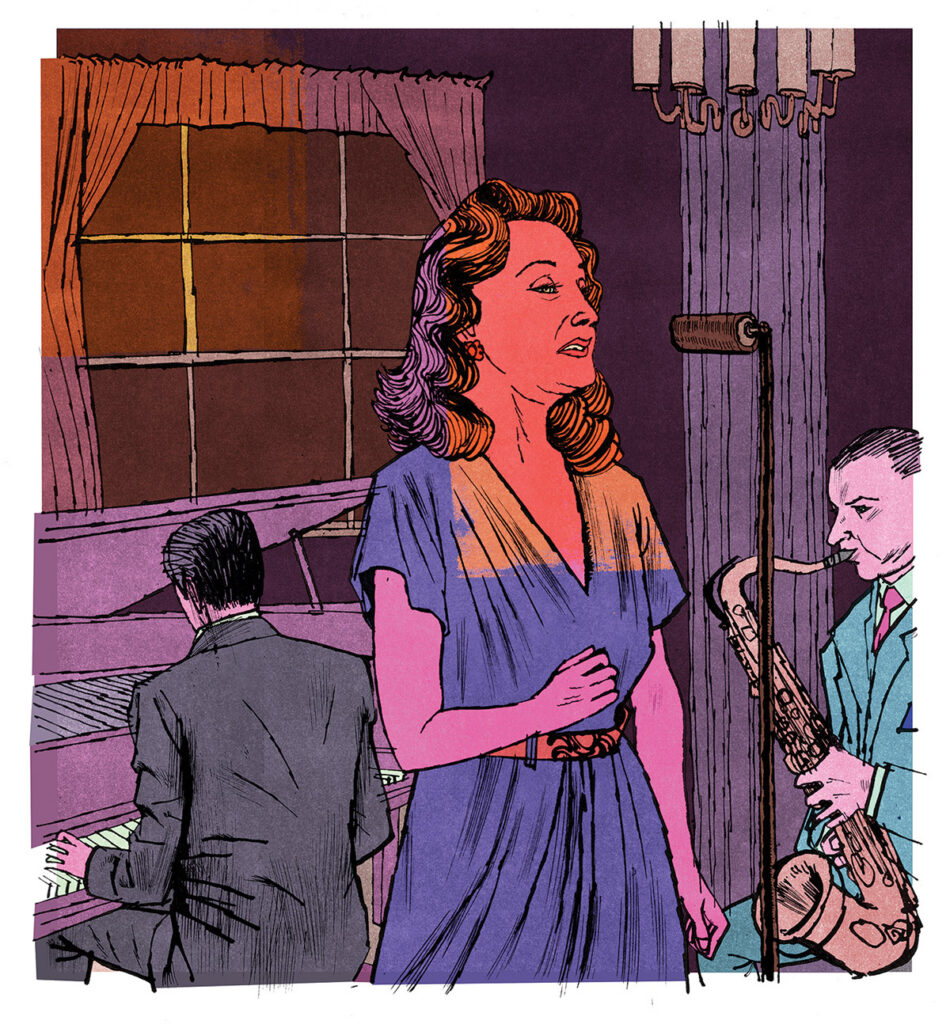
Why Lee Wiley?
Because of the tremble in her throat, the fusion of melancholy and joy. If you want the experience of a nightclub and there isn’t an El Morocco or a Copacabana to go to, listen to her deliver Cole Porter’s “Looking at You,” or the Gershwin brothers’ “My One and Only,” or Rodgers and Hart’s “Manhattan,” or Harold Arlen and Ted Koehler’s “Let’s Fall in Love.”
Because she might have been born in 1908 or 1910 or 1915, and therefore all astrological analysis should be taken with as much salt as rims the glass of a margarita.
Because Lee Wiley (October 9, 1908 [?]–December 11, 1975) was the epitome of a nightclub singer. Born in Fort Gibson, Oklahoma, she ran away from home as a teen and surfaced with the Leo Reisman Orchestra. Leo was good at discovering talent. Dinah Shore first sang with him. And people heard him on the radio, on the Lucky Strike Hit Parade.
Because Wiley had a sexy voice that made up in emotion what it lacked in range. There was silk in her voice, and smoke. Pick your adjective: intimate, sensual, husky, sultry, seductive, or all of the above. She sang with a combination of caprice and melancholy and was among the first, if not the first, to record “songbook” (or “concept”) albums devoted to individual songwriters.
Because she fell, riding a horse. She fell and went blind. But she recovered her sight and rejoined the Leo Reisman Orchestra.
Because she never revealed how she recovered from her temporary blindness, though I like to think that Tiresias appeared to her in a dream and told her the advantages of blindness, then offered a way back to a more conventional life.
Because blind faith and blind hopes are two different things, and she learned to distinguish between them.
Because she was one tough broad.
Login to view the full article
Need to register?
Already a subscriber through The American Scholar?
Are you a Phi Beta Kappa sustaining member?
Register here
Want to subscribe?
Print subscribers get access to our entire website Subscribe here
You can also just subscribe to our website for $9.99. Subscribe here

true