
A Night at the Bougainville Roxy
America’s post-Depression enthusiasm for movies extended to its theaters of war
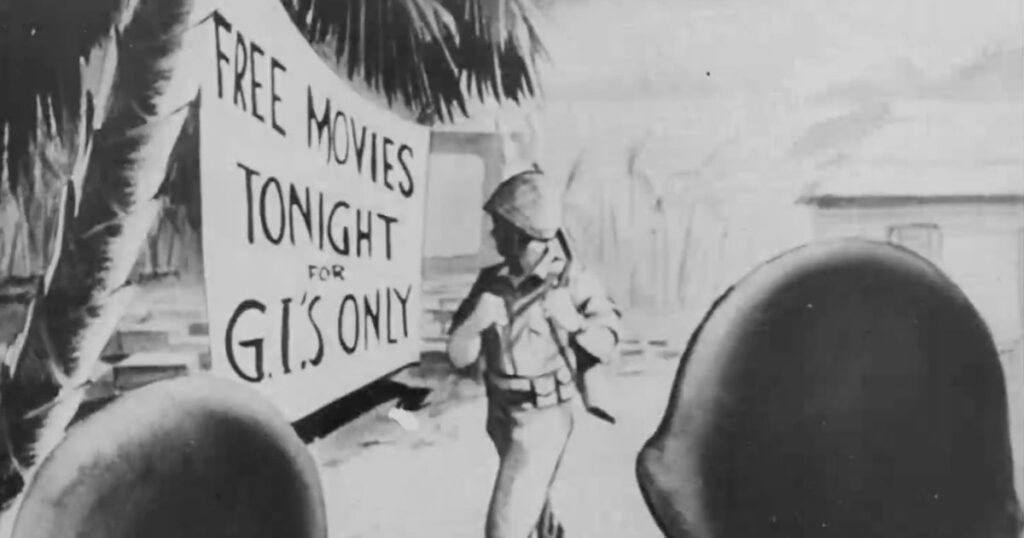
“Letters from home and movies tonight at the Bougainville Roxy!”
It wasn’t as big as the Palace or as grand as the Pantages, and it had a handwritten sign instead of a neon marquee, but the Bougainville Roxy was a hot ticket in 1943. Housed in a tent on the largest island in the Solomon archipelago, the Roxy was one of many movie theaters improvised in even the most rugged outposts during World War II. Venues were standard on stateside Army posts. Movies at War, a documentary produced by the U.S. Army Signal Corps in 1943, reveals that the demand for films did not diminish once servicemembers went abroad. Copies of three new features were sent overseas every week from a New York distribution center by “air express with military right of way. … A million dollars’ worth of morale wrapped in each carton.” Delivery was meant to coincide with a film’s domestic release; sometimes the troops were treated to a world premiere.
Films reached destinations throughout the world by truck, motorcycle, boat, and plane; by porter; by oxcart and pack mule and dogsled and camel. There were approximately 1,500 screenings each night: in tents, at open-air theaters, on airfields with screens mounted on planes, in hospital wards, in commandeered auditoriums. Five and a half million servicemembers went to the movies each week. Prints were screened so many times, the emulsion wore away in five months.
The premise of Movies at War is that films symbolized home to the troops: all those “sights and sounds left behind for the duration but never forgotten.” Motion pictures also fostered unity within U.S. forces and, in dubbed versions, with allies: “millions of troops heterogeneous in other respects yet maintaining a mutual interest in screen entertainment.” Training films such as How to Get Killed in One Easy Lesson offered practical guidance, but feature films generated the greatest anticipation. They satisfied “definite cravings” and “strange appetites,” offered a “respite” from battle, and distracted the wounded from their scars. Movies at War intercuts a scene from Preston Sturges’s comedy The Miracle of Morgan’s Creek with shots of laughing troops convalescing on a hospital ship, Frank Sinatra singing in Higher and Higher with starstruck Army nurses, the end of the religious drama The Song of Bernadette with rapt GIs bathed in the reflected glow of a screen. (Who knows what these audiences were actually watching, but the editing of the stock footage proves affecting and effective.)
The documentary follows one particular shipment to the India Film Exchange in New Delhi. From there, films were dispersed throughout the China-Burma-India theater to Bangalore, Calcutta, and Kabul, to Chabua, and over the perilous Himalayan Hump to Chungking.
My father was a beneficiary of the Army’s movie distribution service in India, where he served as an air traffic controller. How many of the C-47 Skytrains that he guided through takeoff and landing carried film reels in their cargo? Yet though he must have seen movies overseas—he was familiar with Desperate Journey, Destination Tokyo, and other wartime films—he didn’t talk about the experience. Indeed, the only movie he ever recounted watching while in the service was Casablanca, which he saw in New Mexico in 1943, probably at the Alamogordo Army Airfield.
When I was a kid, we watched a lot of movies together. Perhaps it is more accurate to say that while I gave them my full attention, he watched with one eye on the television and the other on his work, which on Sundays he consented to do at the kitchen table instead of in his office. We often caught movies in the middle. These were, after all, medieval days, before streaming and on-demand services. When my parents eventually bought a VCR, it changed my life.
It isn’t surprising that going to see Casablanca was the one wartime trip to the movies my father recounted in any detail. One of Warner Bros.’ most significant contributions to the war effort, the film transcends propaganda—its patriotism never veering into jingoism, its spirit cosmopolitan rather than parochially American, its cast and crew a magnificent alliance of émigrés and refugees.
Casablanca is a prime example of the peculiar magic of the Hollywood studio era: a film not initially “destined for greatness” that nonetheless achieved it, as Thomas Schatz writes in The Genius of the System. Schatz suggests that Humphrey Bogart’s Rick Blaine, jaded café proprietor–turned–patriot, “crystallizes the American shift from neutrality to selfless sacrifice.” “When will you realize,” the rival café owner and racketeer Ferrari (Sydney Greenstreet) chides Rick, “isolationism is no longer a practical policy?”
But when I watch Casablanca now, more than five years after my father’s death, having written a book about the way his war is remembered, and with the B-rolls of audience reactions from Movies at War fresh in my mind, I wonder whether those young GIs in the New Mexico desert were seeing what I see now.
Login to view the full article
Need to register?
Already a subscriber through The American Scholar?
Are you a Phi Beta Kappa sustaining member?
Register here
Want to subscribe?
Print subscribers get access to our entire website Subscribe here
You can also just subscribe to our website for $9.99. Subscribe here

true