
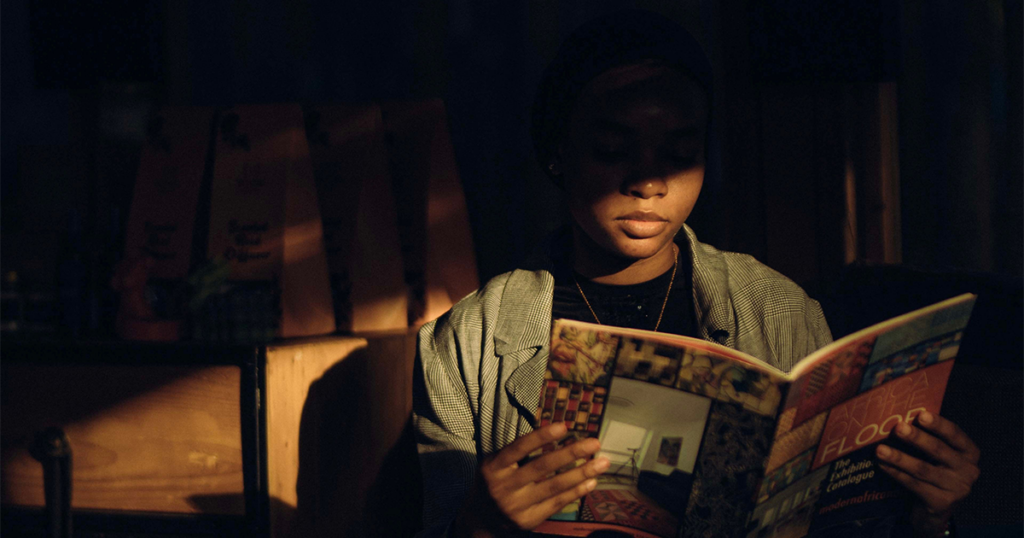
Until recently, whenever I read a novel or a play, I largely forgot its contents within a matter of weeks. The words and events would drain through me, leaving me, at best, with isolated remnants. I marveled at people who could describe in detail passages they’d read years before. They seemed to have been bestowed with some freakish gift of the gods.
But one day something changed, and I am now able to recall the structure and even extended sections of a few dozen works of literature, meaning that I find myself the surprised owner of a small internal library. I can compare the anatomy of various books without looking at the texts. Best of all, if I end up riding a city bus empty-handed, I’m not bored. To the contrary, I have the grand company of strong characters, and I am able to summon up the atmosphere of the pages they inhabit. Miss Havisham and Estella. Emma Bovary and Rodolphe. King Lear and Gloucester. All are companions who quicken the mind because to see them is to see them in action, casting their own particular light on the world.
Most of the books in my internal library are classics that I discussed in my writers’ group. For nearly two decades, we met two or three times a year, but I recall little about the books we discussed in those rambling sessions. Once the Covid lockdown hit, however, we began meeting on Zoom every week for an hour. We focused on 70 pages at a time—in this way, we could spend up to five weeks discussing a novel. And each of us would select a passage to read aloud, explain why we’d chosen it, and then hear what others discerned. This close oral analysis apparently allowed our reading to migrate to a different, more adhesive part of my brain.
We started with Howards End, feeling the need, during those stressful days, of E. M. Forster’s charm and scope, as well as his grand message to connect. I’d read the novel before, but only now was I struck by the seeming nonchalance of the opening: “One may as well begin with Helen’s letters to her sister.” The reader can almost see the tweedy, droll, self-effacing author at his desk pondering how to begin, wearily surveying his options, as if the entire story has already taken place and as if he isn’t himself about to scribble Helen’s delightful, highly emotional, expressive letters.
When I think of the novel, that first line summons the rest, as certain great openings do. The lovely, wry, mediating authorial presence, one that is characteristic of Forster’s work, goes on to provide fine company throughout the book.
The edition I used was a Bantam paperback I’d found on my shelves—it was roughly the size of my hand, with stiffish serif type and saffron-edged pages that were as soft as a cat’s ears. The very heft of the book was consoling. I read slowly, underlining, drawing stars, jotting notes in the margins. Doing so allowed me to notice how Forster set up his plot points like closely positioned dominoes. Now I could also see the strategic importance of the dramatic crescendo leading to what some novelists call a fireworks scene, which in Forster’s hands swivels everything about, and which occurs about 70 percent of the way through the novel, marking the end of the long second act. Once I saw this turning point, it came to mind whenever I thought of the novel. The book now had a shape, which became a sort of visual mnemonic, and the fireworks scene drew to mind the scenes leading up to and away from it.
I’ve learned that noting a few turning points in a story can help you later recall the structure of an entire book. My friend Alice said that she always finds the exact center of every novel: She sees how many pages the book has and divides that number in half. It’s surprising how often one discovers here the very midpoint of the action, the story’s inner hinge. It might seem arbitrary, but the practice has helped me with my memory. In my copy of Howards End, the exact numerical midpoint falls when Helen is imploring Margaret not to marry Wilcox:
“Don’t, don’t do such a thing! I tell you not to—don’t! I know—don’t!”
“What do you know?”
“Panic and emptiness,” sobbed Helen. “Don’t!”
So there, at the center, is a dramatic restatement of the novel’s first epiphany, as well as a warning about what will follow when our heroine makes her decision and ignores her sister’s experience.
Login to view the full article
Need to register?
Already a subscriber through The American Scholar?
Are you a Phi Beta Kappa sustaining member?
Register here
Want to subscribe?
Print subscribers get access to our entire website Subscribe here
You can also just subscribe to our website for $9.99. Subscribe here

true